
Rats Keep Coming Back but There Are No Holes Outside
If rats keep coming back but you cannot find any holes around the outside of your house, the entry point may be hidden.
This is particularly frustrating when you have already checked doors, walls, air bricks and obvious gaps but rats continue appearing inside.
The important thing to understand is that a rat does not necessarily enter through a visible hole in an external wall.
The route could be beneath the building, around concealed services, through an extension, inside a wall cavity or associated with underground drainage.
When rats repeatedly return, finding that route is often more important than simply treating the latest rat.
Why Do Rats Keep Coming Back When There Are No Holes Outside?
If the exterior of a house appears secure, there are several possibilities.
The entry point may be:
- below ground level;
- beneath a suspended floor;
- behind an extension;
- around concealed pipework;
- inside a wall cavity;
- connected with neighbouring property;
- beneath decking or another structure; or
- associated with damaged or redundant drainage.
The place where you see or hear the rat may also be a considerable distance from the original entry point.
Rats Can Travel Beneath Your House
Many UK properties have suspended timber ground floors with a void underneath.
If a rat reaches this void, it can potentially travel beneath several rooms while remaining completely hidden.
It may eventually appear through an opening around pipes, beneath kitchen units or through another internal gap.
This can create the impression that the rat has somehow appeared inside a completely sealed house.
If you are hearing activity below ground-floor rooms, see our guide to scratching under the floor at night.
Check Around Pipes and Services
Pipes and cables are useful areas to inspect, but there is an important distinction.
A gap around a pipe inside the house may be where the rat enters a room. It is not necessarily where the rat originally entered the property.
Check around:
- water pipes;
- kitchen waste pipes;
- boiler and heating pipes;
- gas services;
- soil pipes;
- electrical cables; and
- other service penetrations.
Openings hidden behind cupboards, appliances and boxed-in services can connect occupied rooms with floor voids and wall cavities.
Read Can Rats Get Into Your House Around Pipes? for more detail.
Could the Rats Be Entering Underground?
Yes. This is one reason an ordinary inspection of the outside walls does not always reveal the source.
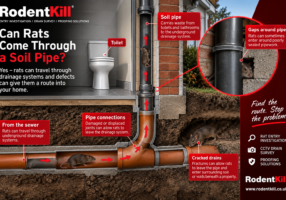
Rats commonly travel through drainage and sewer systems.
Normally, intact drainage keeps them separated from the building. However, defects can potentially provide a route out of the pipework.
Relevant problems can include:
- cracked drains;
- displaced joints;
- collapsed sections;
- open redundant connections;
- damaged inspection chambers; and
- poorly altered drainage.
A rat leaving damaged drainage may enter surrounding soil or an underground void. From there, it may find a route beneath the property.
This means the original access point could be completely invisible from above ground.
Does This Mean the Rats Are Definitely Coming From the Drains?
No.
Not finding an obvious external hole does not prove that drainage is responsible.
Air bricks, service penetrations, wall cavities, neighbouring structures and hidden construction defects can also be involved.
The evidence needs to be considered before deciding whether a drain survey is appropriate.
If drainage is suspected, read Are Rats Coming From My Drains?.
Extensions Can Hide Old Rat Entry Routes
House extensions can make entry routes particularly difficult to identify.
A wall that was originally outside may now be enclosed within the building.
Old air bricks, drainage connections, gullies and service openings can consequently end up beneath or behind the extension.
A problem that once would have been visible from the garden may now be completely concealed.
This is particularly worth considering if rat problems started after an extension or major alteration.
See Rats After a House Extension.
Could Rats Be Coming From Next Door?
Neighbouring properties can sometimes form part of the problem, particularly in terraced and semi-detached houses.
Rats may travel through interconnected drainage, underfloor areas, structural voids or other concealed routes.
This does not mean that every rat problem originates next door. However, repeated activity affecting adjoining properties can provide an important clue.
Our guide My Neighbour Has Rats – Can They Get Into My House? explains this in more detail.
Why Does Pest Control Work and Then the Rats Return?
This is one of the most important clues in a recurring infestation.
Baiting or trapping may successfully control the rats currently inside the property.
But if the entry route remains available, another rat may eventually use it.
The pattern can become:
rats appear → treatment → activity stops → several weeks or months pass → rats appear again.
That does not necessarily mean the treatment failed. It may mean that the source of the infestation was never identified.
Read Why Poison Alone Won't Solve a Rat Problem.
Why Filling Every Hole Can Be a Mistake
It can be tempting to fill every gap you find around a property.
However, proofing is most effective when you understand which openings are actually involved.
Sealing an internal opening while rats remain within a floor or wall void may simply force them to search for another route.
There is also a risk of trapping an animal within an inaccessible part of the building.
Ideally, establish the route first and then carry out appropriate proofing at the correct locations.
How Do You Find a Rat Entry Point When There Is No Visible Hole?
The investigation needs to work backwards from the evidence.
Useful clues include:
- where droppings are appearing;
- where scratching is heard;
- the time and frequency of activity;
- gnawing and damage;
- tracks and travel marks;
- activity beneath floors;
- the position of kitchens and bathrooms;
- extensions and previous alterations;
- service routes; and
- the drainage layout.
These clues can help establish how rats are moving through the property and where the route may begin.
Our guide to how we find rat entry points explains the investigation process.
When Should the Drains Be Investigated?
A CCTV drain survey becomes more relevant when there is evidence suggesting an underground route.
Examples include:
- rats repeatedly returning after treatment;
- activity beneath ground-floor rooms;
- no convincing above-ground entry point;
- old or altered drainage;
- previous extensions;
- known drain defects;
- recurring drainage problems; or
- evidence suggesting rats are travelling from below the building.
A professional rat drain survey can inspect accessible underground drainage for defects and potential routes associated with the infestation.
Stop Looking Only for a Hole in the Wall
If rats keep coming back and you cannot find a hole outside, broaden the investigation.
The route may be beneath the house, around services, through a concealed structural opening or underground.
Most importantly, remember that the place where the rat appears inside is not necessarily where it entered the building.
Finding the complete route gives you a much better chance of solving a recurring rat problem properly.
Need Help Finding a Hidden Rat Entry Point?
RodentKill specialises in investigating recurring rat problems where the source is difficult to identify.
Our rat entry investigations consider the building, underfloor areas, service routes and other potential access points. Where the evidence indicates that drainage may be involved, CCTV inspection can also be used to investigate accessible underground pipework.