
Rats Behind Kitchen Units – Where Are They Coming From
Hearing scratching behind kitchen units or finding rat droppings inside cupboards can be alarming. The obvious question is: how are rats getting behind the kitchen units in the first place?
In many UK homes, the kitchen is not actually where the rats entered the property. It is simply where they emerge from a hidden void beneath the floor, inside a wall cavity or around pipes and drainage connections.
Finding the real entry point is therefore much more important than simply placing bait behind the kitchen cupboards.
Why Do Rats Get Behind Kitchen Units?
Fitted kitchens provide rats with exactly the sort of environment they prefer. The space behind cabinets is dark, protected and rarely disturbed.
More importantly, kitchens contain numerous pipes, cables and drainage connections. Holes are often cut through floors and walls during installation and may be considerably larger than the pipe passing through them.
A rat travelling beneath the floor can find one of these openings and suddenly appear behind the kitchen units.
Where Are Rats Behind Kitchen Units Coming From?
There are several common possibilities. The important thing is not to assume that the nearest visible hole is necessarily the original external entry point.
Gaps Around Water and Waste Pipes
Look beneath the kitchen sink and behind appliances. Pipework frequently passes through floors, walls and the backs of cupboards.
The opening around a pipe may provide access from a floor void or wall cavity into the kitchen.
This is particularly important in older properties or kitchens that have been altered several times. Previous plumbing work can leave unused or poorly sealed openings hidden behind cabinets.
Rats Coming From Beneath the Floor
Suspended timber floors create a substantial hidden space beneath many UK properties. Rats can travel underneath several rooms without being seen.
They may then enter the kitchen through openings around pipes, damaged flooring or gaps concealed by fitted units.
If you hear movement beneath the kitchen, particularly at night, read our guide to scratching under the floor at night.
Drainage Problems
Sometimes the route starts much further away.
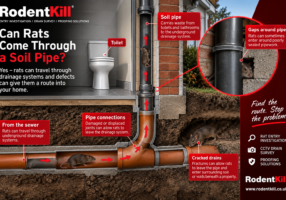
Rats are capable of travelling through drainage systems. A damaged, redundant or poorly connected drain can potentially allow them to leave the drainage system and reach the ground or void beneath a building.
From there, they may travel beneath floors until they discover an opening into the kitchen.
This is one reason recurring rat problems can continue even after rats have been trapped or poisoned.
If drainage is suspected, our guide explaining whether rats are coming from your drains explains some of the warning signs.
Extensions and Altered Kitchens
House extensions are another area worth investigating.
When an extension is built, the original external wall can become an internal wall. Old air-brick openings, drainage connections and service penetrations may remain hidden beneath or behind the new construction.
Rats can exploit these concealed routes.
We explain this problem in more detail in our article about rats after a house extension.
Wall Cavities
Rats do not always approach a kitchen horizontally across the floor.
Depending on the construction of the property, they may gain access to wall cavities and move through concealed spaces before emerging around pipework or behind cabinets.
Noise inside a wall does not automatically mean rats are nesting there. It may simply be part of their route through the building.
Why Are Rat Droppings Often Found Under the Kitchen Sink?
The cupboard beneath a sink is one of the first places homeowners notice evidence of rats.
This is not necessarily because rats are attracted to the sink itself. It is often because several pipes pass through the cupboard, wall or floor in a relatively small area.
Check carefully around:
- hot and cold water pipes;
- sink waste pipes;
- dishwasher connections;
- washing-machine connections;
- boiler and heating pipework;
- holes through the back of the cabinet; and
- openings through the floor.
Droppings concentrated around one particular opening can provide useful evidence about the route being used.
Can Rats Live Behind Kitchen Units?
They can certainly spend time behind kitchen units, although the space where you hear them is not necessarily where they are nesting.
A rat may travel considerable distances through hidden parts of a building while searching for food, water or shelter.
Activity behind a kitchen cabinet might therefore represent only the final few metres of a much longer route.
Signs of Rats Behind Kitchen Cupboards
Possible evidence includes:
- rat droppings inside or beneath cupboards;
- scratching or movement at night;
- gnawing to cupboard backs or kickboards;
- damaged food packaging;
- greasy marks along established routes;
- disturbed insulation or debris;
- an unusual smell; and
- pets repeatedly showing interest in one particular area.
A single piece of evidence rarely tells you the complete route. Looking at the pattern of activity across the property is much more useful.
Should You Pull the Kitchen Units Out?
Usually, not immediately.
Removing fitted cabinets can cause unnecessary damage and may still fail to reveal where the rats originally entered the building.
Start with accessible areas such as removable kickboards, sink cupboards, appliance spaces and visible service penetrations.
A systematic inspection can often narrow down the likely route before anything substantial needs dismantling.
Do Not Seal the First Hole You Find Straight Away
Finding a rat-sized opening behind a kitchen cabinet can make it tempting to seal it immediately.
That can be a mistake if rats are still using the building.
Blocking an internal opening without understanding the complete route may simply cause the rats to find another way into the room. In some situations, it can also trap an animal inside a floor or wall void.
The aim should be to establish where the route begins, not merely where the rat finally appears.
Why Poison Alone May Not Solve the Problem
Bait can be useful as part of professional rodent control, but killing the rats currently inside a property does not repair the route that allowed them to enter.
If the access point remains available, another rat may eventually use exactly the same route.
This is especially relevant when a property has experienced repeated infestations despite previous pest-control treatments.
Read our guide explaining why poison alone won't solve a rat problem.
How Do You Find the Real Rat Entry Point?
A proper investigation works backwards from the evidence inside the property.
That can involve examining droppings, gnawing, footprints, grease marks and likely travel routes before inspecting floors, service penetrations, external walls and drainage.
The objective is to establish how the rat moved from outside the property to the place where activity is being seen.
Our guide to how we find rat entry points explains this process in more detail.
Could the Drains Be Responsible?
Not every kitchen rat problem originates from drainage, so a drain survey should not automatically be the first response to every infestation.
However, drainage becomes particularly relevant when rats repeatedly return, activity appears beneath floors, there is no convincing external entry point, or previous pest-control treatments have only provided temporary relief.
A professional rat drain survey can help identify defects, redundant connections and other drainage features that may be associated with rat access.
Finding Rats Behind Kitchen Units Is a Clue, Not the Answer
If rats are appearing behind your kitchen units, concentrate on finding the route rather than simply treating the place where you see them.
The actual entry point could be beneath the floor, around pipework, within a cavity, through an altered part of the building or associated with the drainage system.
Once the complete route is understood, appropriate proofing or drainage repairs can be targeted at the source of the problem.
Need Help Finding Where the Rats Are Getting In?
RodentKill specialises in investigating recurring rat problems and identifying hidden entry routes in UK properties.
Our investigations can include the building, floors, service penetrations and drainage where appropriate. The aim is to determine how the rats are getting into the property rather than simply placing more bait.