
Can Rats Come Through a Soil Pipe
Can rats come through a soil pipe? Yes, rats can travel through drainage systems connected to soil pipes, and defects or poorly sealed connections can potentially give them a route towards a property.
However, the rat does not necessarily climb out of the top of the soil pipe or emerge directly through a toilet. In many cases, the real problem is hidden lower down.
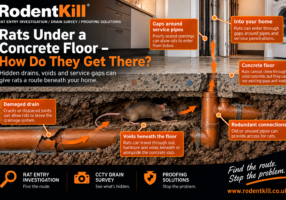
A damaged underground connection, redundant branch, poorly sealed joint or opening around the soil pipe can allow rats to leave the drainage system and enter beneath or inside the building.
If rats keep returning despite previous pest control, understanding the complete drainage route can be more useful than simply treating the rats already inside.
At RodentKill, we specialise in investigating difficult and recurring rat problems. Our Rat Entry Investigation looks for the underlying route rats may be using to enter a property.
What Is a Soil Pipe?
A soil pipe carries wastewater and sewage from toilets and other sanitary fittings into the underground drainage system.
In many UK properties, the soil pipe runs vertically on the outside of the building. In others, some or all of the pipework may be concealed inside the property.
The vertical pipe eventually connects with underground drainage. That drainage may then connect to a private drain, shared drain or public sewer.
This connection is important when investigating rats because sewer systems provide rats with extensive underground travel routes.
Can Rats Travel Through Soil Pipes?
Yes. Rats are capable of travelling through drainage pipework and negotiating surprisingly difficult environments.
They can swim, climb and move through connected drainage systems. However, a sound, properly installed soil and drainage system should separate rats in the sewer network from the occupied parts of your home.
Problems tend to arise when there is a defect or an unintended opening.
Potential problems can include:
- Damaged soil pipe connections
- Cracked underground drainage
- Displaced pipe joints
- Open or redundant branches
- Poorly sealed connections
- Old toilet connections
- Damaged inspection chambers
- Alterations to drainage following building work
- Gaps where pipework passes through walls or floors
The important question is therefore not simply whether rats can travel through a soil pipe.
It is: where can they leave the drainage system and gain access to the building?
How Can a Soil Pipe Lead to Rats Inside a House?
Imagine a rat travelling through the underground drainage system beneath or alongside a house.
The rat reaches the point where the soil pipe connects to the underground drain. If everything is intact, it remains contained within the drainage system.
Now imagine there is a broken junction, displaced connection or redundant branch nearby.
The rat may be able to leave the drain through that opening.
Once outside the pipe, it could potentially enter surrounding soil or an underground void. From there, it may find access beneath the building.
That can lead to rats appearing in:
- Underfloor voids
- Wall cavities
- Behind kitchen units
- Utility rooms
- Bathrooms
- Boxed-in pipework
- Service ducts
- Ceiling voids
This is one reason rat entry problems can be so difficult to diagnose from inside the house.
The place where you hear or see the rat may be nowhere near the original entry point.
Can Rats Climb a Vertical Soil Pipe?
Rats are excellent climbers and can negotiate many types of pipework and drainage structures.
However, seeing evidence of rats upstairs does not automatically mean a rat climbed the entire soil stack and entered at that level.
A rat entering near ground level can also travel vertically through wall cavities, service voids and boxed pipework.
We explain this behaviour in more detail in our guide to whether rats can climb vertical drain pipes.
Can Rats Get Into a House Around a Soil Pipe?
Yes. Sometimes the problem is not inside the soil pipe at all.
Where a soil pipe or other service passes through a wall, floor or foundation, the surrounding opening should be properly sealed.
If there is a significant gap, rats that have already reached the area may exploit it.
This is particularly important around older properties and buildings that have undergone repeated alterations.
Pipework may have been replaced, moved or extended over many years. Old penetrations may remain hidden behind cupboards, boxing or later building work.
Our guide to how we find rat entry points explains why following the evidence is often more effective than simply filling the first visible hole.
Could an Old Toilet Connection Cause a Rat Problem?
Potentially, yes.
Properties change over time. An outside toilet may be removed, a bathroom relocated or an extension built.
The old drainage connection should be properly sealed or removed as part of the work.
If a redundant connection remains open while still connected to active drainage, it could provide rats with an unintended route out of the system.
The old pipe may also be completely hidden beneath a new floor or extension.
This can make the source of a recurring infestation extremely difficult to identify without investigating the drainage layout.
Read our dedicated guide: Can a Disused Drain Cause a Rat Infestation?
Can Rats Come Through the Toilet?
It is possible for rats to travel through toilet drainage, although this should not be assumed to be the cause of every rat problem around a bathroom.
There may be another drainage defect allowing rats to escape before they ever reach the toilet.
For example, a rat could leave through a broken underground connection and then travel beneath the floor or through a service void.
That distinction matters because concentrating solely on the toilet could leave the real entry route untouched.
For more information, see our guide: Can Rats Enter Through the Toilet?
Why Soil Pipe Problems Can Be Difficult to Find
Much of the relevant pipework may be concealed.
The visible soil stack on the side of the house is only one part of a larger drainage system. The most important defect may actually be underground.
It could be beneath:
- A kitchen floor
- A bathroom
- An extension
- A patio
- A driveway
- A utility room
- A suspended timber floor
There may be no obvious damage visible from above ground.
This is why recurring rat activity sometimes requires a more systematic investigation.
What Signs Suggest a Drainage or Soil Pipe Route?
No single sign proves that rats are entering through the drainage system. However, several clues together can make drainage worth investigating.
These include:
- Rats repeatedly returning after pest control
- Scratching beneath ground-floor rooms
- Activity around bathrooms or kitchens
- Rat noises around boxed-in pipework
- No obvious external entry hole
- An older property with historic drainage
- A previous extension or renovation
- A toilet, bathroom or kitchen that has been relocated
- Known drain defects or previous drainage repairs
- Rat activity appearing after building work
If several of these apply, the drainage system may deserve closer investigation.
Can a CCTV Drain Survey Find a Soil Pipe Rat Entry Route?
A CCTV drain survey can inspect accessible underground drainage from inside the pipework.
This allows defects to be examined that would otherwise remain hidden beneath the ground.
A rat-focused CCTV investigation may identify:
- Cracks and fractures
- Displaced joints
- Broken junctions
- Redundant connections
- Old toilet branches
- Open-ended pipework
- Collapsed sections
- Damaged chambers
- Unexpected drainage connections
However, finding a defect does not automatically prove that rats are using it.
The location of the defect needs to be considered alongside the building layout and where rat activity is occurring.
RodentKill's Professional Rat Drain Survey is designed specifically to investigate drainage from the perspective of rat entry rather than simply reporting the general condition of the pipework.
What If the Underground Drain Is Cracked?
A significant crack or fracture can potentially allow a rat to leave the drainage system.
The rat may then enter surrounding soil or a void beneath the property.
Older clay drainage can be particularly interesting during an investigation because it contains numerous individual pipe sections and joints. Ground movement and age can result in fractures or displacement.
Importantly, a damaged drain may continue carrying wastewater. Therefore, the homeowner may have no obvious blockage.
Our guide to cracked drains and rat infestations explains how these hidden defects can contribute to recurring problems.
Why Poison May Not Solve a Soil Pipe Rat Problem
Rat control may successfully remove rats that are already inside the property.
However, bait or traps cannot repair a broken drain, seal a redundant connection or close a structural opening.
If the access route remains available, another rat may eventually use it.
This can create a frustrating cycle:
Rat activity → pest control → quiet period → new rat enters → rat activity returns.
When that pattern keeps repeating, investigating the route may be more valuable than simply repeating the same treatment.
Should You Seal Around a Soil Pipe?
Accessible gaps around pipe penetrations should generally be properly proofed where they could provide rodent access.
However, proofing needs to be carried out carefully.
Sealing one visible opening without understanding the wider route can sometimes move the problem elsewhere rather than solve it.
More importantly, an underground drainage defect cannot be corrected simply by sealing a gap visible inside the house.
The aim should be to establish how the rat reached that point in the first place.
Rat Entry Investigation or CCTV Drain Survey?
The right starting point depends on the evidence.
If you have no idea where rats are entering, a broader Rat Entry Investigation may be appropriate.
This considers the property as a whole, including structural openings, pipe penetrations, cavities, sub-floor areas and drainage where relevant.
If there is already good reason to suspect underground drainage, a Professional Rat Drain Survey can investigate accessible pipework using CCTV equipment.
The objective in either case is the same: identify a credible route rather than guess.
Can Rats Come Through a Soil Pipe? The Bottom Line
Yes, rats can travel through drainage systems connected to soil pipes. However, the real entry route is often more complicated than a rat simply climbing a pipe into the house.
A damaged connection, redundant branch, cracked underground drain or opening around pipework may allow rats to leave the drainage system and move beneath or inside the building.
This is particularly worth investigating when rats repeatedly return after treatment and there is no obvious external entry point.
At RodentKill, we specialise in finding the cause of difficult and recurring rat infestations.
Rats keep coming back? Don't just treat the next rat. Find the route they're using to get in.
Contact RodentKill about your rat problem.
Frequently Asked Questions
Can rats climb up a soil pipe?
Rats are capable climbers and can travel through drainage systems. However, evidence of rats higher in a building does not prove that they climbed the entire soil stack. They can also move upwards through wall cavities and service voids after entering elsewhere.
Can rats enter around a soil pipe?
Yes. A sufficiently large and accessible gap around a pipe penetration can potentially provide an entry route. The important question is how the rat reached that area in the first place.
Can an old toilet pipe let rats into a house?
Potentially. If a redundant toilet or drainage connection remains open while connected to active drainage, it may provide a route for rats to leave the drainage system.
Can rats come through a toilet?
It is possible, although rats appearing around bathrooms may also be using defects elsewhere in the drainage system rather than emerging directly through the toilet.
Can a CCTV drain survey check soil pipe connections?
A CCTV survey can inspect accessible underground drainage and may identify damaged junctions, redundant connections, displaced joints and other defects associated with soil pipe drainage.
Why do rats keep returning after pest control?
One possibility is that the original entry route remains open. Pest control can remove rats already present, but it cannot repair a drainage defect or seal an underground access route.
Does finding a damaged drain prove rats are using it?
No. A drainage defect should be assessed alongside its size, position, the property construction and the location of rat activity. The aim is to determine whether it provides a credible route into the building.
Should I have a rat entry investigation or a drain survey?
If the source is completely unknown, a wider rat entry investigation may be the better starting point. Where the evidence already points towards drainage, a specialist CCTV rat drain survey may be appropriate.