
Rats in the Garage – How Are They Getting In
Finding rats in the garage can be the first sign of a much wider problem.
You might discover droppings behind boxes, hear scratching at night, find bags of bird seed damaged or even notice something has chewed the wiring around your car.
The obvious question is: how are the rats getting into the garage?
Garage doors are certainly one possibility. However, rats can also exploit gaps around pipes, damaged brickwork, vents, adjoining structures and concealed routes from elsewhere around the property.
If rats keep returning, simply catching the rats currently inside may not solve the problem.
You need to find the route.
Why Do Rats Go Into Garages?
A garage can provide an excellent environment for rats.
It is usually quieter than the main house and may remain undisturbed for long periods. Stored belongings provide hiding places, while cardboard and other soft materials can be used for nesting.
Garages may also contain attractive food sources.
These can include:
- Bird seed
- Pet food
- Grass seed
- Animal feed
- Rubbish
- Food stored in boxes or bags
However, food is not always the reason rats are there.
A garage may simply provide shelter or form part of a route into another part of the property.
Signs You Have Rats in the Garage
You may never actually see a rat.
Instead, look for evidence such as:
- Rat droppings along walls or behind stored items
- Gnawed cardboard boxes
- Damaged bags of food or seed
- Scratching or movement at night
- Greasy marks along regular routes
- Shredded nesting material
- Gnaw marks on timber or plastic
- Damage to cables or wiring
- A strong unexplained smell
Fresh droppings appearing repeatedly are particularly useful because they can help identify where rats are travelling.
How Are Rats Getting Into My Garage?
Start with the structure itself.
Rats do not need an inviting open doorway. A vulnerable gap around the garage can be enough.
Common potential entry points include:
- Gaps beneath garage doors
- Damaged door seals
- Gaps at the bottom corners of doors
- Openings around pipes and cables
- Damaged air bricks or vents
- Missing mortar
- Holes in deteriorating brickwork
- Gaps around adjoining roofs
- Openings where the garage joins the house
Do not assume the largest visible hole must be the route.
When investigating recurring rats, the position of droppings, runs and other evidence can be just as important as the opening itself.
Can Rats Get Under a Garage Door?
Yes. A poorly fitting garage door can provide an easy route.
Check the complete bottom edge rather than only looking at the centre.
The corners are particularly important because seals can deteriorate, surfaces may be uneven and doors do not always meet the surrounding structure tightly.
Look from inside the garage during daylight. Visible light around a closed door can reveal areas that deserve closer inspection.
However, finding a gap beneath the door does not automatically prove rats are using it.
Look for supporting evidence nearby.
Can Rats Enter Around Pipes and Cables?
Yes.
Garages often have electrical cables, water pipes, heating pipes and other services passing through walls.
The opening created for a service can sometimes be considerably larger than the pipe or cable itself.
If the remaining gap has not been properly sealed, it may create a potential rodent entry point.
This is not unique to garages. Our guide Can Rats Get Into Your House Around Pipes? explains why service penetrations deserve careful inspection.
Can Rats Get From the Garage Into the House?
Potentially, particularly with an attached garage.
Once a rat is inside the garage, it may encounter further openings leading towards the main building.
Possible routes include service penetrations, wall cavities, ceiling voids and structural gaps between the garage and house.
This means a rat problem that appears to be confined to the garage should not automatically be considered separate from activity elsewhere in the property.
If you hear rats in walls, ceilings or beneath floors as well as finding evidence in the garage, the different areas may be connected.
What About Rats in a Detached Garage?
A detached garage can still develop a significant rat problem.
Rats may be attracted by shelter, stored food or clutter. They may also use the garage as part of a wider route across the garden.
Inspect the outside of the building carefully.
Look around doors, walls, roof edges, vents and service penetrations. Also inspect the surrounding ground for runs and burrows.
A rat disappearing behind a detached garage does not necessarily mean it lives inside it.
It may be travelling behind the building or using a burrow nearby.
Could Rats Be Burrowing Under the Garage?
Yes, rats can burrow through suitable soil alongside structures.
A burrow entrance may appear beside the garage wall, beneath vegetation or near a concrete slab.
However, the presence of a burrow does not automatically tell you where the rats originated.
Our guide Rat Burrows Next to the House – Should You Be Worried? explains how external burrows should be assessed as part of the wider evidence.
Can Rats Damage a Car in the Garage?
Rats can cause problems around vehicles.
They gnaw a wide range of materials and may damage accessible wiring, insulation and other components.
A vehicle that remains stationary for long periods can provide additional shelter.
If rat evidence appears close to a car, check around and beneath the vehicle and inspect the engine area carefully before assuming the activity is confined to the garage itself.
Professional mechanical inspection may be appropriate if you suspect wiring or other vehicle components have been damaged.
Why Do Rats Keep Coming Back to the Garage?
This is where investigation becomes particularly important.
If rats are repeatedly trapped or poisoned but new activity appears later, there may still be an accessible route into the building.
Removing individual rats deals with the animals present at that moment.
It does not necessarily remove the reason they can enter.
This is the same principle discussed in our guide Why Poison Alone Won't Solve a Rat Problem.
Recurring activity should prompt a different question:
Where are the replacement rats coming from?
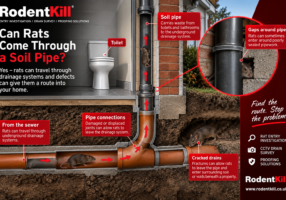
Could Garage Rats Be Coming From the Drains?
It is possible in some properties, but drainage should not automatically be blamed.
Most garage infestations should begin with an inspection of obvious structural routes and surrounding evidence.
Drainage becomes more relevant when there are additional clues suggesting underground activity.
These might include:
- Recurring rats despite treatment and proofing
- Burrows close to drainage
- Rat activity beneath adjoining floors
- Known drainage defects
- Unexplained activity around inspection chambers
- Evidence suggesting rats are travelling from beneath the building
Where the evidence points towards drainage, a Professional Rat Drain Survey can help investigate accessible underground pipework.
Should You Seal the Garage Immediately?
Proofing is important, but timing matters.
Before permanently sealing suspected entry points, consider whether rats could already be inside the structure.
Closing an opening without understanding the infestation could leave rats trapped inside or cause them to search for another route.
Ideally, establish where the rats are travelling and deal with active infestation before completing permanent proofing.
How Do You Stop Rats Getting Into a Garage?
Long-term prevention normally involves a combination of removing attractants and dealing with entry points.
Useful measures include:
- Repairing damaged garage door seals
- Proofing genuine structural entry points
- Sealing unnecessary gaps around services
- Repairing damaged vents
- Keeping bird seed and pet food in robust sealed containers
- Reducing unnecessary clutter
- Removing rubbish and accessible food
- Checking for burrows around the building
- Monitoring for fresh droppings
The objective is not to make the garage look tidy for its own sake.
It is to remove opportunities for rats to feed, hide and enter unnoticed.
What If You Cannot Find the Entry Point?
Finding a rat inside a garage is easy compared with establishing exactly how it arrived there.
That is particularly true when several possible openings exist.
RodentKill's Rat Entry Investigation is designed for situations where the route is unclear or rats continue returning.
Rather than simply identifying every gap around the building, the investigation considers the evidence and attempts to establish which routes are credible.
That distinction matters.
A property can contain numerous gaps that a rat could theoretically use. The aim is to determine how the rats are actually moving around the property.
Rats in the Garage – The Bottom Line
If you find rats in your garage, do not assume that trapping the rat you have seen will solve the problem.
Inspect the garage door, service penetrations, vents, adjoining structures and surrounding ground.
Then look at the evidence.
If rats keep returning, the underlying entry route may still be open.
Find the route. Stop the problem.
If you need help investigating recurring rat activity, contact RodentKill.
Frequently Asked Questions
Why have I suddenly got rats in my garage?
Rats may enter a garage looking for food, shelter or nesting space. Alternatively, the garage may simply lie on an existing rat route. Look for new food sources, damaged doors, structural openings and fresh external activity.
Can rats get underneath a garage door?
Yes. Damaged seals, uneven floors and gaps around the bottom corners of a garage door can provide potential entry points.
Will rats move from my garage into my house?
They potentially can, especially where the garage is attached to the property and openings connect with wall, ceiling or service voids.
Do rats nest in garages?
They can. Quiet areas containing cardboard, insulation or other nesting material may provide suitable shelter. However, evidence in a garage does not necessarily prove the nest itself is there.
Can rats damage my car?
Yes. Rats can gnaw accessible vehicle wiring, insulation and other materials. Suspected vehicle damage should be inspected appropriately.
Why do rats keep coming back after I catch them?
Repeated activity can indicate that the original entry point, food source or external rat population remains. Catching individual rats does not necessarily prevent new ones entering.
Should I block every hole in the garage?
Proofing is important, but it is better to identify credible entry routes and consider whether rats are already inside before permanently sealing openings.