
My Neighbour Has Rats Can They Get Into My House
My Neighbour Has Rats – Can They Get Into My House Through Shared Drains?
If your neighbour has a rat problem, it is natural to wonder whether the rats could eventually reach your home.
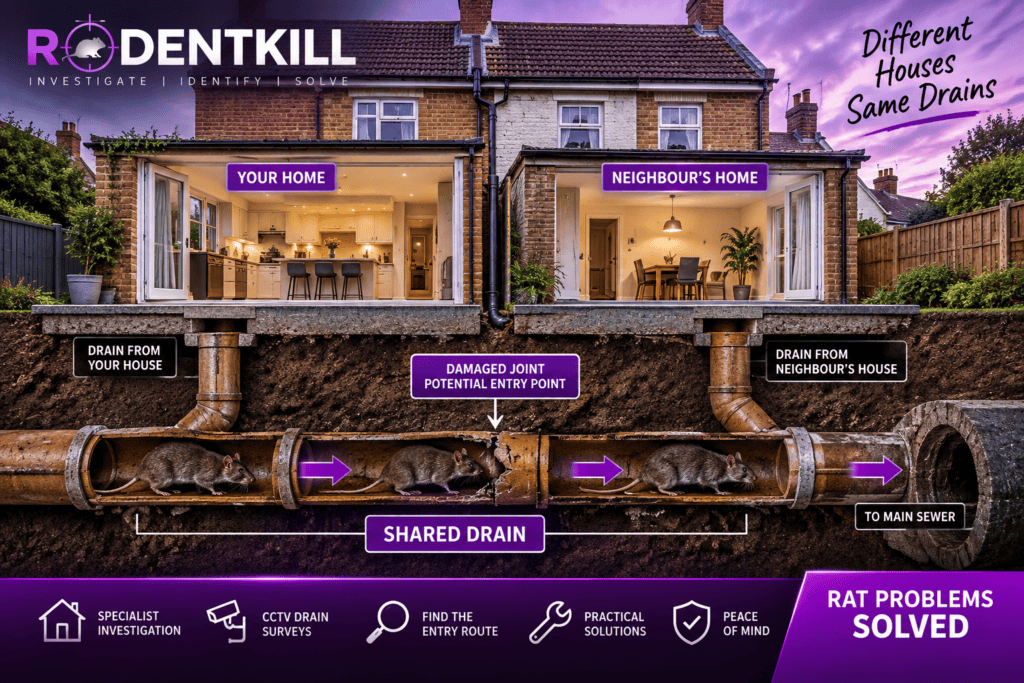
In terraced and semi-detached properties, there is another possibility many homeowners do not consider: the houses may be connected by shared drainage.
Rats can travel considerable distances through sewer and drainage systems. However, a rat travelling through a drain does not automatically mean it can enter your house.
For that to happen, it normally needs to find a route out of the drainage system and towards the building.
If your neighbour has recurring rats and you have suddenly started hearing scratching, finding droppings or noticing unexplained rat activity, the shared drainage system may be worth investigating.
Can Rats Travel Between Neighbouring Houses Through Drains?
Yes. Rats can travel through connected underground drainage systems.
Your home's drainage does not necessarily run independently all the way to the main sewer.
Depending on the age and layout of the properties, drainage from several houses may connect before eventually joining the public sewer.
This is particularly relevant with:
- Terraced houses.
- Semi-detached properties.
- Older housing developments.
- Converted properties.
- Properties with shared inspection chambers.
- Homes with altered or extended drainage systems.
A rat travelling within that connected drainage network could potentially pass beneath several properties.
But there is an important distinction.
Rats travelling beneath your property and rats entering your property are not the same thing.
If My Neighbour Has Rats, Does That Mean I Will Get Them?
No.
A rat problem next door does not automatically mean your home will become infested.
Rats may be travelling through drains beneath an entire row of houses without ever entering any of them.
The problem usually develops when there is an opportunity for a rat to leave the drainage system.
Possible escape routes include:
- Cracked drain pipes.
- Displaced pipe joints.
- Collapsed drainage.
- Open redundant connections.
- Damaged inspection chambers.
- Poor previous drainage repairs.
- Old gullies or drain branches.
- Defects beneath extensions.
If one of these defects provides access into the ground beneath a property, a rat may potentially leave the pipework and investigate the surrounding area.
Why Can Several Neighbours Have Rats at the Same Time?
When several neighbouring properties experience rat problems, it is tempting to assume that one house is responsible.
That is not necessarily the case.
The properties may simply be connected to the same drainage network.
Imagine three terraced houses connected to a shared drain.
Rats may be travelling through that pipework from the sewer. If there is a damaged connection or displaced joint beneath one part of the terrace, rats could potentially escape from the drainage system there.
Once outside the pipe, they may gain access to sub-floor voids or structural cavities that allow them to move beyond the immediate location of the original defect.
This is why the property where a rat is eventually seen is not necessarily where the original underground problem is located.
Can Rats Move Between Terraced Houses?
Yes, potentially.
Terraced houses can present particularly challenging rat problems because the buildings and their services are closely connected.
Once a rat has gained access beneath one property, there may be routes that allow movement through:
- Sub-floor voids.
- Wall cavities.
- Service ducts.
- Pipe penetrations.
- Gaps around joists.
- Structural openings.
Therefore, the original route into the terrace and the room where the rat is eventually heard can be surprisingly far apart.
What About Semi-Detached Houses?
Semi-detached properties can also have interconnected drainage.
Depending on the drainage layout, waste from one property may join drainage serving the neighbouring property before reaching the public sewer.
This does not itself create a rat problem.
A correctly functioning drainage system should keep rats contained within the pipework.
The concern is whether a defect, open connection or structural route allows them to escape.
My Neighbour Has Rats and Now I Hear Scratching Under My Floor
This is when further investigation becomes more worthwhile.
Your neighbour having rats could be completely unrelated to the noise in your property.
However, if neighbouring properties are experiencing rat activity and you suddenly begin hearing movement beneath the ground floor, it provides another clue worth considering.
Other signs include:
- Scratching beneath kitchen floors.
- Noises inside walls.
- Droppings appearing behind kitchen units.
- Activity around bathrooms or utility rooms.
- Rat activity returning after previous pest control.
- No obvious hole around the exterior of the property.
Rather than assuming the neighbour's rats have simply walked into your house, the better question is:
Is there a common route that explains the rat activity?
How Do I Know If My House Has Shared Drains?
The drainage layout is not always obvious from ground level.
Inspection chambers can provide useful clues.
When a chamber is opened, the number and direction of incoming pipes can help establish where drainage is coming from and where it travels next.
Older properties can be more complicated because drainage may have been altered several times during the life of the building.
Extensions, relocated kitchens, removed outside toilets and previous drainage repairs can all change the original layout.
Where necessary, CCTV drainage equipment can be used to investigate accessible underground pipework and help establish how the system is configured.
Can a CCTV Drain Survey Find the Problem?
A CCTV drain survey allows accessible drainage to be examined internally.
When investigating a recurring rat problem, the objective is not simply to identify every minor drainage defect.
The important question is whether the drainage contains a defect or connection that could realistically provide rats with an escape route.
A rat-focused survey may look for:
- Displaced joints.
- Cracked or fractured pipes.
- Open connections.
- Redundant branches.
- Collapsed sections.
- Damaged chambers.
- Poor previous repairs.
- Unexpected drainage connections.
You can find out more about our Professional Rat Drain Survey.
What If I Don't Know Whether the Drains Are Responsible?
Not every rat problem originates from underground drainage.
Rats can also enter properties through structural openings, damaged vents, service penetrations and numerous other routes.
If you have rat activity but do not know where it originates, a wider investigation may be a better starting point.
Our Rat Entry Investigation is designed to investigate the property and answer the most important question:
How are the rats getting in?
If the evidence then points towards drainage, the underground system can be investigated in greater detail.
Who Is Responsible for Shared Drains?
Responsibility depends on the drainage layout and where the problem is located.
Some pipework within the property boundary may be private, while certain shared drainage and public sewers may be the responsibility of the relevant sewerage company.
This is another reason why locating the suspected defect can be important.
Before paying for unnecessary excavation or repairs, it is useful to understand where the problem actually is.
Should I Put Rat Poison Down Because My Neighbour Has Rats?
Not simply because a neighbouring property has reported rats.
The presence of rats next door does not prove they are entering your home.
If you have evidence of rat activity inside your property, appropriate control may be required.
However, with a recurring infestation, killing the rats currently present does not necessarily solve the underlying access problem.
If the route remains open, another rat may eventually use it.
Could a Rat Flap Stop Rats Coming Through Shared Drains?
A suitable rat barrier can be useful in some drainage systems, but it should not automatically be fitted without understanding the drainage layout.
For example, a barrier installed in the wrong location may fail to isolate the relevant drainage branch.
There may also already be rats or an entry defect on the property side of the proposed barrier.
The drainage system should therefore be understood before deciding whether a rat barrier is an appropriate solution.
My Neighbour Has Rats – When Should I Get My Property Investigated?
You do not necessarily need an investigation simply because somebody nearby has seen a rat.
It becomes more relevant when you also have unexplained signs at your own property.
Consider further investigation if:
- You have started hearing scratching beneath floors or inside walls.
- Droppings have appeared inside your home.
- Rats repeatedly return after treatment.
- Several neighbouring properties have similar problems.
- There is no obvious external entry point.
- Your property has older or altered drainage.
- You suspect a shared drain runs beneath or alongside the property.
Don't Guess Which House the Rats Are Coming From
When neighbours experience rat problems, it can quickly become a case of everyone blaming the property next door.
But rats do not understand property boundaries.
If several houses share drainage, the underlying cause may be hidden underground.
The important thing is to follow the evidence and identify the route.
RodentKill specialises in difficult and recurring rat problems, rat entry investigations and CCTV rat drain surveys.
If your neighbour has rats and you are now experiencing unexplained activity in your own home, we can investigate how the rats may be getting in.
Tell Us About Your Rat Problem →
Frequently Asked Questions
Can my neighbour's rats come into my house through the drains?
Rats can travel through connected drainage systems, but travelling beneath a property does not automatically give them access inside. They normally need a defect, opening or another route that allows them to leave the drainage system.
Do terraced houses share drains?
Some terraced properties have interconnected drainage before it reaches the public sewer. The exact arrangement varies according to the age, design and subsequent alterations to the properties.
Can rats move from one terraced house to another?
Potentially. Once rats gain access beneath or inside a building, connected sub-floor areas, cavities and service routes may allow further movement. The exact route needs to be investigated rather than assumed.
Why do several houses in my street have rats?
There can be several explanations, including environmental food sources, nearby harbourage and activity within the sewer network. Where neighbouring properties experience recurring internal infestations, shared drainage may be one factor worth investigating.
Can a CCTV drain survey check shared drainage?
Accessible drainage can be inspected using CCTV equipment. The extent of the survey depends on the drainage layout, available access points and which sections of pipework can be reached safely.
Should I get a rat drain survey because my neighbour has rats?
Not necessarily. A neighbour having rats alone is not enough to establish that your drains have a problem. A survey becomes more relevant when your property also has rat activity or other evidence suggesting an underground entry route.
Rats Next Door and Now Rats in Your Home?
Don't assume where they are coming from.
Find the route. Find the cause. Then solve the problem.