
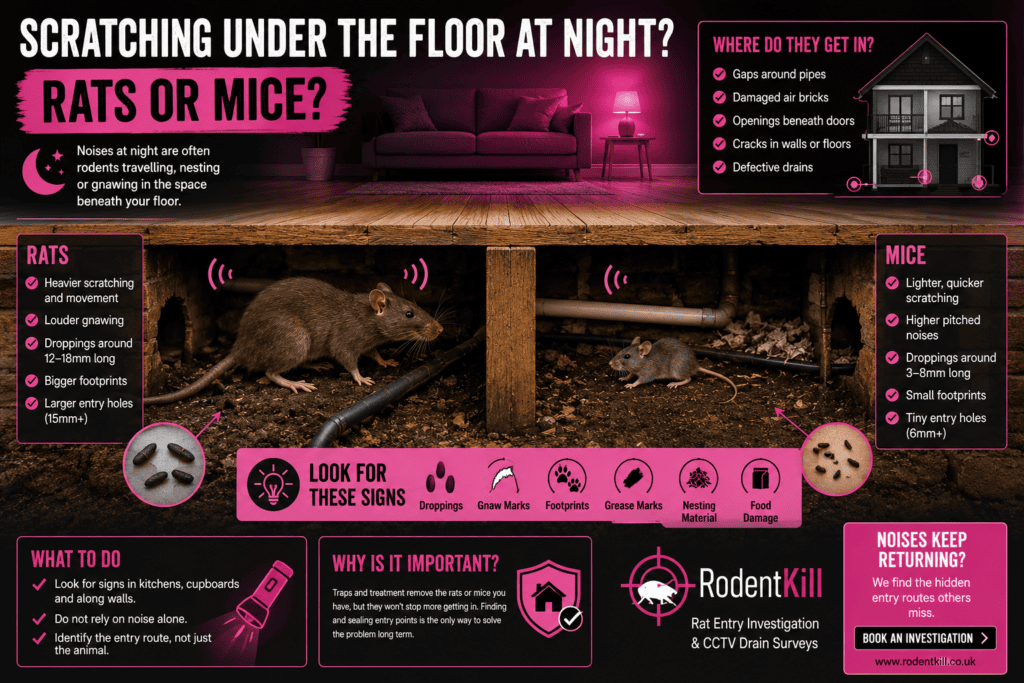
Scratching Under the Floor at Night
If you can hear scratching under the floor at night, it is easy to assume you have rats. However, rats are not the only rodents that can make noises beneath floorboards.
Mice can also enter floor voids, wall cavities and concealed spaces inside a property.
The challenge is working out what you are hearing, where the animal is travelling and, most importantly, how it is getting into the building.
The sound alone may provide useful clues, but it is rarely enough to make a definite identification.
In this guide, we explain the differences between rat and mouse activity, what signs to look for and when scratching beneath the floor may indicate a hidden rat entry route.
What Causes Scratching Under the Floor at Night?
Scratching beneath floorboards can be caused by rodents moving, nesting or gnawing within a concealed floor void.
Many UK properties, particularly older houses, have suspended timber floors.
These floors leave a space between the floorboards and the ground beneath the property.
If rodents gain access to this void, they may be able to move underneath several rooms without ever appearing in the living space above.
Possible causes of noises beneath a floor include:
- Rats
- Mice
- Rodents moving nesting material
- Gnawing around timber or other materials
- Animals travelling through a sub-floor void
- Movement around pipes and service routes
The pattern of the noise and other evidence around the property can help narrow down the cause.
Why Is the Scratching Worse at Night?
Rodents often become much easier to hear once a house becomes quiet.
During the day, televisions, conversations, traffic and normal household activity can hide relatively small sounds.
At night, even slight scratching beneath the floor can sound surprisingly loud.
Rodents may also be more willing to move around concealed areas when household disturbance is reduced.
This explains why many homeowners first become aware of a problem after going to bed.
Do Rats and Mice Sound Different Under Floorboards?
Sometimes, but sound alone is not a reliable way to identify the animal.
Rats are larger and heavier than mice. Their movement may therefore sound heavier or more deliberate.
People sometimes describe rats beneath floors as producing:
- Heavier scurrying
- Louder scratching
- Distinct gnawing
- Movement that sounds like something travelling across the floor void
Mice are much smaller and their movement may sound lighter, quicker or more delicate.
However, building construction can amplify sound considerably.
A small mouse moving beside a pipe or joist can sometimes sound much larger than expected.
For that reason, other evidence should always be considered.
How Can I Tell if It Is Rats or Mice?
Start by looking for physical evidence in accessible areas.
Useful clues can include:
- Droppings
- Gnaw marks
- Food packaging damage
- Footprints
- Greasy travel marks
- Holes or gaps
- Nesting material
- Activity behind kitchen units
- Unusual smells
Rat droppings are generally much larger than mouse droppings.
The size of gnaw marks and the amount of disturbance may also provide clues.
However, avoid relying on a single sign if the identification is uncertain.
Can Rats Live Under Floorboards?
Yes. A sub-floor void can provide rats with a sheltered route through a property.
It may also connect with wall cavities, pipework, kitchens and other concealed areas.
Once beneath a suspended floor, a rat may travel considerable distances without entering the visible rooms above.
This is one reason the location of the scratching does not necessarily reveal where the rat entered the building.
For more information, see our guide to signs rats are living under your house.
Can Mice Live Under Floorboards?
Yes. Mice can also use concealed floor voids and spaces around pipes and services.
Because mice are considerably smaller than rats, they can exploit very small openings.
This means a mouse problem may occur even where there is no obvious large hole in the building.
Again, the evidence around the property is more useful than simply judging the problem by noise.
Why Does the Scratching Move From Room to Room?
This can happen when the floor void is continuous beneath several parts of the property.
A rodent may be heard beneath the lounge one evening and beneath the kitchen another night.
That does not necessarily mean several animals are present.
One animal may simply be travelling through the concealed space beneath the property.
Sound can also travel along joists, pipes and other parts of the structure.
The point where the scratching sounds loudest may therefore not be the animal’s exact position.
Why Do I Hear Scratching Beneath the Kitchen Floor?
Kitchens are important areas during a rodent investigation.
They provide access to food and water, while numerous pipes and services pass through floors and walls.
A rat travelling beneath a suspended floor may find gaps around sink waste pipes, water pipes or other services.
It can then potentially move into the concealed space behind kitchen units.
If you are also finding droppings or other signs around cupboards, read our guide to rats behind kitchen units.
Could Scratching Under the Floor Be Coming From a Wall?
Yes.
Floor voids and wall cavities can sometimes connect.
A rodent may therefore move from beneath the floor into a cavity or service route.
This can make noises seem to travel vertically through the property.
For example, you might first hear scratching beneath a ground-floor room and later hear movement inside a wall.
The entire route may need to be considered rather than treating each noise as a separate problem.
Could Rats Under the Floor Be Coming From the Drains?
Possibly, although not every rodent problem beneath a floor is caused by drainage.
Rats regularly travel through sewer and drainage systems.
If damaged drainage, a redundant connection or another suitable defect allows a rat to leave the pipework, it may potentially reach the ground or void beneath a property.
From there, the rat may travel beneath floorboards and find further routes into the building.
However, other entry points can include damaged air bricks, gaps around services and structural openings.
This is why it is important to follow the evidence rather than automatically assuming the drains are responsible.
What Other Signs Suggest Rats Under the Floor?
Scratching becomes more significant when it appears alongside other evidence.
Look for:
- Rat droppings around the property
- Droppings near air bricks or external walls
- Gnawing around pipework
- Activity behind kitchen units
- Repeated rat sightings
- Greasy marks around openings
- Burrows close to the property
- Strong or unusual odours
The more pieces of evidence that point in the same direction, the easier it becomes to understand the infestation.
Could the Scratching Be Something Other Than Rats or Mice?
Yes.
Not every scratching noise inside a property is caused by a rat or mouse.
Depending on where the noise occurs, other animals may sometimes be responsible.
Building materials can also move or creak as temperatures change.
This is another reason not to start major proofing or dismantling floors solely on the basis of a noise.
Look for supporting evidence before deciding what is responsible.
Should I Lift the Floorboards?
Usually not as the first step.
Randomly lifting floorboards can cause unnecessary disruption and may still fail to reveal the animal or its entry route.
A better approach is to consider where the noises occur and look for evidence in accessible areas first.
If access beneath the floor is eventually necessary, the investigation can help identify the most useful area to inspect.
Should I Block Holes if I Hear Scratching?
Proofing is an important part of long-term rodent control, but timing matters.
If rats are already inside the building, sealing the wrong route may trap them within the structure or force them to find another way into occupied rooms.
The infestation should ideally be understood before major access points are permanently sealed.
The aim should be to:
Identify the animal → control the current activity → identify the entry route → proof or repair the route.
Why Has the Scratching Returned After Pest Control?
This is an important warning sign.
If previous pest control stopped the activity but scratching later returned, the original access route may still exist.
The pattern can become:
Rodent enters → treatment works → property becomes quiet → another rodent enters → scratching returns.
Repeated control may deal with each individual animal without addressing how they are entering the property.
For recurring problems, our Rat Entry Investigation focuses specifically on identifying hidden access routes.
When Should I Consider a Rat Entry Investigation?
A more detailed investigation can be worthwhile when:
- Scratching keeps returning after previous treatment
- You suspect rats but cannot find their entry point
- Noises are occurring beneath ground floors
- Activity is also occurring inside walls
- Rats have appeared repeatedly in kitchens
- The property has been extended or altered
- You suspect an underground entry route
- Previous pest control has only provided temporary relief
The objective is not simply to find the rat that is present today.
It is to determine how rats may be getting into the property.
When Should the Drains Be Checked?
A CCTV drain survey should not automatically be the first response to every scratching noise.
However, drainage investigation may become useful when other evidence suggests rats could be entering from underground.
This can include recurring rat infestations, activity beneath the ground floor, older drainage, previous extensions or the absence of a convincing above-ground entry route.
Where drainage is suspected, RodentKill can investigate accessible underground pipework for defects that could potentially form part of the rat’s route.
Scratching Under the Floor at Night – What Should You Do?
If you hear scratching under the floor at night, start by gathering evidence rather than immediately assuming you have rats.
Look for droppings, gnawing, footprints and signs of activity around kitchens, pipework, air bricks and other potential travel routes.
The difference between rats and mice matters, but there is another question that is equally important:
How is the animal getting into the property?
If the noises repeatedly return or the source cannot be identified, investigating the entry route can provide a much better chance of achieving a long-term solution.
Book a Rat Entry Investigation with RodentKill
Frequently Asked Questions
Why do I hear scratching underneath my floorboards at night?
Rodents can use concealed sub-floor voids to move around a property. Their activity often becomes easier to hear at night when the building is quiet.
Do rats sound louder than mice under floorboards?
Rats are larger and may create heavier movement and louder gnawing. However, building materials can amplify sound, so noise alone should not be used to identify the rodent.
How can I tell if I have rats or mice under the floor?
Look for additional evidence such as droppings, gnaw marks, footprints and the size of openings being used. Rat droppings are generally much larger than mouse droppings.
Can rats travel underneath several rooms?
Yes. Where a suspended floor void continues beneath several rooms, rats may be able to travel considerable distances without being seen.
Do rats under floorboards always come from drains?
No. Damaged air bricks, structural openings, gaps around services and other entry routes may also provide access. Drainage should be investigated when the evidence suggests it may be involved.
Should I lift my floorboards if I hear scratching?
Not necessarily. It is usually better to gather evidence and identify likely travel routes before carrying out disruptive work.
Why does scratching return after pest control?
If the original entry point remains open, another rodent may eventually enter through the same route. Repeated activity can therefore justify a more detailed entry investigation.