
Can Rats Get Into Your House Around Pipes
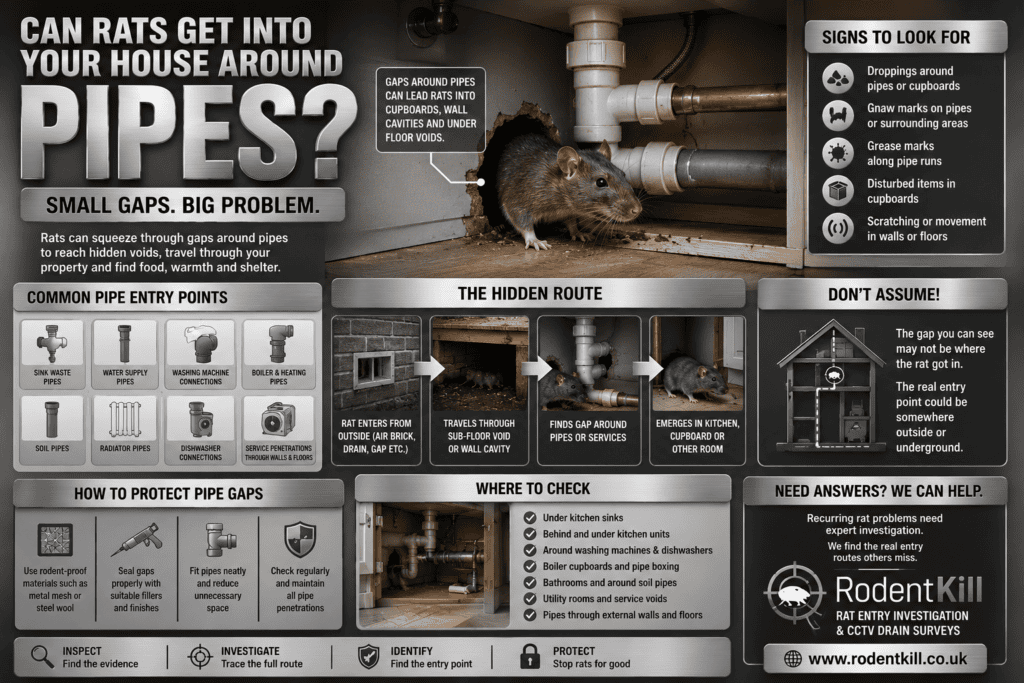
Can rats get into your house around pipes? Yes. Gaps around water pipes, waste pipes, boiler pipes and other services can provide rats with routes into concealed areas and occupied rooms.
This is particularly common where an opening through a wall or floor has been made larger than necessary and the space around the pipe has not been properly sealed.
However, there is an important distinction.
The gap around a pipe may be where a rat enters your kitchen or another room, but it may not be the original entry point into your property.
The rat could already be beneath the floor, inside a wall cavity or travelling through another concealed void.
For recurring rat problems, finding the complete route is therefore more important than simply filling the first hole you discover.
Why Are Gaps Around Pipes a Problem?
UK homes contain numerous services that pass through walls, floors, cupboards and other parts of the building.
These can include:
- Water pipes
- Sink waste pipes
- Washing-machine connections
- Dishwasher connections
- Boiler pipes
- Heating pipes
- Soil pipes
- Bathroom waste pipes
- Electrical and utility services
Installers need to create openings for these services. Ideally, unnecessary space around the pipe should then be appropriately sealed.
Where a larger opening remains and connects with a concealed void, it may become part of a rat's route through the building.
How Do Rats Get In Around Pipes?
Imagine a waste pipe passing through the floor beneath a kitchen sink.
The pipe itself may be relatively small, but the hole cut through the floor could be considerably larger.
If a rat is already beneath the floorboards, the opening around that pipe may provide a route directly into the sink cupboard.
The same principle applies where services pass through walls. A poorly sealed penetration could connect an occupied room with a wall cavity, service duct or another concealed space.
Where Should I Check for Gaps Around Pipes?
Kitchens, bathrooms and utility rooms are useful places to start.
Check accessible areas around:
- Kitchen sink waste pipes
- Hot and cold water pipes
- Dishwasher connections
- Washing-machine connections
- Boiler pipework
- Radiator pipes
- Toilet soil pipes
- Bathroom waste pipes
- Utility cupboards
- External service penetrations
Pay particular attention to openings hidden inside cupboards, behind removable kickboards and around boxed-in services.
Can Rats Get In Around Kitchen Sink Pipes?
Yes. The cupboard beneath a kitchen sink is an important area to inspect when investigating unexplained rat activity.
Waste and water pipes commonly pass through the back or bottom of the cupboard. If gaps remain around these pipes, a rat travelling through a concealed area may potentially enter the cupboard.
Possible signs include:
- Rat droppings beneath the sink
- Gnaw marks
- Disturbed stored items
- Damaged food packaging
- Greasy travel marks
- Visible gaps around pipework
Finding droppings around the pipework is useful evidence, but it does not necessarily tell you how the rat originally entered the building.
Can Rats Get Behind Kitchen Units?
Yes. The concealed space behind fitted kitchen units can provide rats with a hidden travel route.
Once kickboards and units are installed, much of this area disappears from view.
A rat that is already beneath the floor or inside another concealed void may travel behind several units before finding a gap around a pipe that allows it into the kitchen.
Can Rats Come Up Around Pipes Through the Floor?
Yes. This can be particularly relevant in properties with suspended timber floors.
If a rat gains access to the sub-floor void, it may travel beneath several rooms without being seen.
Pipework passing through the floor can then provide opportunities for the rat to move upwards.
A possible route could be:
External entry point → sub-floor void → gap around pipe → kitchen cupboard.
This is why sealing the visible hole around a pipe does not necessarily solve the underlying infestation.
Can Rats Follow Pipes Through a House?
Pipework can form part of a concealed route between different areas of a building.
The rat does not necessarily travel inside the pipe. Instead, it may use spaces surrounding pipework, service ducts or boxed-in areas.
These concealed routes can connect floors, cupboards, wall cavities and other parts of the property.
Can Rats Get Into Wall Cavities Around Pipes?
Potentially, yes.
Where a service penetrates a wall, an unnecessarily large opening may provide access to a cavity or structural void.
Once inside, a rat may move to another part of the building before becoming noticeable.
This can explain why scratching is sometimes heard well away from the original access route.
For more detail, see Rats in Wall Cavities – How Are They Getting In?
Can Rats Climb Pipes?
Rats are capable climbers.
Depending on the surrounding structure and available footholds, pipework can form part of a vertical route through a building.
However, it is important to distinguish between a rat climbing around pipework and travelling through the inside of a functioning pipe.
With household service penetrations, the important issue is often the space around the pipe.
Can Rats Enter Around Boiler Pipes?
Openings created for boiler and heating services should also be inspected.
Where pipes pass through an external wall, check the surrounding area for unnecessary gaps.
Internally, boiler and heating pipework may pass through floors, cupboards and boxed-in areas.
A gap alone does not prove rats are using it. Supporting evidence such as droppings, gnawing or travel marks makes the opening more significant.
Can Rats Get In Around a Soil Pipe?
Gaps around soil pipes can also deserve attention.
A soil pipe may pass through floors, walls or boxed-in areas. Openings around these penetrations can potentially connect different concealed parts of a building.
This is different from a rat travelling inside the functioning soil pipe itself.
When investigating recurring rat activity, both the drainage system and the spaces around associated pipework may need to be considered.
What About Old or Redundant Pipes?
Previous building alterations can leave unusual access routes behind.
A kitchen may have been moved, a bathroom renovated or an extension added. Old pipework and services may then leave openings that are no longer obvious.
Potential problems include:
- Unused holes through external walls
- Openings through floors
- Redundant waste connections
- Old service ducts
- Poorly sealed pipe penetrations
These openings may be concealed behind cupboards, boxing or modern finishes.
If an old waste connection remains connected to active drainage, the issue may go beyond a simple gap around a pipe. Our guide to disused drains and rat infestations explains that problem in more detail.
Should I Seal Every Gap Around My Pipes?
Obvious unnecessary openings should eventually be appropriately proofed, but a difficult rat infestation should not become a race to fill every visible hole.
First consider whether rats are already inside the structure and whether the opening you have found is an original entry point or simply an internal travel route.
If you seal an opening beneath a sink while rats remain beneath the floor, they may simply search for another route into the room.
For recurring infestations, understanding the route before carrying out extensive proofing can produce a much more effective result.
Is Expanding Foam Enough to Stop Rats?
Expanding foam alone should not be relied upon as robust rat proofing.
Rats can damage relatively soft materials by gnawing.
The appropriate repair depends on the size and position of the opening, surrounding construction and the type of service passing through it.
Care is particularly important around hot pipework, electrical services and installations with specific safety requirements.
What Should Rat Proofing Around Pipes Achieve?
Good proofing should close unnecessary access while allowing the pipe or service to operate safely.
The repair should also be appropriate for the surrounding wall, floor or other building material.
Most importantly, proofing should address the route that rats are actually using rather than simply making every visible opening look sealed.
Why Do Rats Keep Appearing After Pipe Gaps Are Sealed?
This is where the difference between an internal travel route and an original entry point becomes important.
Imagine a rat enters beneath a house through an external defect.
It travels beneath the kitchen and then emerges through a gap around the sink waste pipe.
If you seal only the gap beneath the sink, you have prevented access through that particular opening.
But you have not stopped rats entering the sub-floor area.
Another rat may simply find a different route into the living space.
Could the Original Rat Entry Point Be a Drain?
Possibly.
Rats can travel through underground drainage systems. If a relevant defect or open connection allows a rat to leave the pipework beneath or close to a property, it may potentially reach a sub-floor void.
From there, gaps around household pipes may provide further routes into kitchens, bathrooms and other rooms.
However, drainage is only one possibility. Structural openings, air bricks and external service penetrations should also be considered.
If you're unsure whether drainage is involved, read Are Rats Coming From My Drains?
How Do You Find the Original Rat Entry Point?
A useful investigation works backwards from the evidence.
For example:
Droppings beneath sink → gap around waste pipe → activity beneath floor → investigate how rats are reaching the sub-floor void.
This approach is more useful than assuming the first hole discovered must be the source of the infestation.
RodentKill's Rat Entry Investigation is designed for difficult and recurring rat problems where the complete entry route is not obvious.
When Should the Drains Be Investigated?
A gap around a household pipe does not automatically mean there is a drainage problem.
However, underground drainage may deserve investigation when:
- Rats repeatedly return after treatment
- There is activity beneath the ground floor
- No convincing external entry point can be found
- The property has older drainage
- The building has been extended
- Previous alterations changed the drainage layout
- Evidence suggests rats may be entering from underground
Where drainage is genuinely suspected, a Professional Rat Drain Survey can inspect accessible underground pipework for relevant defects and potential rat access routes.
Can Rats Get Into Your House Around Pipes? The Bottom Line
Yes. Poorly sealed openings around pipes and other services can provide rats with routes between concealed areas and occupied rooms.
But finding a gap around a pipe does not necessarily mean you have found the original entry point.
The rat may already have entered beneath the floor, through a wall cavity or via another hidden route.
For recurring rat problems, the aim should be to establish the complete route:
Where did the rat enter the building? How is it travelling through the property? Where is it emerging?
If rats keep appearing despite previous treatment or proofing, RodentKill can investigate the property to help identify the underlying access route.
Enquire about a Rat Entry Investigation →
Frequently Asked Questions
Can rats squeeze through gaps around pipes?
Yes. Where an opening around pipework is sufficiently large, it can potentially provide access between concealed areas and occupied parts of a property.
Why are there rat droppings around my kitchen pipes?
Droppings around pipework may indicate that rats are using the area as a travel route. However, the pipe opening may not be the original entry point into the building.
Can rats come up around pipes through the floor?
Yes. If rats are already beneath a suspended floor, openings around pipes can potentially allow them to move upwards into cupboards or rooms.
Should I fill gaps around pipes with expanding foam?
Expanding foam alone should not be relied upon as robust rat proofing because rodents can damage relatively soft materials. The repair method should be appropriate for the particular service and surrounding construction.
Why do rats still appear after I sealed a pipe hole?
The opening may have been an internal travel route rather than the original point where rats entered the property. They may still have access to the sub-floor void, cavity or another concealed area.
Can rats follow pipes into wall cavities?
Openings around services can potentially connect with wall cavities and other structural voids, allowing rats to move through concealed areas.
Does a gap around a soil pipe mean rats are coming from the drains?
No. A gap around the outside of a soil pipe and a defect within the underground drainage system are different potential routes. The wider evidence should be investigated before deciding which is responsible.
How do I find where rats are actually getting into my house?
Look at the complete pattern of evidence rather than individual holes. With recurring infestations, a specialist rat entry investigation can help trace likely routes through the building and identify where further investigation or proofing is required.