
Rats in a Terraced House – Where Are They Coming From
Rats in a terraced house can be particularly difficult to investigate because the source of the problem may not be confined to one property.
You might hear scratching beneath the floor, find droppings in the kitchen or repeatedly catch rats, yet find no obvious hole around the outside of your home.
In a terrace, rats may potentially use underfloor voids, gaps around services, structural openings, wall cavities or shared drainage.
The important question is not simply where you have seen the rat. It is how the rat is getting into the building in the first place.
Why Can Rat Problems Be Difficult in Terraced Houses?
Terraced properties are physically connected to neighbouring homes.
Depending on their age and construction, they may also share or connect through drainage systems, service routes and parts of the building structure.
Many older UK terraces have been altered repeatedly over the years. Kitchens move, bathrooms change, extensions are built and new heating, water and electrical services are installed.
These alterations can create concealed routes that are difficult to identify during a quick inspection.
Where Do Rats Get Into Terraced Houses?
There is no single entry point that applies to every terraced property.
Areas worth investigating include:
- damaged air bricks and ventilation openings;
- gaps around water, gas and heating pipes;
- openings around waste and soil pipes;
- damaged brickwork;
- gaps beneath doors;
- suspended floor voids;
- wall cavities and service ducts;
- extensions and previous alterations;
- redundant drain connections;
- damaged underground drainage; and
- shared drainage systems.
The opening where a rat appears inside the house may only be the final part of a much longer route.
Can Rats Travel Between Terraced Houses?
Potentially, but it depends on the construction of the properties and the routes available.
A sound party wall should provide a physical barrier. However, openings associated with services, alterations and concealed voids can complicate matters.
Rats may also appear to be travelling directly between houses when they are actually using another shared route beneath or outside the properties.
For this reason, finding rats in adjoining houses does not automatically prove that they are simply moving straight through the party wall.
Can Rats Travel Under Terraced Houses?
Many traditional terraced houses have suspended timber floors.
These create a void beneath the floorboards.
If a rat gains access to this area, it may move beneath rooms without ever entering the visible living space.
It might then emerge through a gap around pipework, behind kitchen units or through another opening further inside the property.
This can explain why scratching is heard beneath the floor even though no external hole can be found nearby.
Read our guide to scratching under the floor at night.
Can Rats Get Through the Party Wall?
The party wall itself should not normally provide an open route between properties.
However, the areas around it deserve attention where services or building alterations have created openings.
Examples can include:
- pipe penetrations;
- electrical cables;
- heating services;
- joist pockets;
- old fireplaces;
- damaged masonry; and
- previous alterations.
The relevant opening may also be beneath the floor or behind fitted units, where it cannot easily be seen.
Could the Rats Be Coming From Next Door?
They could potentially be using a route that involves a neighbouring property, but avoid assuming that your neighbour is the cause.
Two adjoining houses can experience rat activity because they are both exposed to the same underlying problem.
For example, rats could be travelling through drainage serving several properties.
Alternatively, one property may have a structural entry point while another has a completely different one.
If a neighbour also has rat activity, that information is useful evidence rather than proof of the source.
See My Neighbour Has Rats – Can They Get Into My House?
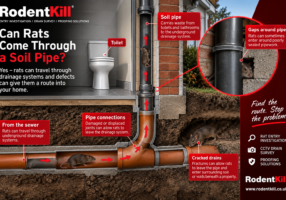
Are Shared Drains Important in Terraced Houses?
They can be.
Drainage from neighbouring properties may connect before eventually reaching the public sewer.
Rats can travel within sewer and drainage systems. Their presence inside the drains is not unusual and does not by itself mean there is a problem with your house.
The important issue is whether there is a defect or opening that allows a rat to leave the drainage system and reach the building.
Possible routes include:
- cracked or displaced drain pipes;
- collapsed sections;
- damaged chambers;
- open redundant connections; and
- poorly altered drainage.
Does Seeing a Rat in the Drain Prove It Is Entering the House?
No.
This is an important distinction.
Rats can travel through drainage without ever entering the property above.
Seeing a rat on a drain camera therefore does not automatically identify the cause of an infestation.
The investigation needs to find a credible route allowing rats to leave the drainage system and reach the property.
Why Are Kitchens Often Where Rats Appear?
Kitchens contain numerous service penetrations.
Water pipes, sink wastes, heating pipes and appliance connections frequently pass through floors and walls.
Fitted cupboards also conceal these openings.
A rat that is already beneath the floor may therefore find an easy route into a kitchen through a poorly sealed service opening.
However, the gap behind the kitchen unit may not be the original entry point into the house.
Read Can Rats Get Into Your House Around Pipes?
Can an Extension Cause Rat Problems in a Terraced House?
An extension does not automatically cause a rat problem, but previous building work can change potential access routes.
An old external wall may become internal. Air bricks can become concealed and drainage may be diverted or abandoned.
An old gully or redundant drain connection can also end up beneath a new floor.
If rats started appearing following building work, the altered part of the property deserves careful investigation.
See Rats After a House Extension.
Why Do Rats Keep Coming Back to the Same Terraced House?
Recurring rat problems often indicate that an access route remains available.
Treatment may successfully remove the rats currently inside the property.
However, if another rat can subsequently use the same route, the problem can return.
The cycle may look like this:
rat activity → pest control → quiet period → another rat enters → problem returns.
When this happens repeatedly, investigating the entry route becomes increasingly important.
What if There Are No Holes Outside?
Do not assume the property is completely sealed simply because the external walls look sound.
The route may be concealed beneath the building, behind an extension, around underground services or within altered drainage.
The rat may also enter one part of the structure and travel some distance before appearing inside.
This is why a difficult rat investigation looks at the property as a connected structure rather than concentrating on one room.
Should You Seal Every Gap You Find?
Proofing is important, but random sealing can be counterproductive if rats are already inside concealed parts of the building.
An internal opening may only be one section of the route.
Closing it without understanding the wider problem can cause rats to search for another way through.
Where possible, identify the active route before carrying out extensive proofing.
When Should the Drains Be Investigated?
Not every rat problem in a terraced house requires a drain survey.
Drainage becomes more relevant where:
- rats repeatedly return after treatment;
- activity occurs beneath ground-floor rooms;
- neighbouring properties also have problems;
- no convincing external entry point can be found;
- the property has old drainage;
- the house has been extended or significantly altered; or
- other evidence suggests an underground route.
A professional rat drain survey can inspect accessible underground pipework for defects and potential entry routes.
How Do You Find Where Rats Are Entering a Terraced House?
Start by building a picture of the activity throughout the property.
Consider where droppings appear, where noises are heard, where pipes enter rooms and whether activity occurs beneath floors or inside walls.
The exterior, air bricks, extensions and service penetrations should then be considered alongside the history of the property.
Where the evidence supports it, the drainage layout can also be investigated.
The objective is to identify a credible route from outside the property to the areas where rats are active.
Rats in a Terraced House – Find the Route
A terraced house can present more complicated rat problems because neighbouring structures, concealed voids and drainage may all need to be considered.
But the principle remains straightforward:
Do not just find the rat. Find the route it is using to get in.
Once that route has been identified, proofing and repairs can be targeted at the actual source of the problem.
Need Help With Rats in a Terraced House?
RodentKill specialises in investigating difficult and recurring rat problems.
Our rat entry investigations look at the building and potential access routes rather than simply treating the latest rat. Where drainage is a credible part of the problem, CCTV inspection can also be used to investigate accessible underground pipework.