
Rat Burrows Next to the House – Should You Be Worried
Finding a rat burrow next to your house can be worrying, particularly if you have also seen rats in the garden or heard noises inside the property.
Brown rats are capable burrowers. They commonly dig into soil where they can create sheltered nesting areas and underground routes.
A hole beside your house does not automatically mean rats are getting inside. However, a suspected rat burrow close to foundations, air bricks, drains or other potential entry points deserves investigation.
The important questions are: is it really a rat burrow, where does it lead, and why are rats using that particular area?
If you are experiencing recurring rat activity, RodentKill's Rat Entry Investigation focuses on finding the route rather than simply treating the rats you can see.
What Does a Rat Burrow Look Like?
A rat burrow usually appears as an opening in soil rather than a random shallow hole.
Signs that may suggest an active rat burrow include:
- A relatively smooth entrance
- Freshly disturbed soil
- A worn route leading towards the opening
- Rat droppings nearby
- Greasy marks along frequently used routes
- Footprints in soft ground
- Gnawing nearby
- Repeated rat sightings around the same area
There may also be more than one opening associated with a burrow system.
However, identifying an animal from a hole alone can be unreliable. Other animals also dig or occupy holes in gardens, so surrounding evidence matters.
Why Do Rats Dig Burrows Next to Houses?
Rats look for places that provide shelter and access to food and water.
The ground alongside buildings can offer protection from weather and predators. Structures may also make rats feel less exposed as they move around.
Common locations for rat burrows include:
- Alongside foundations
- Under decking
- Beneath sheds
- Beside patios
- Near garden walls
- Around drain chambers
- Beneath concrete slabs
- Under dense vegetation
- Near compost areas
- Around outbuildings
Food availability can also influence where rats establish themselves.
Bird seed, pet food, poorly managed compost, rubbish and animal feed can all support rat activity around a garden.
Does a Rat Burrow Next to the House Mean Rats Are Inside?
Not necessarily.
Rats may live outside without entering the house. A burrow could simply provide shelter while the rats feed elsewhere.
Nevertheless, a burrow close to a building is worth taking seriously because it places rat activity close to potential access points.
These may include:
- Damaged air bricks
- Gaps around pipes
- Missing mortar
- Openings beneath doors
- Service penetrations
- Sub-floor ventilation openings
- Structural defects
If you also have evidence of rats indoors, the relationship between the external burrow and internal activity should be investigated.
Can Rats Burrow Under House Foundations?
Rats can excavate suitable soil alongside structures and exploit existing spaces beneath or around buildings.
That does not mean every burrow beside a foundation travels underneath the house.
The construction of the property, ground conditions and surrounding structures all affect what routes are available.
For example, an older property with suspended timber floors may have a sub-floor void. If a rat finds an opening into that space, it can potentially move underneath much of the ground floor without being seen.
This is one reason external evidence can be important when investigating rats heard beneath floorboards.
Our guide to signs rats are living under your house explains what other evidence to look for.
Can Rat Burrows Damage Foundations?
A rat burrow beside a building should not automatically be assumed to mean serious structural damage.
However, extensive burrowing can disturb soil locally, particularly where the ground is already loose, washed out or affected by other defects.
More importantly, unexplained ground disturbance beside a property may indicate another problem that deserves investigation.
For example, leaking or damaged underground drainage can affect surrounding soil.
If there is subsidence, cracking, significant ground movement or concern about the building's structure, appropriate building or structural advice should be obtained rather than assuming rats are the sole cause.
Could a Rat Burrow Be Connected to the Drains?
Potentially, but not every rat burrow is connected with drainage.
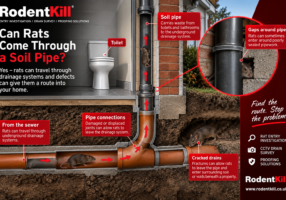
Rats commonly inhabit sewer systems. Normally, sound drainage keeps those rats contained within the pipework.
Problems can arise when underground drains contain significant defects.
A rat travelling through a drain may potentially leave through a cracked pipe, displaced joint, collapsed section or open connection.
Once outside the pipe, it may enter surrounding soil and burrow away from the defect.
A possible route could therefore be:
Sewer → underground drain → drainage defect → surrounding soil → burrow → building.
However, that route should not be assumed simply because a burrow happens to be near a drain.
Evidence matters.
Why Are Rat Burrows Sometimes Found Beside Drains?
Drainage areas can provide several things that interest rats.
They may offer established underground routes, moisture, shelter and disturbed ground around previous excavations.
Older inspection chambers and drainage installations may also contain defects.
If a burrow repeatedly appears close to a drain chamber, soil pipe or drainage route, it may justify closer inspection — particularly where rats are also appearing inside the property.
Our guide Are Rats Coming From My Drains? explains how drainage-related rat entry can occur.
Can Rats Burrow Under a Concrete Slab or Patio?
Rats can burrow through suitable soil beneath and alongside hard surfaces if they have access to the ground.
Patios, sheds, decking and other structures can make good shelter because the space underneath is protected from disturbance.
The rat is not normally digging through sound concrete itself. Instead, it uses soil or existing voids beneath or around the structure.
This can make burrows difficult to follow from above ground.
You may see the entrance disappear beneath a paving slab without knowing how far the route continues.
Can Rat Burrows Lead Under Suspended Floors?
Potentially.
Many older UK houses have suspended timber ground floors with a void underneath.
External air bricks ventilate this space.
If rats gain access through a damaged vent, structural opening or another defect, they can enter the sub-floor area.
Once underneath the property, rats may travel towards kitchens, bathrooms, wall cavities and pipe penetrations.
This can explain why a homeowner hears rats beneath the floor even though no obvious hole can be found inside the house.
What If the Burrow Is Under Decking?
Decking can conceal rat activity extremely effectively.
The ground underneath is usually dark, sheltered and rarely disturbed.
Rats may establish a burrow there or simply use the space as part of a regular travel route.
Seeing a rat disappear underneath decking therefore does not prove that its nest is there.
Our guide Can Rats Live Under Decking? explains how to distinguish between nesting and rats simply passing through.
Should You Block a Rat Burrow?
Simply filling a suspected rat burrow without understanding the infestation is not always the best first step.
If rats are actively using the burrow, blocking one entrance may encourage them to excavate another route.
More importantly, filling the visible hole does not explain where the rats came from or whether another route leads towards the building.
Before permanent proofing or repair work, it is useful to understand:
- Whether the burrow is active
- Where rats are feeding
- Whether other burrows exist
- Whether rats are entering the building
- Whether drainage may be involved
- Whether neighbouring land is contributing to the activity
The aim should be to deal with the infestation as a whole rather than one visible hole.
How Can You Tell If a Rat Burrow Is Active?
Fresh evidence around the entrance can help.
Look for recently disturbed soil, fresh droppings, footprints, worn runs and repeated sightings.
An entrance that remains clean and open despite changing weather can also suggest regular use.
Professional investigation may use monitoring techniques where the situation is unclear.
A single hole with no other evidence should not automatically be labelled an active rat burrow.
Should You Put Poison Down a Rat Burrow?
Rodent control should be carried out carefully and in accordance with the product label and UK rodenticide stewardship requirements.
Simply putting poison into every hole found around a property is not a substitute for understanding the infestation.
There may be risks to wildlife, pets and other non-target animals if rodenticides are used incorrectly.
Furthermore, killing the rats currently using a burrow will not solve a structural or drainage route that allows new rats to arrive.
This is why RodentKill combines rat control with investigation where recurring activity is involved.
What Should You Do If You Find a Rat Burrow Beside Your House?
Start by looking at the wider area rather than disturbing the hole immediately.
Check for:
- Additional burrows
- Droppings
- Regular rat runs
- Food sources
- Damaged air bricks
- Gaps around pipework
- Drain chambers nearby
- Signs of digging around foundations
- Activity underneath decking or sheds
If rats are also active inside the property, finding the connection between the outside and inside evidence becomes particularly important.
When Is a CCTV Rat Drain Survey Worth Considering?
A rat burrow alone does not mean you need a CCTV drain survey.
However, drainage investigation may become appropriate when other evidence points underground.
Examples include recurring rats inside the property, burrowing concentrated around drainage, activity beneath floors, previous drainage problems or an infestation that returns despite treatment and proofing.
A Professional Rat Drain Survey can inspect accessible underground pipework for defects that could potentially allow rats to leave the drainage system.
Any defect found should then be considered alongside the position of the burrow and the evidence from the property.
Professional Rat Entry Investigation
When rats repeatedly appear around or inside a property, the visible burrow may only be one part of the problem.
RodentKill's Rat Entry Investigation looks at how rats are moving around the property and where they may be gaining access.
We consider external evidence, structural openings, sub-floor areas, pipe penetrations and drainage where relevant.
The objective is not simply to find a hole.
It is to establish a credible route and determine what needs to be done to stop it.
Rat Burrows Next to the House – The Bottom Line
A rat burrow next to your house does not automatically mean rats are living inside the property.
However, active burrowing close to foundations, drains, air bricks or other potential entry points should not be ignored.
Look at the wider evidence.
If rats are repeatedly entering the house, the most important question is not simply how to fill the burrow. It is where the rats are coming from and how the outside activity connects with the infestation indoors.
Find the route. Stop the problem.
Contact RodentKill about a recurring rat problem.
Frequently Asked Questions
What does a rat burrow look like?
An active rat burrow may have a smooth entrance, disturbed soil and evidence such as droppings, footprints or a worn run nearby. Other animals also create holes, so the surrounding evidence should be considered.
Should I worry about a rat hole next to my house?
It deserves investigation, particularly if you also have rats inside, repeated sightings or other evidence close to the building.
Can rats burrow underneath a house?
Rats can dig through suitable soil and exploit existing spaces around buildings. Whether a particular burrow reaches beneath a house depends on the construction and ground conditions.
Can a rat burrow be connected to a sewer?
Potentially. A drainage defect can sometimes allow rats to leave underground pipework and enter surrounding soil. However, a burrow near a drain does not by itself prove a sewer connection.
Do rats burrow under patios?
They can burrow through suitable ground beneath or alongside paving where access exists. Patios and other structures can provide useful shelter.
Should I fill in a rat burrow?
It is better to understand whether the burrow is active and how it relates to the wider infestation before relying on filling the visible opening as the solution.
Does a rat burrow mean there is a nest?
Not always. Rats may use burrows for shelter and nesting, but an opening can also form part of a wider travel route.
When should drains be investigated?
Drainage becomes more relevant when rat activity repeatedly returns, burrows are concentrated around drainage, rats are active beneath the house or there is other evidence suggesting an underground route.