I Hear Rats at Night but Cannot Find Them – Where Are They Hiding
Hearing rats at night but being unable to find them can be one of the most frustrating types of rodent problem.
You may hear scratching behind a wall, movement beneath the floor, scurrying above a ceiling or gnawing somewhere around the kitchen. Then, when you investigate, there is nothing there.
The reason is simple: rats can travel through hidden parts of a building without entering the rooms you can see.
Floor voids, wall cavities, boxed-in pipework, ceiling spaces, service ducts and damaged drainage can all provide concealed routes through a property.
More importantly, the place where you hear the rat is not necessarily where it entered the building.
This guide explains where rats may be hiding, why they are often easier to hear at night and how the route into the property can be investigated.
Why Can I Hear Rats but Never See Them?
Rats do not need to run across your kitchen floor to live or travel inside your house.
Many UK properties contain concealed spaces that can allow rodents to move almost completely out of sight.
These can include:
- Voids beneath suspended timber floors
- Wall cavities
- Spaces behind kitchen units
- Boxed-in soil and waste pipes
- Ceiling voids
- Lofts and roof spaces
- Service ducts
- Utility cupboards
- Spaces beneath baths and shower trays
- Voids around extensions
A rat may therefore spend much of its time inside the structure of the building.
You hear it because it is moving, scratching or gnawing against building materials. You do not see it because it has no reason to enter the occupied room.
Why Are Rat Noises Worse at Night?
There are two main reasons rat activity often appears much more noticeable at night.
First, the house becomes quieter. Televisions, conversations, traffic and normal household activity can mask surprisingly loud rodent movement during the day.
Second, rats often feel safer moving through concealed areas when disturbance around the property is reduced.
This can make scratching, gnawing and scurrying particularly noticeable late in the evening or during the early hours.
However, hearing activity at night does not automatically prove that rats are responsible. Mice and other causes should also be considered.
If the noise is specifically coming from beneath the floor, read our guide to scratching under the floor at night.
What Do Rats Inside a House Sound Like?
The sound depends on where the animal is moving and what materials surround it.
Homeowners commonly describe:
- Scratching
- Scurrying
- Gnawing
- Rustling
- Heavier movement beneath floors
- Movement travelling along a wall
- Noise above a ceiling
- Sudden bangs or knocks inside a void
A rat moving across a timber joist may sound very different from one moving through insulation or alongside a plastic pipe.
Building materials can also amplify sound. For this reason, it is difficult to judge the size or precise location of an animal from noise alone.
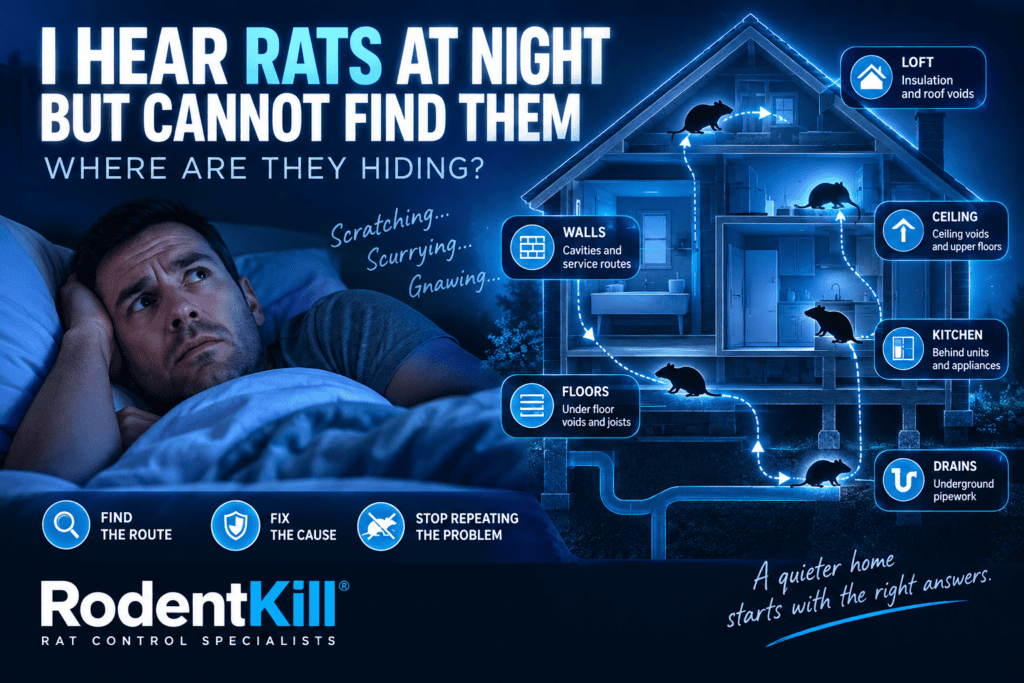
Where Could the Rats Be Hiding?
Where Rat Noises Can Come From
Insulation • eaves • roof voids
Cavities • ducts • pipe routes
Joists • suspended voids • foundations
Drains • redundant pipes • underground voids
The key question isn't only “Where is the rat?” It is “How did it reach that part of the building?”
Under the Floor
Suspended timber floors can create large concealed spaces beneath a house.
Once rats enter this area, they may travel underneath several rooms without appearing above the floorboards.
Potential access routes include damaged air bricks, gaps around services, openings within the structure and underground routes.
Inside Wall Cavities
Wall cavities and other vertical voids can allow rats to move between different levels of a property.
They may reach these areas from beneath the floor and then climb around pipework or rough internal surfaces.
Our guide to rats in wall cavities explains these routes in more detail.
Behind Kitchen Units
Kitchens contain numerous potential travel routes.
Water pipes, waste pipes, gas services, electrical cables and boxed-in services frequently pass through walls and floors.
A rat may therefore emerge behind a kitchen plinth or appliance while remaining almost completely hidden from view.
Above the Ceiling
If noises appear to come from above, rats may be travelling within a ceiling void, upper floor structure or loft.
Do not assume they entered through the roof.
A rat can potentially enter much lower in the building and travel upwards through cavities or service routes.
Behind Boxed-In Pipework
Boxing around soil pipes, heating pipes and other services can create concealed vertical routes.
These routes are particularly important when noises appear around bathrooms, kitchens and utility areas.
The Rat May Be Nowhere Near Its Entry Point
This is one of the most important things to understand when investigating a hidden rat problem.
Suppose you hear scratching in a bedroom wall.
It would be tempting to concentrate entirely on that wall. Yet the rat might have entered through a defect beneath the ground floor, travelled underneath the house and then climbed upwards through a service void.
The bedroom wall is simply where you can hear it.
That is why randomly sealing the area closest to the noise can fail to solve the problem.
A Hidden Rat Route Could Look Like This
↓
Drain defect or structural opening
↓
Void beneath the property
↓
Gap around pipework
↓
Wall or service cavity
↓
WHERE YOU HEAR THE RAT
Finding the noise is useful. Finding the route is what can prevent the problem returning.
Could Rats Be Coming From the Drains?
Possibly, but drains should not automatically be blamed for every hidden rat problem.
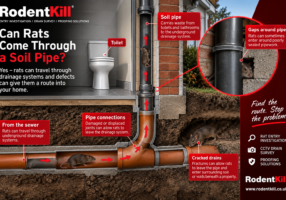
Rats can travel through sewer systems. Problems can arise when defects or redundant connections allow them to leave the drainage system beneath or close to a property.
Potential problems include:
- Cracked drainage pipes
- Displaced pipe joints
- Redundant connections
- Open-ended drainage
- Damaged inspection chambers
- Defects beneath extensions
- Poorly sealed soil pipe connections
Once outside the pipe, a rat may reach a void beneath the building and continue through gaps around services or structural openings.
This is one reason some properties experience rat activity despite having no obvious hole around the exterior.
If drainage appears to be involved, a professional rat drain survey can be used to inspect accessible underground pipework.
Signs That Can Help Locate a Hidden Rat
Noise is only one piece of evidence.
A proper investigation may also consider:
- Droppings
- Gnaw marks
- Grease marks
- Footprints
- Disturbed insulation
- Damaged food packaging
- Smells
- Burrows outside the building
- Gaps around pipework
- Damaged air bricks
- Activity around inspection chambers
Individually, these signs may not identify the entire route. Together, they can build a much clearer picture.
Should I Start Opening Walls and Floors?
Usually not.
Opening a wall or lifting flooring simply because a noise was heard there can result in unnecessary damage without revealing the entry route.
It is generally better to gather evidence first.
Record where the noises occur, approximately what time they happen and whether the apparent location changes.
Also check accessible areas for droppings, gnawing and other physical evidence.
Targeted investigation can then be used instead of dismantling parts of the property at random.
Should I Block the Hole as Soon as I Find One?
Be careful.
An opening that appears suspicious may be part of the rat's route, but sealing it immediately is not always the best first step.
If rats are already inside a concealed void, inappropriate proofing could potentially trap them within the structure or cause them to search for another way out.
It is also possible to seal one visible opening while leaving the actual entry route untouched.
The wider infestation should therefore be understood before substantial proofing work begins.
Why Poison or Traps May Not Solve the Problem Permanently
Trapping or rodenticide can be useful parts of rat control when used appropriately.
However, controlling the rats currently inside the property does not necessarily remove the route they used to enter.
If that access remains available, another rat may eventually use it.
This is particularly important when homeowners experience the same pattern repeatedly:
- Rat noises begin.
- Pest control is carried out.
- The noises disappear.
- Several weeks or months pass.
- The noises return.
In that situation, investigating the route of entry can be just as important as controlling the current infestation.
How Do You Find an Entry Point When the Rat Is Hidden?
A rat entry investigation looks beyond the room where the activity is being heard.
The investigation may consider the construction of the property, previous infestation history, structural openings, service penetrations, drainage and physical signs of rat movement.
The aim is to answer a different question from ordinary pest treatment:
How are the rats getting into the building?
This may involve examining likely routes around the exterior, beneath floors, around pipework, within accessible voids and around the drainage system.
If evidence suggests that the source may be underground, CCTV drainage inspection can then be considered.
When Should You Consider a Professional Investigation?
A more detailed investigation may be worthwhile when:
- You repeatedly hear rats but cannot find them
- The activity returns after previous pest control
- There is no obvious external entry point
- Noises occur beneath floors or inside walls
- Activity appears around kitchens or bathrooms
- The property has been extended or altered
- You suspect old or redundant drainage
- Several different areas of the property are affected
- Previous proofing has not stopped the problem
RodentKill specialises in investigating difficult and recurring rat problems where the source is not immediately obvious.
Frequently Asked Questions
Why can I hear rats at night but never see them?
Rats can travel through floor voids, wall cavities, ceilings and spaces around services. They may therefore remain inside the structure of the property rather than entering occupied rooms.
Can rats live inside walls?
Rats can use wall cavities and other structural voids for movement and shelter where suitable access exists.
Can rats move from underneath the floor into the walls?
Yes. Openings around pipes, services and structural gaps can connect different hidden areas of a building.
Why does the noise seem to move around the house?
The rat may genuinely be moving through connected voids. Sound can also travel through joists, pipes and wall structures, making the apparent position difficult to judge.
Does scratching at night definitely mean rats?
No. Mice and other causes can produce similar noises. Droppings, gnawing, footprints and other evidence should be considered before deciding what animal is responsible.
Could rats in my walls be coming from the drains?
Yes, in some properties. A drainage defect can potentially allow a rat to leave the drain beneath the building before travelling through floor and wall voids. However, above-ground entry routes should also be considered.
Should I lift the floorboards to find the rat?
Not necessarily. Identifying likely routes and gathering evidence first can avoid unnecessary disruption.
Why do rats keep returning after pest control?
One possibility is that the rats were controlled but the original access route remained available. New rats may then enter through the same route.
Cannot Find Where the Rats Are Coming From?
If you can hear rats inside your property but cannot work out where they are hiding or how they are getting in, repeatedly treating the visible symptoms may not resolve the underlying problem.
RodentKill investigates hidden and recurring rat infestations with the aim of identifying likely access routes.
Depending on the evidence, this may involve inspection of the building, service penetrations, concealed routes and accessible drainage.
Find the route. Fix the cause. Stop treating the same problem repeatedly.