PROFESSIONAL RAT DRAIN SURVEYS
Professional CCTV Rat Drain Survey
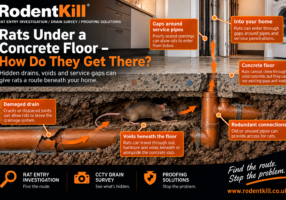
Recurring rat problems are often caused by defects within the drainage system. A professional CCTV rat drain survey can identify damaged pipes, displaced joints, redundant connections and other hidden routes that may be allowing rats towards your property.
✓ CCTV Drain Inspection
✓ Sonde Locating
✓ Rat Entry Investigation
✓ Clear Written Findings
FIND THE SOURCE OF THE PROBLEM
CCTV Drain Inspection to Find Hidden Rat Entry Points
Are rats repeatedly entering your home or business despite previous pest control treatments?
The source of the infestation may be hidden beneath your property.
RodentKill provides professional rat drain survey services using specialist CCTV equipment to inspect underground drainage systems, identify possible rat entry points and locate damaged pipework.
We do more than look for general drainage defects. Our surveys combine drainage inspection with practical knowledge of rat behaviour, helping us investigate how rats may be leaving the sewer system and gaining access to your building.
Call RodentKill on 07908 954865 to discuss your rat problem or request a quotation for a CCTV rat drain survey.
For more specialist guidance on rats in drains, recurring rat problems, drainage defects and entry routes, visit our Rat Knowledge Centre.
IDENTIFY THE ENTRY ROUTE
Find Out How Rats Are Entering Your Property
Recurring rat infestations are often caused by an entry point that has not been identified or sealed.
Baiting and trapping can reduce the number of rats inside a property. However, the problem may return when rats still have access through a cracked drain, a displaced joint, a redundant pipe, or a damaged inspection chamber.
A rat drain survey allows us to inspect the underground pipework rather than relying on guesswork.
During the survey, we look for drainage defects and hidden routes that could allow rats to travel from the sewer system into:
✓ Voids beneath floors
✓ Wall cavities
✓ Service ducts
✓ Utility cupboards
✓ Kitchens
✓ Bathrooms
✓ Extensions
✓ Basements
✓ Commercial premises
✓ Agricultural buildings
UNDERSTAND THE SURVEY
What Is a Rat Drain Survey?
A rat drain survey is a specialist CCTV inspection of the drainage system around a property.
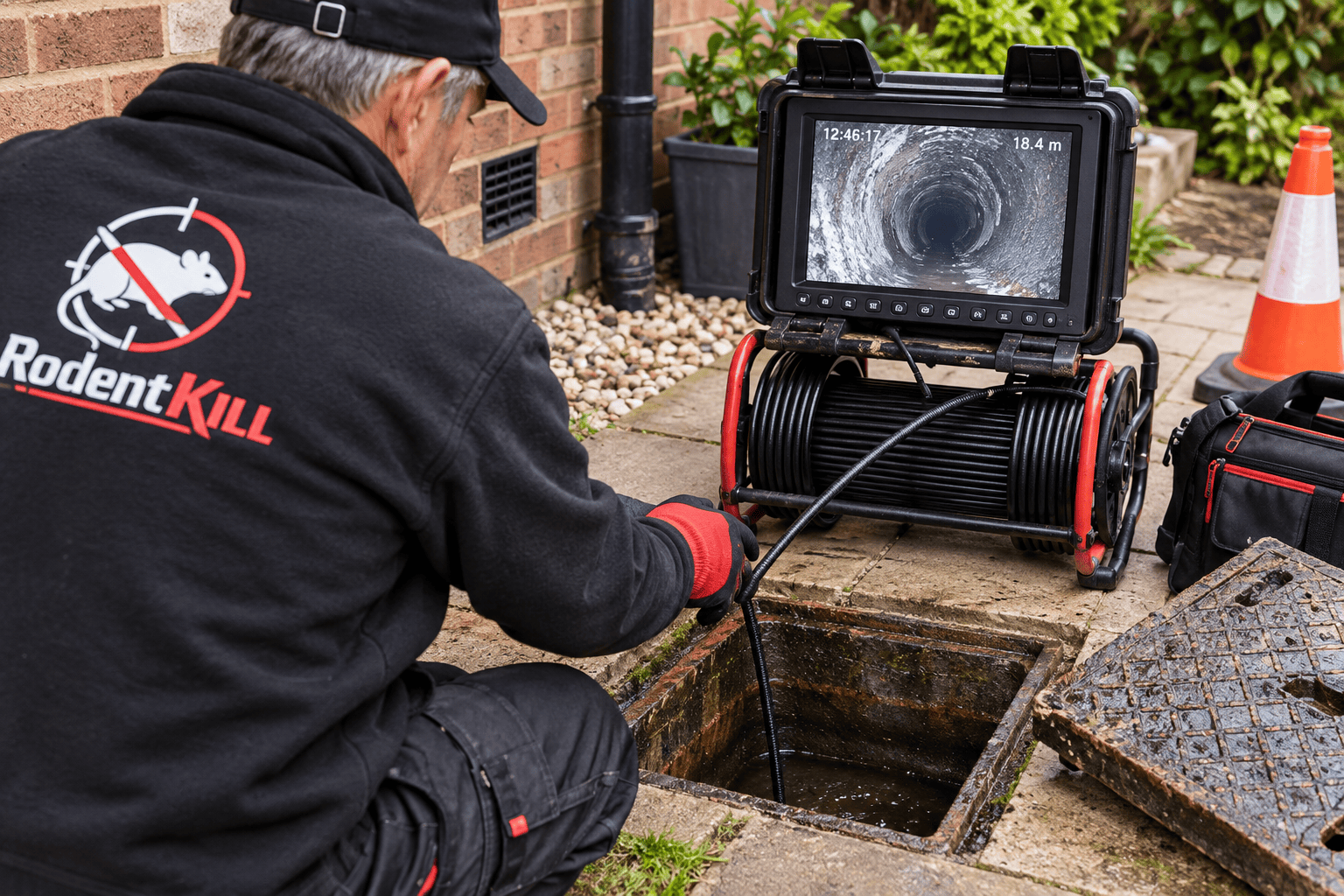
A high-definition drain camera is inserted through an accessible inspection chamber or drainage access point. The camera is then guided through the pipework while the internal condition of the drain is viewed on a monitor.
Unlike a general blockage inspection, our investigation focuses specifically on defects that could contribute to rodent ingress.
Want a more detailed explanation of the process? Read our guide: What Is a Rat Drain Survey?
We may inspect for:
✓ Cracked or fractured pipes
✓ Displaced pipe joints
✓ Open connections
✓ Collapsed drain sections
✓ Root ingress
✓ Redundant pipework
✓ Poorly sealed extensions
✓ Damaged inspect chambers
THE AIM ISN'T JUST TO INSPECT THE DRAIN
It’s to find the route the rats are using
A drainage defect only matters to a rat investigation if it helps explain how rats are travelling from the sewer system towards the property. That is why we look beyond general drain condition and focus on potential rat entry routes.
WHEN TO INVESTIGATE THE DRAINS
Signs You May Need a CCTV Rat Drain Survey
Not every rat infestation starts in the drains. However, drainage should be investigated when the pattern of activity suggests that rats are entering from below the property.
✓ Rats keep returning after pest control treatment
✓ Scratching is heard beneath the floor
✓ Rats appear behind kitchen units or bathroom fittings
✓ Activity is concentrated around boxed-in pipework
✓ Rats are entering without an obvious external hole
✓ Burrows are found close to inspection chambers
✓ Rats appeared following building or extension work
✓ A rat has appeared through or close to a toilet
WHY RATS USE DRAINS
Why Rats Enter Buildings Through Drains
Rats commonly live and travel within sewer networks. Underground drains provide shelter, food sources and routes between different locations.
Most rats remain within the sewer system. Problems begin when damaged private drainage allows them to leave the pipework.
A rat does not always need to chew through a drain. In many cases, it simply takes advantage of an existing defect.
Once outside the pipe, a rat may move through loose ground or an underground void until it reaches a gap around services, pipework or the foundations of a building.
From there, it can enter the internal structure through surprisingly well-hidden routes.
This is why a property can appear secure from the outside while rats continue to appear indoors.

COMMON DRAINAGE PROBLEMS
Common Drain Defects That Allow Rat Entry
Damage or alterations within a drainage system can create routes that allow rats to leave the sewer network and move towards a property. During a CCTV rat drain survey, we look for defects that could help explain recurring rat activity.
Displaced Drain Joints
Older drainage pipes can move out of alignment through ground movement or deterioration.
The resulting gaps may allow rats to leave the drain and enter the surrounding ground.
Cracked or Fractured Pipes
Clay, concrete and plastic drainage pipes can become cracked through ground movement, tree roots, building work or deterioration.
Even when wastewater still flows, a fracture may provide an opening that rats can use to leave the drainage system.
Redundant Drain Connections
Old toilets, sinks and other fittings can leave redundant drain connections when properties are altered or extended.
If these pipes are left open or poorly sealed, they can provide rats with a direct route towards the building.
Damaged Inspection Chambers
Broken channels, failed benching or open pipe connections inside an inspection chamber can allow rats to escape into the surrounding ground.
From there, they may travel beneath floors, paving or extensions towards the property.
Collapsed Drains
A partially collapsed drain may still allow wastewater to flow while leaving gaps around the damaged pipework.
Rats can use these spaces as a route out of the drainage system and into the surrounding ground.
Root-Damaged Pipework
Tree roots can enter drains through small cracks or poorly sealed joints as they grow towards moisture.
As the roots expand, they can enlarge the defect and create openings that rats may use to leave the drainage system.
Initial Rat Infestation Assessment
01
We begin by discussing the history of the problem, including where rats have been seen or heard, when the activity began, previous treatments or drainage problems, and any alterations to the property.
Understanding the pattern of activity helps us focus the drainage inspection on the most relevant areas.
Inspection of Drainage Access Points
02
We identify accessible inspection chambers and assess the visible drainage layout.
The direction of flow, pipe configuration and position of connections are considered before the camera is inserted.
CCTV Drain Inspection
03
The CCTV camera is carefully passed through the drainage system.
We monitor the live footage for defects, open connections, obstructions and possible rat access points.
Relevant findings can be recorded using video footage or still images where appropriate.
Drain Tracing & Sonde Locating
04
Where required, electronic sonde locating can help trace the camera head from above ground.
This can pinpoint the position of a suspected defect, trace underground pipework and help reduce unnecessary excavation.
Findings & Recommendations
05
After the survey, we explain what has been found and how it may relate to the rat infestation.
We then recommend the most appropriate next steps, which may include drainage repairs, proofing, a suitable rat flap or further investigation
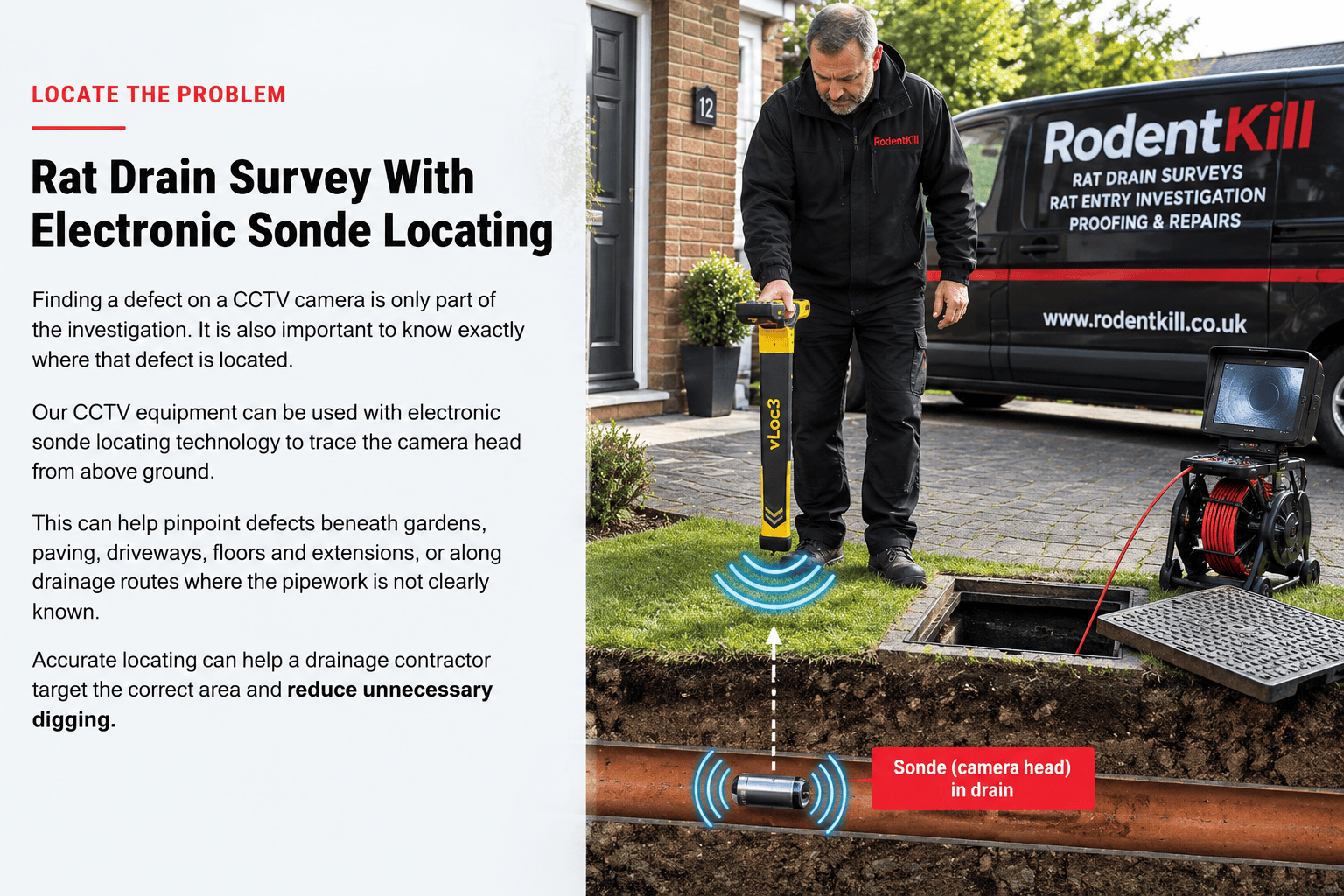
Rat Drain Survey With Electronic Sonde Locating
Finding a defect on a CCTV camera is only part of the investigation. It is also important to know exactly where that defect is located.
Our CCTV equipment can be used with electronic sonde locating technology to trace the camera head from above ground.
This can help pinpoint defects beneath gardens, paving, driveways, floors and extensions, or along drainage routes where the pipework is not clearly known.
Accurate locating can help a drainage contractor target the correct area and reduce unnecessary digging.
Rat Drain Surveys for Recurring Infestations
Have you paid for several rat treatments, only for the problem to return?
This does not necessarily mean that the previous treatment was ineffective.
The rats inside the property may have been controlled successfully. However, new rats can enter when the original access route remains open.
This often creates a repeating cycle:
- Rat activity is discovered.
- Bait or traps reduce the infestation.
- Activity temporarily stops.
- New rats enter through the same drain defect.
- The infestation begins again.
A rat drain survey can help break this cycle by investigating the route of entry.
Effective long-term rat control often requires a combination of population control, drainage repairs, structural proofing and monitoring.
Do You Need a Rat Flap?
A rat flap is a non-return device fitted within suitable drainage pipework.
It allows wastewater to leave the property while restricting rats attempting to travel back from the sewer.
A rat flap can be useful in certain situations. However, it must be positioned correctly and should not be treated as a universal solution.
For example, a rat flap may not solve the infestation when:
- Rats are already living beyond the proposed installation point
- The drainage system has several possible entry routes
- A damaged pipe allows rats to leave the drain beneath the building
- The device is installed in the wrong section of pipework
- The pipe is unsuitable for the selected product
- The drain defect itself remains unrepaired
We recommend inspecting the drainage system before deciding whether a rat flap is appropriate.
Domestic Rat Drain Surveys
RodentKill provides CCTV rat drain surveys for houses, flats and other residential properties.
Domestic drainage problems can be especially difficult to diagnose because the pipework may run beneath kitchens, extensions, conservatories, driveways or landscaped gardens.
We can assist homeowners who are experiencing:
- Rats beneath suspended floors
- Rat activity behind kitchen units
- Recurring infestations after treatment
- Noises around bathrooms or soil pipes
- Rats associated with an extension
- Suspected redundant drainage
- Damage around inspection chambers
- Unexplained internal rat sightings
We also work with landlords, letting agents and property managers who need clear information about recurring rat activity in rented accommodation.
Commercial Rat Drain Surveys
Drain-related rat infestations can present a serious concern for commercial premises.
We provide rat drain survey services for properties such as:
- Restaurants
- Hotels
- Offices
- Shops
- Warehouses
- Schools
- Care facilities
- Rental properties
- Food premises
- Farms and agricultural buildings
A drainage defect can allow rats to bypass external proofing and emerge within service areas, storage rooms, kitchens or wall voids.
Early investigation can help protect the building, reduce disruption and support an effective pest management programme.
Areas Covered
RodentKill provides rat drain surveys across Ipswich, Suffolk, Essex, Norfolk, Cambridgeshire, London and surrounding areas.
We can also travel to other locations across southern and central England depending on the size and requirements of the survey.
Contact us with your postcode and a brief description of the problem. We will confirm availability and provide information about the next steps.
Book a Rat Drain Survey
Recurring rats should not be ignored.
The longer an access route remains open, the greater the risk of further activity, contamination and damage within the property.
A professional rat drain survey can help establish:
- Whether rats may be entering through the drains
- Which drainage defects require attention
- Where the suspected defect is located
- Whether a rat flap may be suitable
- What repairs or proofing may be needed
- How to approach the infestation as a long-term problem
Call RodentKill on 07908 954865 or complete our online enquiry form to request a quotation.
Please include your postcode, property type, where the rats have been seen and details of any previous pest control or drainage work.
Frequently Asked Questions About Rat Drain Surveys
How much does a rat drain survey cost?
The price depends on the location, size of the property, number of inspection chambers and complexity of the drainage system. See our rat control and drain survey prices for current starting prices.
Contact RodentKill with your postcode and details of the infestation for a clear quotation.
How long does a rat drain survey take?
The time required depends on the size, accessibility and condition of the drainage system.
A straightforward domestic inspection may be completed relatively quickly, while larger or more complicated drainage networks can take longer.
Will you need to dig up my property?
The initial CCTV survey is normally carried out through existing drainage access points without excavation.
When a defect is found, electronic locating equipment may help identify its position so any necessary repair can be targeted more accurately.
Can you guarantee that the rats are coming from the drains?
No responsible surveyor should decide that rats are entering through the drains without examining the evidence.
Our survey is designed to determine whether relevant defects or access routes are present. We then explain whether the findings are likely to be connected to the infestation.
Can rats be seen on the drain camera?
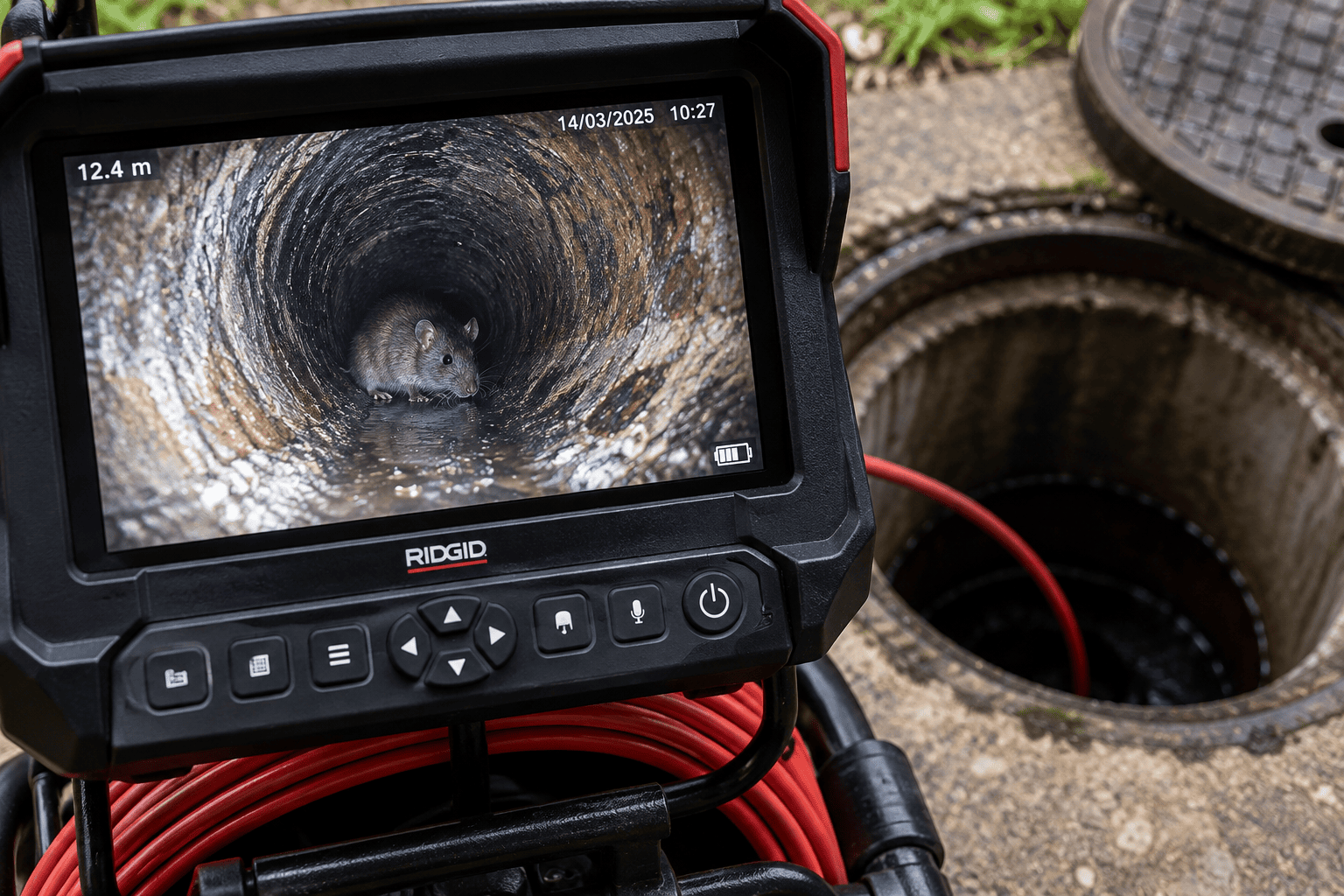
Occasionally, rats are seen during a live CCTV inspection.
However, the absence of a visible rat does not mean the drains are clear. Structural defects, footprints, disturbed deposits, grease marks and the overall infestation pattern may still provide useful evidence.
Can rats climb drain pipes?
Rats are capable climbers and may move through chambers, rough pipework, service ducts and other parts of a drainage system.
They may also exploit bends, joints and damaged sections to reach areas above the main sewer.
Can rats come through a toilet?
It is possible, although it is not the most common route into a property.
Where a rat has appeared in or near a toilet, the drainage system, soil pipe connections and any relevant non-return devices should be investigated.
Will poison solve a drain rat problem?
Rodenticide may control rats currently using the property, but it will not repair a damaged drain or seal an entry point.
A lasting solution may require pest control together with drainage repairs and structural proofing.
Does every cracked drain need replacing?
Not necessarily.
The correct repair depends on the type, position and severity of the damage. Options may include local repair, excavation, pipe replacement or drain relining.
A suitable drainage contractor should advise on the repair method after the defect has been identified.
Should a rat flap be installed before the survey?
We generally recommend inspecting the drainage layout first.
This helps determine whether a rat flap is suitable and identifies the correct installation position. Installing one without understanding the drainage system could leave the actual entry point unresolved.
Can you survey an older property with clay drains?
Yes.
Older clay drainage systems are one of the main reasons homeowners request CCTV rat drain surveys. We can inspect accessible pipework for displaced joints, cracks, root ingress, collapses and redundant connections.
Stop Treating the Same Rat Problem Again and Again
For more specialist guidance on recurring rat problems, drainage defects, hidden entry routes and proofing, visit our Rat Knowledge Centre.
When rats keep returning, there is usually a reason.
RodentKill can inspect your underground drainage system, locate possible rat access points and help you understand what must be done to prevent another infestation.
Call 07908 954865 today or complete our enquiry form to arrange your professional rat drain survey.