Can Rats Get Through Air Bricks
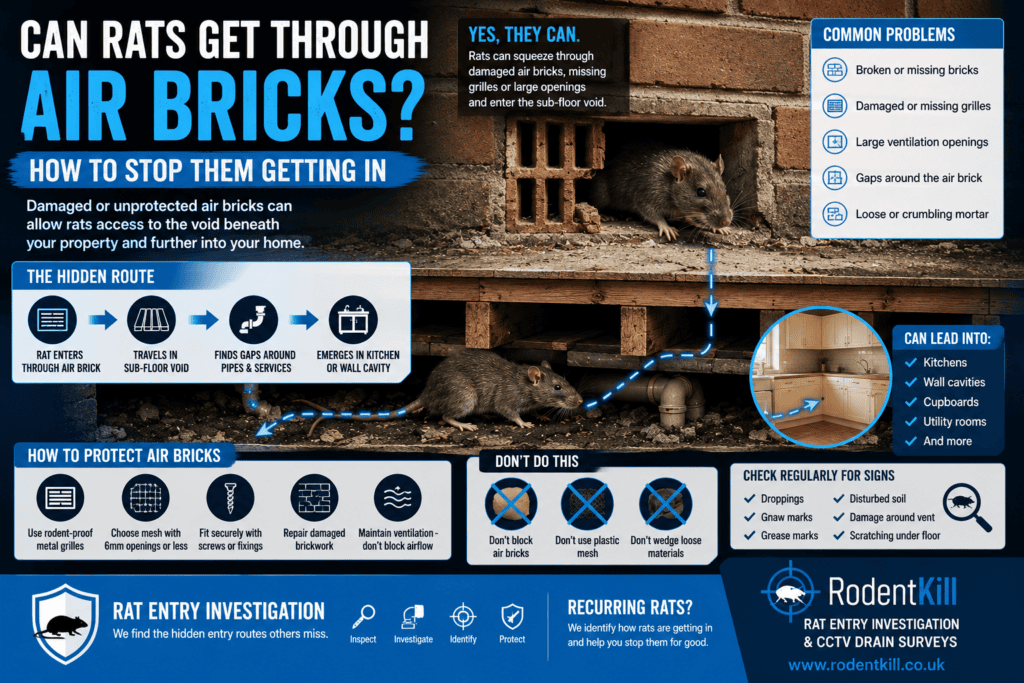
Can rats get through air bricks? If an air brick is damaged, has large enough openings or is inadequately protected, it may provide rats with access to the void beneath a property.
This can be particularly important in UK homes with suspended timber floors.
Once a rat gets beneath the floorboards, it may be able to travel through concealed areas of the building before appearing in a kitchen, wall cavity or another room.
However, there is an important point to remember: air bricks provide essential ventilation and should not simply be blocked.
The objective is to prevent rodent access while maintaining the airflow the building requires.
What Is an Air Brick?
An air brick is a ventilated brick, block or grille built into an external wall.
In many older UK properties, air bricks help ventilate the space beneath suspended timber floors.
This airflow is important because it helps control moisture beneath the building.
You will often find air bricks relatively close to ground level around the outside walls of older houses.
Unfortunately, their position also means they deserve attention during a rat entry investigation.
Can Rats Really Get Through Air Bricks?
Potentially, yes.
Whether a rat can get through depends on the design and condition of the air brick or vent.
Problems can include:
- Broken air bricks
- Missing sections
- Damaged grilles
- Large ventilation openings
- Previous poor repairs
- Gaps around the outside of the air brick
- Loose or deteriorated brickwork
A rat does not necessarily have to pass through the intended ventilation slots.
Damage around the vent may provide an easier route.
Why Are Air Bricks Important When Investigating Rats?
An air brick can potentially lead directly into the sub-floor void beneath a suspended timber floor.
This matters because the space beneath the floor may connect with several parts of the property.
Once underneath the house, a rat could potentially travel beneath:
- The lounge
- Dining rooms
- Hallways
- Kitchens
- Utility rooms
- Other ground-floor areas
It may then discover further openings around pipes, walls and services.
This means a rat entering through an air brick at the front of a house could potentially be heard beneath a room some distance away.
How Do I Know if Rats Are Using an Air Brick?
Look at the surrounding area for physical evidence.
Possible signs include:
- Droppings close to the vent
- Greasy marks around openings
- Gnaw damage
- Disturbed soil
- Damage to the air brick
- Loose mesh or grilles
- Tracks or repeated activity nearby
However, simply finding a damaged air brick does not prove that rats are using it.
The suspected entry point should fit with the wider pattern of evidence inside the property.
Can Rats Enter an Air Brick and Travel Under the Floor?
Yes, where the air brick provides access to a sub-floor void.
This can explain why homeowners hear scratching beneath floorboards without seeing rats inside their rooms.
The rat may remain almost entirely underneath the property.
It could then emerge elsewhere through a gap around pipework or another internal opening.
If you are hearing unexplained activity beneath your floor, read our guide to signs rats are living under your house.
Why Do I Hear Rats Far Away From the Air Brick?
Suspended floor voids can allow rats to travel beneath several rooms.
Sound can also travel through timber joists, pipes and other parts of the building.
Therefore, the place where scratching sounds loudest does not necessarily identify the entry point.
This is an important principle when investigating recurring rat problems:
Where you hear the rat is not necessarily where the rat entered.
Can Rats Get From Under the Floor Into the Kitchen?
Yes.
Kitchens contain numerous pipes and services passing through floors and walls.
If gaps have been left around these services, a rat beneath the property may potentially move into the concealed space behind kitchen units.
This is one reason kitchen rat activity can sometimes be connected with a problem elsewhere around the building.
If you are finding evidence around cupboards or appliances, see our guide to rats behind kitchen units.
Can Rats Get From Under the Floor Into Wall Cavities?
Potentially, yes.
Structural voids can sometimes connect with one another.
A possible route through a property could be:
Damaged air brick → sub-floor void → wall cavity → another part of the house.
This helps explain why some rat infestations appear to move between floors or different parts of a building.
Should I Block an Air Brick to Stop Rats?
No. Do not simply block an air brick.
The air brick is there for a reason.
Reducing or eliminating ventilation beneath a suspended floor can contribute to moisture problems.
Instead, the objective should be to prevent rodent access while allowing the vent to continue performing its intended function.
How Do You Rat-Proof an Air Brick?
The correct solution depends on the design and condition of the existing vent.
Options may include a suitable rodent-resistant grille or mesh that prevents access while maintaining adequate airflow.
Damaged brickwork or gaps around the vent may also need appropriate repair.
Any material used should be:
- Suitable for the location
- Securely fitted
- Resistant to gnawing
- Appropriate for external use
- Installed without unnecessarily restricting ventilation
Simply pushing temporary material into a hole is not the same as properly repairing and proofing the opening.
Can I Put Wire Mesh Over an Air Brick?
A suitable rodent-resistant metal mesh can sometimes be used to protect ventilation openings.
However, it needs to be securely fitted and appropriate for the size and design of the vent.
The installation should also avoid unnecessarily reducing airflow.
Plastic mesh may not provide the same resistance to gnawing as a suitable metal product.
Should I Use Expanding Foam Around an Air Brick?
Expanding foam on its own should not be relied upon as a robust rat-proofing material.
Rodents can damage relatively soft materials.
Foam can be useful in some building applications, but where rodent proofing is required, the repair needs to be physically resistant to gnawing.
Most importantly, do not fill the ventilation openings themselves with foam.
Should I Cover Every Air Brick on My House?
Not automatically.
Inspect each vent and consider its condition and purpose.
If suitable protection is required, it should be installed correctly while preserving the required ventilation.
You should also remember that an air brick may be only one of several potential entry points around a property.
Protecting the vents will not solve the infestation if rats are actually entering through damaged drainage, pipe penetrations or another structural opening.
What If My Air Bricks Are Already Protected?
Then the investigation needs to continue elsewhere.
Other possible routes can include:
- Gaps around pipes
- Openings around cables
- Damaged brickwork
- Door gaps
- Wall cavities
- Extensions
- Old building alterations
- Roofline defects
- Underground drainage defects
This is why finding the actual route matters more than simply proofing every opening that looks suspicious.
Could Rats Under the Floor Be Coming From the Drains Instead?
Yes. Air bricks are only one possible route into a sub-floor void.
Rats regularly travel through underground sewer and drainage systems.
If damaged drainage or an open connection allows a rat to leave the pipework beneath a property, it may potentially gain access to the same sub-floor area.
This can create very similar symptoms.
In both situations, you may hear scratching beneath the floor without seeing the rat.
The difference is the original entry point.
How Can You Tell Whether It Is the Air Brick or the Drain?
This is where investigation becomes important.
Evidence around external vents may suggest an air-brick route.
However, recurring activity with no convincing above-ground access point may justify looking deeper.
A proper investigation can consider:
- Air bricks and external vents
- Dropping locations
- Sub-floor activity
- Pipe penetrations
- Extensions
- Previous building alterations
- External structural defects
- Drainage where appropriate
Our Rat Entry Investigation is designed to investigate these difficult and recurring access problems.
When Is a CCTV Drain Survey Worth Considering?
A CCTV drain survey is not necessary simply because rats are heard beneath a floor.
However, it may become useful when:
- Rats repeatedly return after treatment
- Air bricks appear secure
- No convincing external entry point can be found
- The property has older drainage
- The house has been extended
- Previous building work altered the drainage layout
- Other evidence suggests an underground route
Where drainage is suspected, a CCTV drain survey for rat problems can inspect accessible underground pipework for defects and potential rat entry routes.
Why Do Rats Keep Coming Back After Air Bricks Are Covered?
If rat activity continues after suitable air-brick protection has been installed, another access route may exist.
This is an important clue.
Rather than repeatedly adding more proofing materials, the property should be assessed to establish where rats are actually entering.
Recurring infestations are often best approached as an investigation rather than a guessing exercise.
Can Rats Get Through Air Bricks? The Bottom Line
So, can rats get through air bricks?
They potentially can where an air brick, grille or surrounding brickwork provides a suitable opening.
This can give rats access to the concealed space beneath a suspended floor, from where they may travel to other parts of the property.
However, do not simply block ventilation openings.
Air bricks need to continue providing airflow while being appropriately protected against rodent access.
If your air bricks appear secure but rats continue to get underneath your property, another hidden route may be responsible.
That is when it is worth investigating the building rather than continuing to guess.
Book a Rat Entry Investigation with RodentKill
Frequently Asked Questions About Rats and Air Bricks
Can a rat fit through an air brick?
A damaged or unsuitable air brick can potentially provide a rat with access. Gaps around the vent can also be important, so the entire opening should be inspected.
Should air bricks be covered with mesh?
Suitable rodent-resistant protection can be used in some situations, provided it is securely installed and does not unnecessarily restrict the ventilation the air brick is designed to provide.
Can I completely block an air brick to stop rats?
No. Air bricks provide ventilation and should not simply be sealed. The aim is to prevent rodent access while maintaining appropriate airflow.
Can rats get under floorboards through air bricks?
Yes, where the vent connects with a sub-floor void and provides a sufficiently large access route.
Why can I hear rats under the floor when my air bricks are protected?
Another entry point may exist. Possible routes include structural openings, gaps around services or defects associated with underground drainage.
Does covering an air brick permanently solve a rat problem?
Only if the air brick was the actual entry route and any rats already present have been appropriately controlled. Other access points may still exist.
How do I find where rats are getting under my house?
Look at the entire pattern of evidence, including external openings, air bricks, pipework, droppings, noises, previous alterations and drainage where appropriate. Persistent problems may require a specialist rat entry investigation.