
Can Rats Come Up Through The Kitchen Floor
Rats behind kitchen units can be difficult to understand because the place where you find the rat may not be where it entered your home.
You may hear scratching behind cupboards at night, find droppings beneath the sink or notice activity behind appliances, yet see no obvious hole leading into the property.
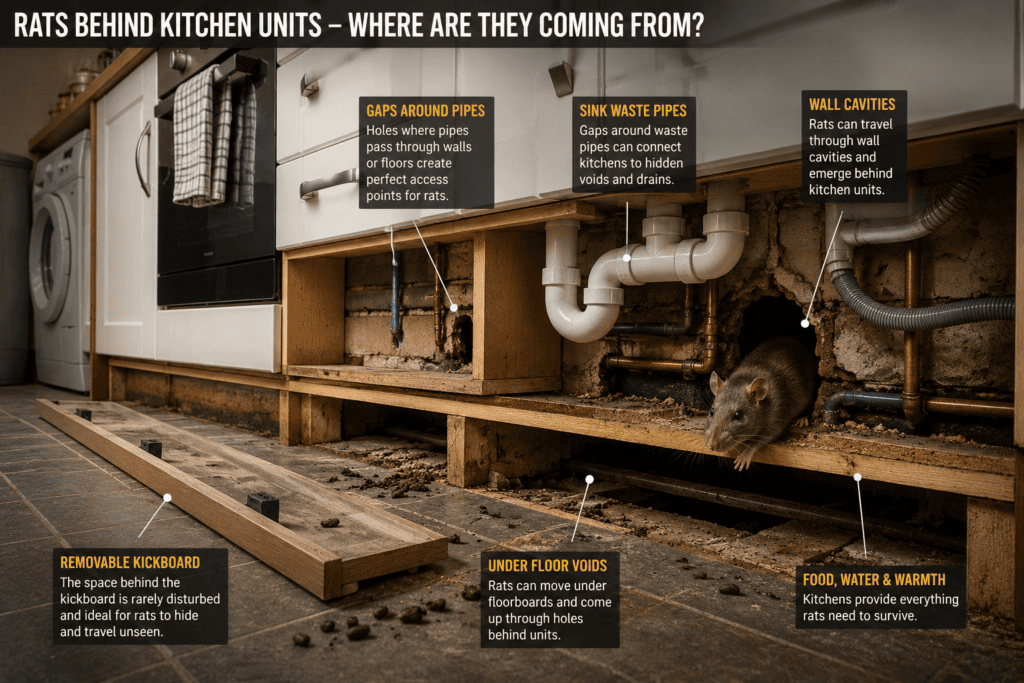
Fitted kitchens contain numerous concealed spaces. Rats may travel beneath floors, behind units, through wall cavities and around pipework before finally becoming noticeable in the kitchen.
The important question is therefore not simply:
How did the rat get behind my kitchen units?
It is also:
How did the rat get into the property in the first place?
Why Do Rats Hide Behind Kitchen Units?
Kitchens provide several things that can attract rat activity, including food, water, warmth and shelter.
Fitted kitchen units also create large concealed spaces that homeowners rarely see.
Once the plinth or kickboard is installed beneath the cupboards, rats may be able to move behind several units without crossing the visible kitchen floor.
Behind those units there may also be:
- Water pipes
- Sink waste pipes
- Dishwasher connections
- Washing-machine connections
- Electrical services
- Holes through walls
- Openings through floors
- Boxed-in pipework
These features can create routes between the kitchen and concealed parts of the building.
How Are Rats Getting Behind My Kitchen Units?
There are several possible routes.
Common possibilities include:
- Gaps around sink waste pipes
- Openings around water pipes
- Holes where services pass through walls
- Gaps through the kitchen floor
- Sub-floor voids
- Wall cavities
- Damaged or poorly protected air bricks
- External building defects
- Old or redundant pipework
- Routes associated with defective drainage
The difficult part is determining which route is actually being used.
A Rat Entry Investigation looks at the wider evidence to help establish how rats are entering and moving through the property.
Check Under the Kitchen Sink
The cupboard beneath the kitchen sink is one of the most useful places to inspect.
Waste and water pipes normally pass through the back or bottom of the cupboard. Sometimes the holes around these pipes are considerably larger than necessary.
Check for:
- Rat droppings
- Gnaw marks
- Greasy travel marks
- Disturbed stored items
- Damaged food packaging
- Gaps around pipework
- Openings through the back or base of the cupboard
A gap around a pipe may allow a rat to enter the cupboard from a concealed area.
However, it may only be the final part of the route rather than the original entry point into the house.
For a closer look at this particular problem, see Can Rats Get Into Your House Around Pipes?
Remove the Kitchen Plinth and Look Behind the Units
If it is safe and practical, removing a removable kitchen plinth or kickboard can reveal an area that is normally completely hidden.
Look for:
- Droppings
- Gnawing
- Shredded material
- Food debris
- Grease marks
- Gaps around services
- Holes through walls
- Openings through the floor
Try to look at the pattern of evidence rather than concentrating on a single hole.
For example, a concentration of droppings or travel marks near one end of the units may provide a useful clue about the direction from which the rat is approaching.
Can Rats Come Up Through the Floor Behind Kitchen Units?
Yes. This can be particularly relevant in properties with suspended timber floors.
If rats gain access to the void beneath the floorboards, they may travel beneath several rooms without being visible.
Kitchens contain numerous services that pass through the floor, giving rats possible opportunities to move upwards behind cupboards.
A route might look like this:
External entry point → sub-floor void → opening around pipework → behind kitchen units.
This is why a rat appearing in the kitchen does not necessarily mean that the original entry point is located there.
Why Am I Hearing Rats Beneath the Kitchen Floor?
Scratching, movement or gnawing beneath a kitchen floor can indicate activity within a concealed void.
However, sound alone cannot tell you exactly where the rat is located or where it entered.
Rats may travel beneath several rooms, while sound can also transfer through joists, pipes and other parts of the structure.
If unexplained noises are one of your main symptoms, see Scratching Under the Floor at Night – Rats or Mice?
Why Are There Rat Droppings Behind My Kitchen Units?
Droppings are useful evidence because they can help show where rats have been active.
Finding them behind units, beneath the sink or around appliances suggests that these concealed areas are being used.
However, droppings alone do not identify the original entry point.
If droppings are your main sign of activity, our guide Rat Droppings in the Kitchen but No Rat – What Does It Mean? explains what to look for next.
Could Rats Be Entering Through an Air Brick?
Possibly, particularly where an air brick provides ventilation to a suspended floor void.
If a suitable opening allows rats beneath the property, they may then travel under the floor before appearing behind kitchen units.
Air bricks should not simply be blocked because ventilation beneath suspended floors is important.
Read Can Rats Get Through Air Bricks? for more information about this particular entry route.
Could Rats Behind Kitchen Units Be Coming From a Wall Cavity?
Potentially.
Openings around services can sometimes connect the concealed space behind kitchen units with wall cavities or other structural voids.
A rat may therefore travel through part of the building before reaching the kitchen.
If you are also hearing scratching inside walls, see Rats in Wall Cavities – How Are They Getting In?
Could Rats Behind Kitchen Units Be Coming From the Drains?
Possibly, but this should not automatically be assumed.
Rats commonly travel through sewer and drainage systems. Normally, the pipework keeps them separated from the property.
A relevant drainage defect or open connection may, in some circumstances, provide a route out of the drainage system beneath or close to a building.
A rat could then potentially reach a sub-floor or another concealed area before appearing behind kitchen units.
However, structural openings, air bricks, pipe penetrations and other entry points also need to be considered.
If you are trying to determine whether drainage is involved, read Are Rats Coming From My Drains?
Why Can Kitchen Extensions Be Important?
Extensions can be particularly interesting when investigating unexplained rat activity in kitchens.
During previous building work, walls may have been removed, floors altered and drainage diverted or made redundant.
An area that is now inside the kitchen may once have contained an external drain, gully, waste connection or other service.
If an old route was not correctly dealt with during construction, it may remain hidden beneath the finished extension.
For more detail, see Rats After a House Extension – Where Are They Coming From?
Why Do Rats Keep Coming Back to My Kitchen?
Recurring activity can indicate that the underlying access route remains available.
Traps, bait or other pest-control measures may deal with rats that are currently present.
But removing a rat does not automatically close the route it used to enter.
This can produce a frustrating cycle:
Rat appears → treatment → activity stops → another rat eventually appears.
When this happens repeatedly, investigating the route into the property becomes increasingly important.
Should I Fill Holes Behind My Kitchen Units?
Rat proofing can be an important part of solving the problem, but avoid assuming that every visible hole is the original entry point.
For example, sealing a gap around a sink pipe may stop a rat entering that particular cupboard while leaving it free to travel beneath the floor.
It may then search for another route into the room.
Where possible, work out how the rat is reaching the concealed area before carrying out extensive proofing.
Do I Need to Remove My Kitchen Units?
Usually not as a first step.
Removing accessible plinths and inspecting beneath cupboards can provide useful evidence without dismantling the kitchen.
The investigation should follow the evidence.
Unnecessarily removing units, opening walls or lifting large areas of flooring can cause considerable disruption without necessarily revealing the original entry point.
When Should the Drains Be Checked?
Not every rat problem in a kitchen requires a drain survey.
However, investigating the drainage system may be appropriate when:
- Rats repeatedly return after treatment
- No convincing external entry point can be found
- Activity is occurring beneath the ground floor
- The kitchen is part of an extension
- The property has older drainage
- Previous alterations changed the drainage layout
- There is other evidence suggesting an underground route
Where drainage is genuinely suspected, a Professional Rat Drain Survey can inspect accessible underground pipework for relevant defects and potential rat access routes.
What If the Drains Are Fine?
Then the investigation should continue elsewhere.
A clear drain survey can itself be useful because it allows attention to move towards other possible routes.
These might include:
- Air bricks
- External service penetrations
- Gaps around pipework
- Wall cavities
- Sub-floor access points
- Damaged building fabric
- Openings associated with extensions
This is why RodentKill does not assume that every recurring rat problem originates from the drains.
How RodentKill Investigates Rats Behind Kitchen Units
The aim is not simply to find the rat that is currently in the kitchen.
We want to understand the route it used to get there.
Depending on the property and evidence available, an investigation may consider:
- Where droppings and other evidence are concentrated
- Areas behind kitchen units
- Pipe and service penetrations
- Sub-floor areas
- Wall cavities and structural openings
- External building defects
- Previous extensions or alterations
- The drainage system where appropriate
Working backwards from the evidence can help distinguish the place where a rat appears from the original route into the building.
Rats Behind Kitchen Units – Find the Original Entry Route
If rats are appearing behind your kitchen units, do not assume that the first hole you discover is necessarily the source of the infestation.
The rat may have travelled beneath the floor, through a wall cavity or along another concealed route before reaching the kitchen.
The long-term objective is to establish:
Where is the rat entering the building? How is it travelling through the property? Where is it emerging into the kitchen?
If rats keep returning despite previous pest control, RodentKill can investigate the property and help identify the underlying access route.
Enquire about a Rat Entry Investigation →
Frequently Asked Questions About Rats Behind Kitchen Units
Why have I got rats behind my kitchen units?
Kitchen units provide concealed spaces close to food, water and pipework. Rats may reach them from sub-floor voids, wall cavities, gaps around services or other hidden routes.
Can rats come up through the kitchen floor?
Yes. Rats that gain access beneath a suspended floor may travel underneath the property and emerge through suitable openings around pipes and other services.
Can rats get behind kitchen units through pipe holes?
Yes. Gaps around water, waste and other service pipes can potentially provide access from concealed areas. However, the pipe gap may only be part of the route rather than the original entry point.
Why are there rat droppings under my kitchen sink?
The sink cupboard contains several pipe penetrations and can connect with concealed areas behind units or beneath the floor. Droppings suggest activity in the area but do not by themselves identify the original entry route.
Do rats behind kitchen units mean my drains are damaged?
No. Drainage is one possible source, but rats can also enter through structural gaps, air bricks, pipe penetrations and other openings.
Should I remove my kitchen units to find a rat?
Usually not as a first step. Removing accessible kickboards can reveal useful evidence without dismantling the kitchen. More disruptive investigation should be guided by evidence.
Why do rats keep returning to my kitchen after pest control?
If the original access route remains open, controlling the rats currently present may only provide temporary relief. Other rats may eventually discover the same route.
Do I need a CCTV drain survey for rats in my kitchen?
Not automatically. A drain survey becomes more relevant where the evidence suggests a possible underground route, particularly with recurring problems, activity beneath floors, older drainage or previous extensions.