Cracked Drains and Rat Infestations
Cracked Drains and Rat Infestations: How Rats Get Into UK Homes
Cracked drains and rat infestations can be closely connected. If rats keep returning to your home despite baiting, trapping or previous pest control, a damaged underground drain could be providing a hidden entry route.
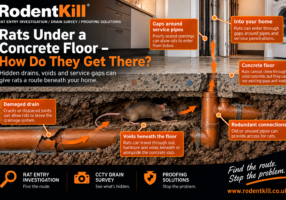
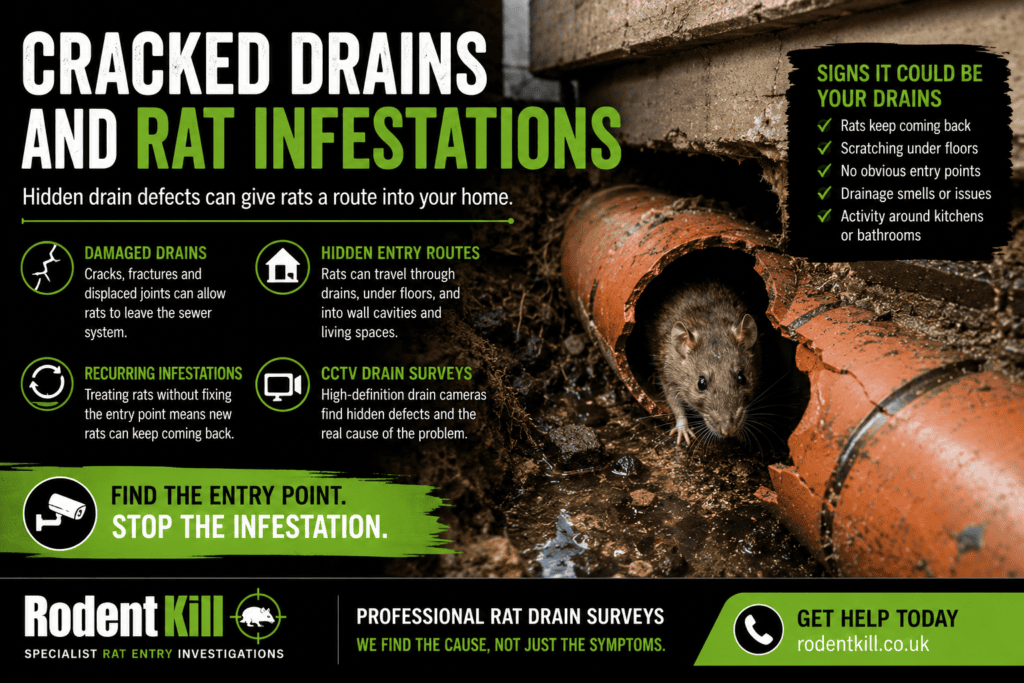
Rats commonly travel through sewer and drainage systems. Normally, the pipework keeps them separated from your property. However, when a drain cracks, fractures or becomes displaced, rats may be able to leave the drainage system and enter the surrounding ground.
From there, they can potentially reach voids beneath floors, wall cavities and other concealed areas of a building.
At RodentKill, we investigate recurring rat problems to find the underlying entry point rather than simply treating the rats that have already appeared.
This guide explains the connection between cracked drains and rat infestations, the warning signs to look for and how a CCTV rat drain survey can help identify the problem.
Can Cracked Drains Cause Rat Infestations?
Yes. A sufficiently damaged drain can potentially provide rats with a route out of the drainage system.
Rats do not necessarily need to chew through a sound drainage pipe. In many cases, they simply exploit damage that already exists.
Potential problems include:
- Cracked clay drains
- Fractured pipes
- Displaced joints
- Open pipe connections
- Collapsed drainage
- Root-damaged drains
- Poor previous repairs
A small defect may gradually become more serious as water escapes and surrounding soil is washed away.
If a rat travelling through the drain discovers the opening, it may investigate the surrounding void.
How Cracked Drains and Rat Infestations Are Connected
Understanding cracked drains and rat infestations means looking at the complete route a rat may take.
A typical drainage-related entry route could be:
- A rat travels through the underground sewer or drainage system.
- It reaches a crack, fracture or displaced joint.
- The rat leaves the pipe through the defect.
- It enters the soil or a void surrounding the drain.
- The rat moves towards or beneath the building.
- It finds another opening into a floor void or wall cavity.
- The rat eventually reaches the occupied part of the property.
This is why homeowners can struggle to find an obvious hole around the outside of the building.
The original entry point may be underground and completely invisible from the surface.
Why Do Underground Drains Crack?
Drainage pipes are designed to last for many years, but underground conditions can change.
Common causes of cracked or fractured drains include:
- Ground movement
- Natural ageing
- Tree root pressure
- Heavy vehicle loading
- Poor installation
- Building work
- Excavation damage
- Ground settlement
Older clay drainage systems can be particularly vulnerable because they are constructed from multiple individual pipe sections and joints.
Why Cracked Clay Drains Can Be a Rat Entry Risk
Vitrified clay drainage is still common around older UK properties.
Clay itself is a durable material, but older systems contain numerous joints. After decades underground, movement can cause pipes to crack or individual sections to become displaced.
Wastewater may continue to flow normally even when a significant defect is present.
This means a homeowner may have no obvious drainage symptoms while a structural opening exists beneath the property.
For a rat travelling through the drainage system, that opening can provide an opportunity to escape from the pipe.
Can Rats Squeeze Through Cracks in Drains?
Rats can squeeze through surprisingly restricted openings, but not every hairline crack in a drain is large enough to allow a rat through.
The concern is normally a more substantial fracture, missing section, open joint or crack that has deteriorated over time.
Escaping wastewater can wash fine material away from the outside of a damaged pipe. This may gradually enlarge the surrounding void.
As a result, the visible defect inside the pipe may only be part of the problem.
Displaced Drain Joints and Rat Problems
A cracked pipe is not the only drainage defect that can allow rats to escape.
Displaced joints are another important problem, particularly with older clay drainage.
A displaced joint occurs when adjoining pipe sections move out of their original alignment.
This can create a gap between the pipes.
The drain may continue functioning, but the gap can potentially allow:
- Wastewater to escape
- Soil to enter the drain
- Tree roots to penetrate the pipe
- Rats to leave the drainage system
During a specialist rat investigation, these joints can be particularly significant.
Can a Cracked Drain Let Rats Under the House?
Yes. This can be one of the most important consequences of a drainage defect beneath or close to a building.
A rat does not necessarily need the cracked drain to lead directly into a room.
It may only need the defect to provide access to the ground beneath the property.
Once underneath the building, rats may travel through:
- Suspended floor voids
- Wall cavities
- Service ducts
- Pipe penetrations
- Boxed-in services
- Gaps around utility pipes
This can explain why rats are sometimes heard beneath floors before they are ever seen.
Signs a Cracked Drain May Be Causing Your Rat Problem
Not every rat infestation is caused by damaged drainage. However, certain signs can make a drainage investigation worthwhile.
Rats Keep Coming Back
Recurring infestations are one of the biggest warning signs.
The rats are treated, the property becomes quiet and then activity returns several weeks or months later.
If this keeps happening, a permanent entry route may still be open.
Scratching Beneath the Floor
Scratching, gnawing or movement beneath ground-floor rooms can indicate rats are travelling through an underfloor void.
Drainage defects should be considered where there is no obvious external route into that void.
No External Entry Point Can Be Found
Doors, air bricks, vents and service penetrations may all appear secure.
If rats continue appearing despite this, the access route could be underground.
Recurring Drain Blockages
Repeated blockages can sometimes indicate a structural drainage problem.
Cracks, displaced joints, root ingress and collapsed sections can all affect the normal operation of a drain.
Foul Drain Smells
Persistent foul smells can sometimes accompany defective drainage, although smells alone do not prove that a rat entry route exists.
Rats Appear Around Kitchens or Bathrooms
Kitchens, bathrooms and utility rooms contain multiple waste and soil pipe connections.
Unexplained rat activity around these areas can justify investigating the drainage system.
Can Cracked Drains Cause Rats Under Floorboards?
Potentially, yes.
If a damaged drain allows rats to leave the pipe beneath or close to a building, they may gain access to the underfloor area.
Once inside a suspended floor void, rats can travel considerable distances without being seen.
Common signs include:
- Scratching beneath floorboards
- Gnawing sounds
- Activity at night
- Droppings appearing in cupboards
- Rats emerging behind kitchen units
The location where a rat finally appears may be some distance from the original drain defect.
Why Poison Alone May Not Solve a Drain Rat Problem
Rodenticides and traps can be useful for controlling rats already inside a property.
However, they cannot repair cracked drainage.
Consider a property with a broken drain beneath the kitchen.
A rat leaves the pipe, enters the floor void and eventually reaches the kitchen. Pest control removes that rat and activity stops.
But the crack remains open.
Another rat travelling through the drainage system may eventually discover the same route.
The result can become:
Rat infestation → pest control → quiet period → reinfestation → more pest control.
Finding and correcting the entry route can be essential to breaking that cycle.
How Do You Find a Cracked Drain?
Because underground drainage cannot normally be inspected from the surface, CCTV equipment can be used to examine accessible pipework internally.
A specialist drain camera is passed through the drainage system while the condition of the pipe is viewed on a monitor.
CCTV inspection can help identify:
- Cracks
- Fractures
- Displaced joints
- Open connections
- Collapsed sections
- Root ingress
- Structural deterioration
- Poor previous repairs
Where appropriate equipment is available, electronic locating can also help establish the position of a defect from above ground.
How a Rat Drain Survey Can Find Cracked Drains
A professional rat drain survey looks at drainage defects specifically from the perspective of rodent entry.
This is important because finding a crack does not automatically mean it is responsible for the infestation.
The defect needs to be considered alongside:
- Its size
- Its position
- The drainage layout
- The construction of the property
- Where rats are being heard or seen
- Other possible entry routes
The objective is to determine whether the defect provides a credible route from the drainage system into the building.
What Happens If a Cracked Drain Is Found?
The appropriate repair depends on the type, size and location of the damage.
Possible solutions can include:
- Local excavation and pipe replacement
- Drain patch repairs
- Drain relining
- Joint repairs
- Replacement of collapsed sections
- Sealing redundant connections
- Repairing damaged inspection chambers
Once the drainage entry route has been corrected, other rat access points around the property may also need proofing.
Can Cracked Drains Be Repaired Without Digging?
Sometimes.
Certain drainage defects can be repaired internally using patch lining or drain relining techniques.
A liner or local patch can be installed inside the existing pipe to cover the damaged section.
This can reduce the need for excavation in suitable situations.
However, relining is not suitable for every problem.
A badly collapsed or severely displaced drain may still require excavation and replacement.
Will Repairing a Cracked Drain Stop Rats?
If the cracked drain is confirmed as the route rats are using to leave the drainage system, repairing it can form an important part of the long-term solution.
However, the complete infestation still needs to be considered.
There may already be rats inside the property, and additional entry points may exist elsewhere.
A successful approach may therefore involve:
- Identifying the drainage defect
- Controlling rats already present
- Repairing the damaged drain
- Proofing additional building entry points
- Monitoring for further activity
Will a Rat Flap Help With Cracked Drains and Rat Infestations?
A rat flap or suitable non-return device can sometimes prevent rats travelling from the public sewer into private drainage.
However, it should not be treated as a replacement for repairing damaged pipework.
If the cracked drain is beneath the property and rats are already able to reach it from another section of the drainage system, installing a device in the wrong location may not solve the problem.
The drainage layout should therefore be understood before deciding whether a rat prevention device is appropriate.
When Should You Investigate Cracked Drains and Rat Infestations?
You should consider investigating the drainage system if:
- Rats repeatedly return after treatment
- You hear rats beneath floors
- No obvious external entry point can be found
- Your property has older clay drainage
- You experience repeated drain blockages
- There are persistent drainage smells
- The property has been extended or altered
- Previous rat proofing has failed
If it is unclear whether drainage is responsible, our rat entry investigation looks more broadly at potential access routes around the property.
Cracked Drains and Rat Infestations: Find the Entry Point
Cracked drains and rat infestations can become a repeating problem when the underground access route is never identified.
Baiting and trapping may control the rats already inside, but they cannot repair a broken pipe.
If rats keep returning, a CCTV inspection can help determine whether cracked drains, displaced joints, redundant connections or other underground defects are contributing to the infestation.
At RodentKill, we specialise in investigating difficult and recurring rat problems.
Our professional rat drain survey service can investigate accessible drainage for hidden defects and potential rat entry routes.
If you do not yet know whether your drains are responsible, our rat entry investigation service provides a wider investigation of the property.
Rats keep coming back? Find the entry route rather than simply treating the next rat.
Frequently Asked Questions About Cracked Drains and Rats
Can cracked drains cause rat infestations?
Yes. A sufficiently large crack or fracture can potentially allow rats travelling through drainage to leave the pipe and enter surrounding soil or a void beneath a building.
Can rats get through small cracks in drains?
Not every small crack will allow a rat through. The main concern is where cracking has developed into a larger fracture, opening or structural defect that provides sufficient access.
How do I know if rats are coming from a cracked drain?
Recurring infestations, activity beneath floors, drainage problems and the absence of an obvious external entry point can justify a CCTV drain investigation.
Can a CCTV drain survey find cracked pipes?
Yes. CCTV equipment can identify visible cracks, fractures, displaced joints, collapsed sections and other defects within accessible drainage pipework.
Can a cracked drain cause rats under the floor?
Yes. If a damaged drain allows rats to leave the pipe beneath or close to the building, they may gain access to an underfloor void.
Will poison solve rats coming from a cracked drain?
Poison may control rats already present, but it will not repair the drainage defect. If the route remains open, further rats may potentially enter later.
Will repairing a cracked drain stop rats coming back?
If the damaged drain is confirmed as the entry route, repairing it can be an important part of preventing further access. Existing rats and any additional building defects should also be addressed.
Cracked Drains and Rat Infestations: How Rats Get Into UK Homes
Cracked drains and rat infestations can be closely connected. If rats keep returning to your home despite baiting, trapping or previous pest control, a damaged underground drain could be providing a hidden entry route.
Rats commonly travel through sewer and drainage systems. Normally, the pipework keeps them separated from your property. However, when a drain cracks, fractures or becomes displaced, rats may be able to leave the drainage system and enter the surrounding ground.
From there, they can potentially reach voids beneath floors, wall cavities and other concealed areas of a building.
At RodentKill, we investigate recurring rat problems to find the underlying entry point rather than simply treating the rats that have already appeared.
This guide explains the connection between cracked drains and rat infestations, the warning signs to look for and how a CCTV rat drain survey can help identify the problem.
Can Cracked Drains Cause Rat Infestations?
Yes. A sufficiently damaged drain can potentially provide rats with a route out of the drainage system.
Rats do not necessarily need to chew through a sound drainage pipe. In many cases, they simply exploit damage that already exists.
Potential problems include:
- Cracked clay drains
- Fractured pipes
- Displaced joints
- Open pipe connections
- Collapsed drainage
- Root-damaged drains
- Poor previous repairs
A small defect may gradually become more serious as water escapes and surrounding soil is washed away.
If a rat travelling through the drain discovers the opening, it may investigate the surrounding void.
How Cracked Drains and Rat Infestations Are Connected
Understanding cracked drains and rat infestations means looking at the complete route a rat may take.
A typical drainage-related entry route could be:
- A rat travels through the underground sewer or drainage system.
- It reaches a crack, fracture or displaced joint.
- The rat leaves the pipe through the defect.
- It enters the soil or a void surrounding the drain.
- The rat moves towards or beneath the building.
- It finds another opening into a floor void or wall cavity.
- The rat eventually reaches the occupied part of the property.
This is why homeowners can struggle to find an obvious hole around the outside of the building.
The original entry point may be underground and completely invisible from the surface.
Why Do Underground Drains Crack?
Drainage pipes are designed to last for many years, but underground conditions can change.
Common causes of cracked or fractured drains include:
- Ground movement
- Natural ageing
- Tree root pressure
- Heavy vehicle loading
- Poor installation
- Building work
- Excavation damage
- Ground settlement
Older clay drainage systems can be particularly vulnerable because they are constructed from multiple individual pipe sections and joints.
Why Cracked Clay Drains Can Be a Rat Entry Risk
Vitrified clay drainage is still common around older UK properties.
Clay itself is a durable material, but older systems contain numerous joints. After decades underground, movement can cause pipes to crack or individual sections to become displaced.
Wastewater may continue to flow normally even when a significant defect is present.
This means a homeowner may have no obvious drainage symptoms while a structural opening exists beneath the property.
For a rat travelling through the drainage system, that opening can provide an opportunity to escape from the pipe.
Can Rats Squeeze Through Cracks in Drains?
Rats can squeeze through surprisingly restricted openings, but not every hairline crack in a drain is large enough to allow a rat through.
The concern is normally a more substantial fracture, missing section, open joint or crack that has deteriorated over time.
Escaping wastewater can wash fine material away from the outside of a damaged pipe. This may gradually enlarge the surrounding void.
As a result, the visible defect inside the pipe may only be part of the problem.
Displaced Drain Joints and Rat Problems
A cracked pipe is not the only drainage defect that can allow rats to escape.
Displaced joints are another important problem, particularly with older clay drainage.
A displaced joint occurs when adjoining pipe sections move out of their original alignment.
This can create a gap between the pipes.
The drain may continue functioning, but the gap can potentially allow:
- Wastewater to escape
- Soil to enter the drain
- Tree roots to penetrate the pipe
- Rats to leave the drainage system
During a specialist rat investigation, these joints can be particularly significant.
Can a Cracked Drain Let Rats Under the House?
Yes. This can be one of the most important consequences of a drainage defect beneath or close to a building.
A rat does not necessarily need the cracked drain to lead directly into a room.
It may only need the defect to provide access to the ground beneath the property.
Once underneath the building, rats may travel through:
- Suspended floor voids
- Wall cavities
- Service ducts
- Pipe penetrations
- Boxed-in services
- Gaps around utility pipes
This can explain why rats are sometimes heard beneath floors before they are ever seen.
Signs a Cracked Drain May Be Causing Your Rat Problem
Not every rat infestation is caused by damaged drainage. However, certain signs can make a drainage investigation worthwhile.
Rats Keep Coming Back
Recurring infestations are one of the biggest warning signs.
The rats are treated, the property becomes quiet and then activity returns several weeks or months later.
If this keeps happening, a permanent entry route may still be open.
Scratching Beneath the Floor
Scratching, gnawing or movement beneath ground-floor rooms can indicate rats are travelling through an underfloor void.
Drainage defects should be considered where there is no obvious external route into that void.
No External Entry Point Can Be Found
Doors, air bricks, vents and service penetrations may all appear secure.
If rats continue appearing despite this, the access route could be underground.
Recurring Drain Blockages
Repeated blockages can sometimes indicate a structural drainage problem.
Cracks, displaced joints, root ingress and collapsed sections can all affect the normal operation of a drain.
Foul Drain Smells
Persistent foul smells can sometimes accompany defective drainage, although smells alone do not prove that a rat entry route exists.
Rats Appear Around Kitchens or Bathrooms
Kitchens, bathrooms and utility rooms contain multiple waste and soil pipe connections.
Unexplained rat activity around these areas can justify investigating the drainage system.
Can Cracked Drains Cause Rats Under Floorboards?
Potentially, yes.
If a damaged drain allows rats to leave the pipe beneath or close to a building, they may gain access to the underfloor area.
Once inside a suspended floor void, rats can travel considerable distances without being seen.
Common signs include:
- Scratching beneath floorboards
- Gnawing sounds
- Activity at night
- Droppings appearing in cupboards
- Rats emerging behind kitchen units
The location where a rat finally appears may be some distance from the original drain defect.
Why Poison Alone May Not Solve a Drain Rat Problem
Rodenticides and traps can be useful for controlling rats already inside a property.
However, they cannot repair cracked drainage.
Consider a property with a broken drain beneath the kitchen.
A rat leaves the pipe, enters the floor void and eventually reaches the kitchen. Pest control removes that rat and activity stops.
But the crack remains open.
Another rat travelling through the drainage system may eventually discover the same route.
The result can become:
Rat infestation → pest control → quiet period → reinfestation → more pest control.
Finding and correcting the entry route can be essential to breaking that cycle.
How Do You Find a Cracked Drain?
Because underground drainage cannot normally be inspected from the surface, CCTV equipment can be used to examine accessible pipework internally.
A specialist drain camera is passed through the drainage system while the condition of the pipe is viewed on a monitor.
CCTV inspection can help identify:
- Cracks
- Fractures
- Displaced joints
- Open connections
- Collapsed sections
- Root ingress
- Structural deterioration
- Poor previous repairs
Where appropriate equipment is available, electronic locating can also help establish the position of a defect from above ground.
How a Rat Drain Survey Can Find Cracked Drains
A professional rat drain survey looks at drainage defects specifically from the perspective of rodent entry.
This is important because finding a crack does not automatically mean it is responsible for the infestation.
The defect needs to be considered alongside:
- Its size
- Its position
- The drainage layout
- The construction of the property
- Where rats are being heard or seen
- Other possible entry routes
The objective is to determine whether the defect provides a credible route from the drainage system into the building.
What Happens If a Cracked Drain Is Found?
The appropriate repair depends on the type, size and location of the damage.
Possible solutions can include:
- Local excavation and pipe replacement
- Drain patch repairs
- Drain relining
- Joint repairs
- Replacement of collapsed sections
- Sealing redundant connections
- Repairing damaged inspection chambers
Once the drainage entry route has been corrected, other rat access points around the property may also need proofing.
Can Cracked Drains Be Repaired Without Digging?
Sometimes.
Certain drainage defects can be repaired internally using patch lining or drain relining techniques.
A liner or local patch can be installed inside the existing pipe to cover the damaged section.
This can reduce the need for excavation in suitable situations.
However, relining is not suitable for every problem.
A badly collapsed or severely displaced drain may still require excavation and replacement.
Will Repairing a Cracked Drain Stop Rats?
If the cracked drain is confirmed as the route rats are using to leave the drainage system, repairing it can form an important part of the long-term solution.
However, the complete infestation still needs to be considered.
There may already be rats inside the property, and additional entry points may exist elsewhere.
A successful approach may therefore involve:
- Identifying the drainage defect
- Controlling rats already present
- Repairing the damaged drain
- Proofing additional building entry points
- Monitoring for further activity
Will a Rat Flap Help With Cracked Drains and Rat Infestations?
A rat flap or suitable non-return device can sometimes prevent rats travelling from the public sewer into private drainage.
However, it should not be treated as a replacement for repairing damaged pipework.
If the cracked drain is beneath the property and rats are already able to reach it from another section of the drainage system, installing a device in the wrong location may not solve the problem.
The drainage layout should therefore be understood before deciding whether a rat prevention device is appropriate.
When Should You Investigate Cracked Drains and Rat Infestations?
You should consider investigating the drainage system if:
- Rats repeatedly return after treatment
- You hear rats beneath floors
- No obvious external entry point can be found
- Your property has older clay drainage
- You experience repeated drain blockages
- There are persistent drainage smells
- The property has been extended or altered
- Previous rat proofing has failed
If it is unclear whether drainage is responsible, our rat entry investigation looks more broadly at potential access routes around the property.
Cracked Drains and Rat Infestations: Find the Entry Point
Cracked drains and rat infestations can become a repeating problem when the underground access route is never identified.
Baiting and trapping may control the rats already inside, but they cannot repair a broken pipe.
If rats keep returning, a CCTV inspection can help determine whether cracked drains, displaced joints, redundant connections or other underground defects are contributing to the infestation.
At RodentKill, we specialise in investigating difficult and recurring rat problems.
Our professional rat drain survey service can investigate accessible drainage for hidden defects and potential rat entry routes.
If you do not yet know whether your drains are responsible, our rat entry investigation service provides a wider investigation of the property.
Rats keep coming back? Find the entry route rather than simply treating the next rat.
Frequently Asked Questions About Cracked Drains and Rats
Can cracked drains cause rat infestations?
Yes. A sufficiently large crack or fracture can potentially allow rats travelling through drainage to leave the pipe and enter surrounding soil or a void beneath a building.
Can rats get through small cracks in drains?
Not every small crack will allow a rat through. The main concern is where cracking has developed into a larger fracture, opening or structural defect that provides sufficient access.
How do I know if rats are coming from a cracked drain?
Recurring infestations, activity beneath floors, drainage problems and the absence of an obvious external entry point can justify a CCTV drain investigation.
Can a CCTV drain survey find cracked pipes?
Yes. CCTV equipment can identify visible cracks, fractures, displaced joints, collapsed sections and other defects within accessible drainage pipework.
Can a cracked drain cause rats under the floor?
Yes. If a damaged drain allows rats to leave the pipe beneath or close to the building, they may gain access to an underfloor void.
Will poison solve rats coming from a cracked drain?
Poison may control rats already present, but it will not repair the drainage defect. If the route remains open, further rats may potentially enter later.
Will repairing a cracked drain stop rats coming back?
If the damaged drain is confirmed as the entry route, repairing it can be an important part of preventing further access. Existing rats and any additional building defects should also be addressed.