Why Do Rats Keep Coming Back After Pest Control
Why Do Rats Keep Coming Back After Pest Control?
You had a rat problem. Pest control was carried out. The scratching stopped, the droppings disappeared and everything seemed fine.
Then, a few weeks or months later, the rats came back.
It is an extremely frustrating situation, particularly if you have already paid for one or more pest control treatments.
But there is an important point to understand.
If rats keep coming back after pest control, the problem may not simply be the rats. It may be the route they are using to enter your property.
Killing or trapping rats already inside a building can control the immediate infestation. However, if a hidden access point remains open, another rat may eventually use the same route.
This is why difficult recurring infestations sometimes require a different approach.
Instead of simply asking, “How do we get rid of the rats?”, it can be more useful to ask:
“How are the rats getting into the building in the first place?”
RodentKill offers a specialist Rat Entry Investigation service designed specifically to investigate possible hidden entry routes and help establish why rats are repeatedly getting inside.
Why Do Rats Keep Coming Back After Pest Control?
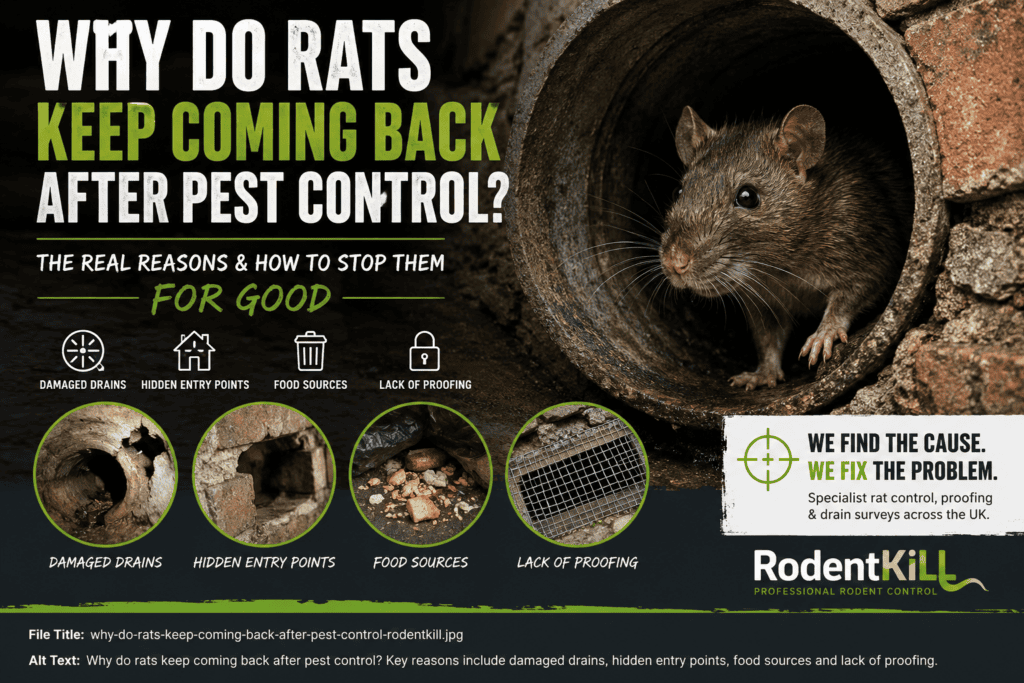
There are several reasons why rat activity can return after treatment.
The original infestation may not have been completely eliminated. Food, water or shelter around the property may continue to attract rats. There may also be an established population nearby.
However, where treatment initially appears successful and rats later reappear inside the building, an unresolved entry route should also be considered.
Rats are highly adaptable animals. They can burrow, climb, travel through sewer systems and exploit defects within buildings.
Potential access routes can include:
- Damaged or defective drains
- Redundant drain connections
- Gaps around waste and soil pipes
- Damaged air bricks
- Service ducts
- Wall cavities
- Sub-floor voids
- Openings around utility services
- Poorly sealed building alterations
- Old drainage beneath extensions
- Gaps around doors and external structures
The important point is that where you see or hear a rat is not necessarily where it entered the building.
Pest Control Can Remove the Rat Without Removing the Entry Route
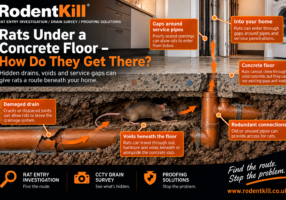
Imagine a rat has discovered a route from defective drainage beneath a property into a sub-floor void.
From there, it moves into a wall cavity before eventually appearing behind the kitchen units.
A professional baiting or trapping programme may successfully remove that rat.
But consider what happens if the original route remains:
Sewer → drainage defect → sub-floor void → wall cavity → kitchen
The immediate infestation may have been controlled, but the pathway into the building is still available.
Another rat could potentially discover the same route later.
This can create the impression that pest control has repeatedly “failed”, when the real issue is that an underlying structural or drainage access point has not yet been identified.
Can Rats Enter Houses Through Drains?
Yes. Brown rats are strongly associated with drains and sewer systems and can use these networks to move between locations.
Problems can occur where defects or redundant connections provide a route from the drainage system towards the structure of a building.
Potential drainage issues can include:
- Cracked pipes
- Displaced joints
- Damaged inspection chambers
- Redundant drainage connections
- Open-ended pipework
- Poorly sealed historical alterations
- Defective junctions
- Old drains beneath extensions
However, not every recurring rat infestation originates from the drains.
This is why immediately carrying out a drain survey is not necessarily the correct approach for every property.
The evidence should be considered first.
If drainage appears to be the likely source, RodentKill can then carry out a Professional Rat Drain Survey to investigate the drainage system in more detail.
Signs You May Have a Hidden Rat Entry Point
Some recurring rat problems are particularly suggestive of an unresolved access route.
Rats Return After Apparently Successful Treatment
If rat activity disappears completely following treatment but later returns, it is worth investigating whether rats have an ongoing route into the property.
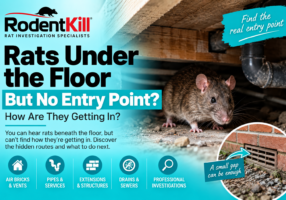
Scratching Beneath the Floor
Movement beneath ground floors can sometimes indicate activity within sub-floor voids or around drainage and service penetrations.
Rats Are Heard Inside Walls
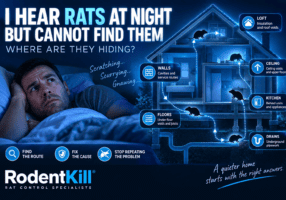
Rats can move through concealed areas of a building.
Hearing scratching inside one wall does not necessarily mean the rat entered immediately behind that wall.
There Is No Obvious Hole
Some of the most difficult rat infestations involve concealed entry routes.
The access point may be beneath flooring, behind kitchen units, around service pipes, within a cavity or connected with the drainage system.
You Have Already Had Several Pest Control Treatments
If baiting or trapping repeatedly provides temporary relief but rats continue returning, simply repeating the same treatment may not address the underlying cause.
This is when a specialist Rat Entry Investigation can become particularly useful.
What Is a Rat Entry Investigation?
A Rat Entry Investigation looks at the infestation from a different perspective.
Rather than concentrating solely on removing rats currently inside the property, the objective is to investigate how rats may be entering and moving through the building.
Depending on the property and the evidence available, an investigation may consider:
- External building defects
- Pipe and utility penetrations
- Air bricks and ventilation openings
- Sub-floor areas
- Likely rat movement routes
- Drainage chambers
- Accessible drainage
- Extensions and previous building alterations
- Droppings and other evidence of activity
- Gnawing and grease marks
- Possible access between drainage and building voids
The history of the infestation can also provide important clues.
Questions may include:
- Where was the first rat seen?
- Where are scratching noises heard?
- Where are droppings appearing?
- Has pest control previously been carried out?
- How long did the previous treatment appear to work?
- Has the property been extended?
- Have kitchens or bathrooms been relocated?
- Are there old or redundant drains?
Each piece of evidence helps build a clearer picture of how rats may be gaining access.
Rat Entry Investigation vs Rat Drain Survey
These two RodentKill services are related, but they have different purposes.
Rat Entry Investigation
The main question is:
“How are rats getting into my property?”
The investigation considers the wider building, the history of the infestation, evidence of rat movement and possible structural and drainage routes.
Learn more about our Rat Entry Investigation service.
Professional Rat Drain Survey
The main question is:
“Could rats be using my drainage system to reach the property?”
CCTV equipment can be used to inspect accessible drainage internally and look for defects, redundant connections and other potential problems.
Learn more about our Professional Rat Drain Surveys.
For difficult recurring infestations, these two approaches can complement each other.
Why Filling the First Hole You Find May Not Solve the Problem
Rat proofing is an important part of long-term rat control, but it needs to be carried out intelligently.
Finding one hole does not necessarily mean you have found the main entry route.
There may be additional openings elsewhere, or the primary route may be concealed underground.
This can be particularly relevant in older UK properties that have been altered numerous times.
A property may have had:
- An extension
- A conservatory
- A new kitchen
- A downstairs toilet
- Drainage alterations
- Old external walls incorporated into the building
- Redundant waste pipes
- Changes to underground drainage
Every alteration has the potential to change how the building and drainage systems fit together.
This can create unusual rat entry routes that may not be obvious during a standard pest control treatment.
How CCTV Drain Surveys Can Help With Recurring Rat Problems
Where evidence suggests that the drainage system could be involved, CCTV inspection can be extremely useful.
A specialist drain camera can be passed through accessible drainage to examine sections of pipework that cannot otherwise be seen.
When investigating rats, the objective is not simply to determine whether a drain flows correctly.
We are particularly interested in defects or configurations that could potentially provide rats with a route towards the building.
These can include:
- Redundant connections
- Displaced pipe joints
- Damaged pipework
- Open connections
- Unusual drainage configurations
- Potential routes beneath the building
Rat-related drainage investigation is a specialist area because understanding the drainage system needs to be combined with an understanding of rat behaviour.
Can Rat Flaps and Drain Barriers Stop Rats?
In suitable circumstances, a correctly selected rat barrier or one-way device may form part of a solution.
However, a rat flap should not automatically be installed simply because rats have appeared inside a property.
The drainage layout and suspected route need to be understood first.
In some cases a barrier may be appropriate.
In others, repairing a drainage defect, sealing a redundant connection or carrying out structural proofing may provide a better long-term solution.
A rat barrier is a tool. It is not a substitute for finding out how the rats are getting in.
Who Is Responsible for Damaged Drains?
Responsibility depends on the location and type of drainage.
In England and Wales, drains serving an individual property within its boundary are generally the responsibility of the property owner or landlord. Public sewers and many lateral drains are normally the responsibility of the sewerage company.
More information is available from Ofwat's guidance on public and private sewers.
Stop Treating the Symptom and Start Investigating the Cause
If this is the first time you have experienced a rat problem, conventional professional rat control may be exactly what is required.
But if you are on treatment number three, four or five and rats continue appearing inside the same property, it may be time to approach the problem differently.
The objective becomes:
- Find the likely entry route.
- Understand why rats can access it.
- Correct the defect where possible.
- Prevent rats from repeatedly using the same route.
This root-cause approach is the thinking behind RodentKill's specialist rat investigation service.
Rats Keep Coming Back? RodentKill Can Investigate Why
If you have already had pest control but rats continue returning, it may be worth investigating the property for hidden access routes.
Our Rat Entry Investigation service looks beyond the immediate infestation to help establish how rats may be getting into your property.
Where drainage is suspected, we can also investigate the system further with a Professional Rat Drain Survey.
Contact RodentKill to discuss your recurring rat problem and the most appropriate investigation.
Frequently Asked Questions
Why do rats keep coming back after pest control?
There can be several causes. One possibility is that rats have an unresolved route into the building. Treatment may remove rats currently present without necessarily preventing another rat from entering later.
Does this mean my previous pest controller did a bad job?
Not necessarily. A treatment may successfully control the rats present while a concealed structural or drainage defect remains undiscovered.
How do I find where rats are getting into my house?
Start by examining the pattern of activity and likely structural access points. Where the route is not obvious or rats repeatedly return, a professional Rat Entry Investigation can investigate the problem in more detail.
Can rats get into houses from drains?
Yes. Rats commonly inhabit sewer systems, and faulty drains, open connections and other defects can potentially provide routes towards buildings.
Should I have a CCTV drain survey for rats?
If the evidence suggests drainage involvement, CCTV inspection can help examine hidden sections of the drainage system. However, not every recurring rat problem originates from drains, which is why establishing the likely route first can be valuable.
Will sealing an entry point permanently solve a rat problem?
It depends on whether the correct route and any additional access points have been identified. Effective long-term control can require a combination of rat treatment, proofing, drainage repairs and removing sources of food and harbourage.
What is the difference between rat control and a rat entry investigation?
Rat control concentrates on controlling the current infestation. A Rat Entry Investigation concentrates on establishing how rats may be entering the building so that the underlying access problem can potentially be corrected.