Why are Rats Common in London Properties
Why Are Rats So Common in London Properties?
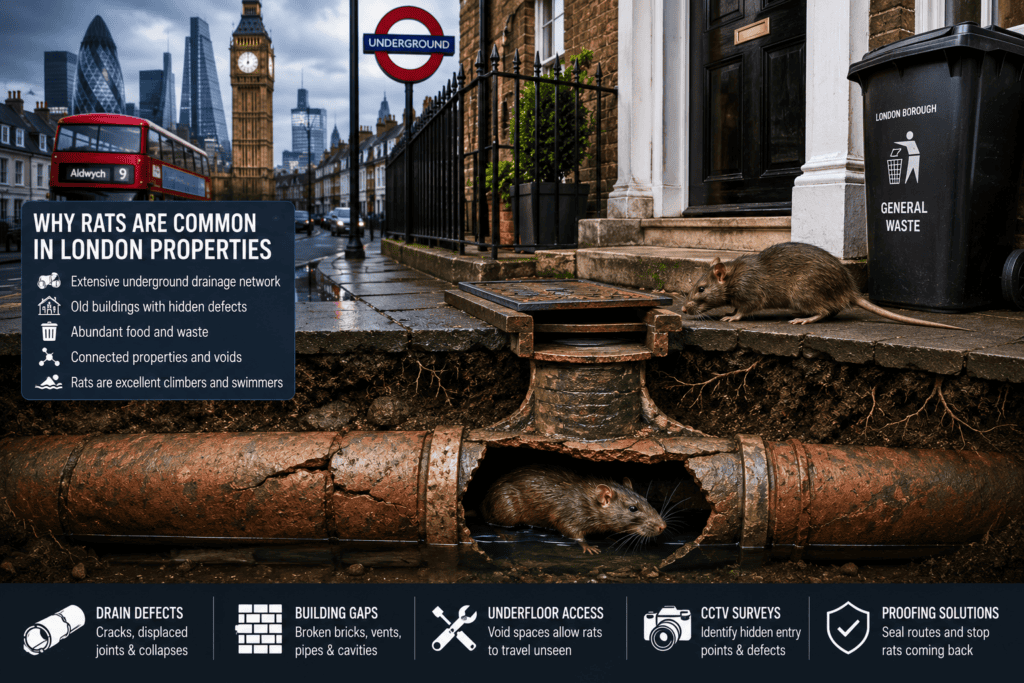
Rats in London properties are a common problem. The capital provides almost everything rats need, including food, water, shelter and an extensive underground drainage system.
However, seeing rats around London does not mean you should accept them inside your home.
When rats enter a property, there is usually a route that allows them access. The challenge is finding it.
At RodentKill, we investigate difficult and recurring rat problems. This includes hidden entry points and possible drainage routes.
In this guide, we explain why rats in London properties are so common and why some infestations keep returning after treatment.
Why Are There So Many Rats in London?
London provides an ideal environment for brown rats.
Millions of people live and work within a relatively small area. As a result, huge amounts of food waste are produced every day.
London also has an enormous network of:
- Sewers
- Underground drains
- Service tunnels
- Basements
- Cellars
- Railway infrastructure
- Commercial buildings
- Residential properties
These environments provide shelter and opportunities for rats to move around while remaining largely hidden.
London's Drainage System Gives Rats a Place to Live
Underground drainage is particularly important when considering rat activity in London.
Rats are excellent swimmers. They are also strong climbers and can travel considerable distances through drainage systems.
Normally, this does not mean they can enter your home. An intact drainage system should keep rats within the pipework.
However, problems can begin when a drain becomes damaged.
Old London Properties Can Have Old Drains
London contains a huge number of Victorian and Edwardian properties.
Many older homes were originally constructed with clay drainage. Although clay pipes can last for many years, problems may develop over time.
Common defects include:
- Cracked clay pipes
- Displaced joints
- Collapsed drains
- Root ingress
- Damaged inspection chambers
- Open connections
- Poor previous repairs
A significant defect may allow a rat travelling inside the drain to reach the surrounding ground.
From there, it may find another route towards the property.
Victorian London Properties Can Be Vulnerable to Rats
Victorian houses can be particularly interesting during a rat investigation.
The age of the building is only part of the reason.
Many properties have been altered several times since they were originally built. For example, bathrooms may have moved and outside toilets may have disappeared.
In addition, kitchens may have been extended and old drains may have been replaced.
As a result, the drainage beneath the property may be very different from the original layout.
Old and Redundant Drains Can Create Hidden Rat Routes
Redundant drainage connections can be easy to overlook.
For example, an old London house may once have had an outside toilet. Decades later, the toilet was removed and an extension was built.
If the old connection was not correctly sealed, it could remain connected to the drainage system.
A rat may then be able to travel along the redundant pipe towards the building.
Meanwhile, the homeowner may have no idea the old pipe is still there.
London Extensions Can Hide Old Drainage
Extensions are another potential complication.
London properties are valuable, so owners often make maximum use of the available space. Rear extensions, side-return extensions and basement conversions are common.
However, building work can alter the original drainage layout.
Old inspection chambers may have been:
- Moved
- Abandoned
- Covered
- Built over
- Hidden beneath flooring
Drainage may also have been rerouted.
Therefore, understanding what is happening underground can become an important part of a difficult rat investigation.
Why Are Rats Common in London Terraced Houses?
Terraced properties can present another challenge.
A rat problem may not originate entirely within the affected property.
Rats can potentially move between connected buildings using hidden routes. These may include underfloor voids, wall cavities and drainage systems.
Therefore, a homeowner can have a rat problem even when their own property is clean and well maintained.
Neighbouring building defects can sometimes contribute to the problem.
Rats Can Travel Beneath London Properties
Many older London homes have suspended timber floors.
This creates a void between the floorboards and the ground below.
If a rat reaches this area, it can potentially move beneath several rooms without being seen.
Signs may include:
- Scratching beneath floorboards
- Movement at night
- Gnawing sounds
- Droppings behind kitchen units
- Activity around boxed pipework
The location where you hear the rat does not always reveal where it entered.
In fact, the original entry point could be several metres away.
Why Are Rats Common in London Flats?
Flats can also experience rat problems, including properties above ground-floor level.
Rats can move through buildings using service routes and structural voids.
Possible routes include:
- Soil stacks
- Service ducts
- Wall cavities
- Pipe boxing
- Ceiling voids
- Communal areas
- Waste storage areas
As a result, finding rats in an upper-floor flat does not necessarily mean they entered through a nearby window or door.
The route may begin much lower in the building.
Food Waste Can Encourage London Rat Populations
Food is another major factor.
London has thousands of restaurants, takeaways, shops and other food businesses. In addition, millions of households produce food waste every day.
Rats are opportunistic feeders. Therefore, poorly managed waste can provide a reliable food source.
Common sources include:
- Overfilled bins
- Food waste
- Rubbish bags
- Commercial waste
- Bird feeding
- Pet food
- Compost
However, food alone does not explain how a rat has entered your home.
Once rats are inside, the entry route still needs to be considered.
Building Work Can Disturb Rats
London is constantly changing.
Properties are renovated, basements are excavated and old buildings are demolished. Roads and utilities are also regularly repaired.
This activity can disturb existing rat harbourage.
When their environment changes, rats may move elsewhere in search of food and shelter.
Nearby properties can then experience increased activity.
Why Do Rats Keep Coming Back After Pest Control?
This is one of the most important questions.
Rat control may successfully remove the animals currently inside a property.
However, treatment does not automatically close the original entry route.
If that route remains open, another rat may eventually discover it.
The cycle can become:
Rats appear → treatment → quiet period → new rats enter → problem returns.
Therefore, a recurring infestation may require a more detailed investigation.
Could Rats Be Coming Through London Drains?
Yes. Drainage should be considered when the evidence suggests an underground route.
A damaged drain may allow rats to leave the pipework and reach the surrounding ground.
Potential problems include:
- Displaced pipe joints
- Cracked drains
- Collapsed sections
- Open redundant pipes
- Damaged chambers
- Poor previous drainage repairs
This can be particularly relevant when rats are heard beneath ground floors but no obvious external entry point can be found.
Signs Your London Rat Problem May Be Drain Related
No single sign proves that rats are entering through a drain.
However, further investigation may be worthwhile if:
- Rats repeatedly return after treatment
- Scratching is heard beneath the ground floor
- No obvious external entry point can be found
- The property has old clay drainage
- The house has been extended
- Previous proofing has failed
- There are recurring drainage problems
- Old toilets or bathrooms have been relocated
In these situations, the drainage system may need to be investigated rather than simply assumed to be sound.
How Does a Rat Entry Investigation Work?
A Rat Entry Investigation looks for possible routes into the property.
The investigation may consider the exterior of the building, service penetrations, structural defects and underfloor access.
We also consider whether the drainage system could be involved.
The aim is to answer one important question:
How are the rats getting into the property?
Rat Drain Surveys & Investigations in London
If drainage is suspected, a Rat Drain Survey & Investigation can examine accessible underground pipework.
A CCTV drain camera is passed through the drainage system. This allows us to inspect areas that cannot be seen from above ground.
We can look for:
- Cracked drains
- Displaced joints
- Collapsed pipes
- Redundant connections
- Root ingress
- Damaged chambers
- Other possible rat escape points
However, finding a defect is only part of the process.
We also consider whether its position and condition could explain the rat activity within the property.
Can a Rat Flap Help in London Properties?
A suitable rat flap can sometimes restrict rats travelling from the sewer towards a property.
However, it should not automatically be installed without considering the drainage layout.
For example, a rat flap may not solve the problem if rats are already beyond the proposed installation point.
It will also not repair a damaged private drain.
Therefore, we can assess whether a suitable rat flap installation point exists as part of a Rat Drain Survey & Investigation.
Rat Control Should Be About More Than Poison
Poison and trapping can form part of professional rat control. However, they do not physically repair an entry point.
If a rat is entering through a damaged drain, the drain remains damaged after the rat has been removed.
Likewise, a hole around a pipe remains open until it is correctly proofed.
For recurring problems, the long-term solution may therefore involve:
- Controlling existing rats
- Finding the entry route
- Proofing building defects
- Investigating drainage
- Repairing damaged drains
- Installing a rat flap where appropriate
- Monitoring for further activity
Rat Specialists for London Properties
London can be a challenging environment for rat control.
Dense housing, old drainage, shared buildings, extensions and underground infrastructure can create complicated infestations.
At RodentKill, we specialise in difficult and recurring rat problems.
Our services include Rat Entry Investigations and Rat Drain Surveys & Investigations for London properties.
Rather than simply asking how to kill the rat, we investigate a more important question:
How did the rat get into the property in the first place?
Frequently Asked Questions About Rats in London Properties
Why are rats so common in London?
London provides rats with food, water, shelter and extensive underground drainage. Dense development also creates many places where rats can live and travel unnoticed.
Are rats common in Victorian London houses?
They can be. Older properties may have clay drains, suspended floors, wall cavities and redundant drainage connections. These features can create hidden routes if defects develop.
Can rats come into London houses through drains?
Yes. Rats can travel through drainage systems. Significant cracks, displaced joints, collapsed sections and open connections may allow them to leave damaged pipework.
Why do rats keep coming back after treatment?
The original entry route may still be open. Removing existing rats does not automatically repair a damaged drain or seal a structural opening.
Can rats get into London flats?
Yes. Rats may use soil stacks, service ducts, cavities and other hidden routes. Therefore, rat activity is not limited to houses or ground-floor properties.
Do I need a CCTV drain survey for rats?
Not every rat infestation requires a CCTV survey. However, it can be useful when rats repeatedly return, activity is beneath floors or an underground entry route is suspected.
Will a rat flap stop rats coming into my London property?
A rat flap can help in suitable drainage systems. However, the drainage layout should be assessed first because a flap will not repair damaged private pipework.
Why Rats Are Common in London Properties
Rats in London properties are common because the capital provides an ideal environment for them. However, recurring rats inside a home often indicate that an access route remains available.
Old drainage, displaced joints, redundant pipes, extensions and structural voids can all play a part.
Therefore, repeatedly treating the rats may not be enough.
At RodentKill, we investigate difficult rat problems across London and the surrounding areas.
If the source is unclear, our Rat Entry Investigation can look for hidden access routes. Where drainage is suspected, our Rat Drain Survey & Investigation can examine accessible underground pipework using CCTV.
If rats keep coming back, don't just treat the next rat. Find the route they are using to get in.