Who Do I Call If Rats Are Coming From Drains
If you suspect rats are coming from the drains, knowing who to call can be surprisingly difficult.
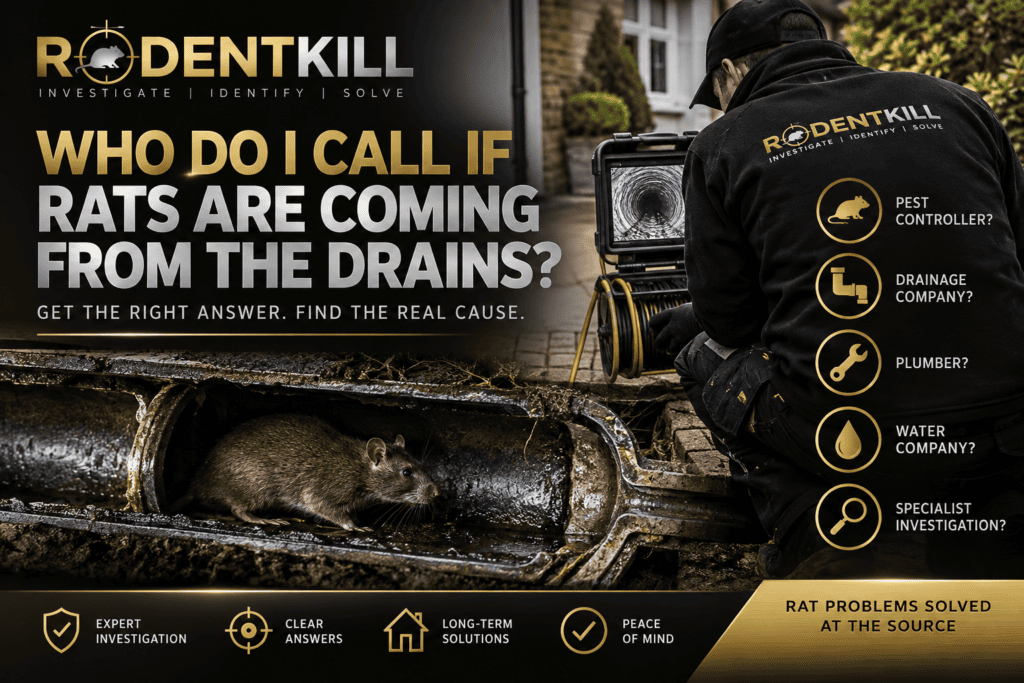
Do you need a pest controller, a drainage company, a plumber, the local water company, or someone who specialises in investigating rat entry routes?
The answer depends on the problem.
If rats are repeatedly getting into your home and you suspect the drainage system is involved, simply killing the rats may not solve the underlying cause. You need to establish how the rats are getting from the drainage system into the property.
At RodentKill, we specialise in difficult and recurring rat problems, including investigating drainage systems for possible rat entry routes.
Who Should I Call About Rats Coming From Drains?
If rats are entering your property and you suspect the drains, a rat specialist who understands drainage investigation can be a sensible starting point.
This is because two separate issues may need investigating:
- The active rat infestation.
- The route allowing rats to enter the building.
A traditional pest control treatment may deal with rats currently inside the property.
A drainage contractor may inspect the condition of the drains.
However, with a recurring rat problem, the most important question is often:
Is there something within the drainage system that is allowing rats to escape from the drains and reach the property?
That is where a specialist rat-focused drainage investigation can be particularly useful.
Should I Call a Pest Controller?
A professional pest controller is appropriate when you have active rats inside or around your property.
Baiting, trapping and other professional control methods can help remove the rats currently present.
However, if rats disappear and then return weeks or months later, an unresolved access route may still be open.
Repeatedly controlling rats without identifying that route can result in the same problem happening again.
This is particularly worth considering when:
- You have already had pest control several times.
- Rats disappear temporarily but return.
- You hear rats underneath the ground floor.
- There is no obvious hole around the outside of the house.
- The property has old or altered drainage.
- An extension has been built over previous drainage.
In these situations, investigation may be more useful than simply repeating another standard treatment.
Should I Call a Drainage Company?
A drainage company can inspect damaged, blocked or defective drains and carry out repairs.
However, a conventional drainage survey and a rat-focused drain investigation do not necessarily have the same objective.
A general CCTV drain survey normally concentrates on the structural condition and operation of the drainage system.
When investigating rats, the focus is different. We are particularly interested in anything that could provide an escape route from the pipework.
This can include:
- Displaced pipe joints.
- Cracked or fractured drains.
- Collapsed sections.
- Open redundant connections.
- Damaged inspection chambers.
- Poorly sealed alterations.
- Defective junctions.
- Old connections beneath extensions.
A defect that looks relatively minor from a drainage-flow perspective may be much more important when investigating how a rat could leave the drainage system.
Do I Need a Plumber?
Usually, a plumber would not be the first person to call simply because you suspect rats are travelling through underground drains.
Plumbers mainly deal with internal plumbing, water supplies, sanitary fittings and associated pipework.
Investigating underground drainage defects and hidden rat entry routes is a different type of work.
A plumber may become relevant if the problem involves internal pipework or sanitary fittings, but suspected underground drainage problems are generally better investigated using appropriate CCTV drainage equipment.
Should I Contact the Water Company?
Responsibility for drainage depends on where the defect is located and whether the pipework is private drainage or part of the public sewer network.
A defect within private drainage serving your property may be the homeowner's responsibility, while defects within the public sewer may fall under the relevant sewerage company's responsibility.
The problem is that homeowners often do not know exactly where the suspected defect is located.
A CCTV drain investigation can help establish the drainage layout, identify suspicious defects and provide useful information before deciding who is responsible for the repair.
Why Would Rats Be Coming From My Drains?
Rats can live and travel through sewer and drainage systems.
The presence of rats underground does not automatically mean there is something wrong with your property.
The problem begins when a rat finds a route out of the drainage system.
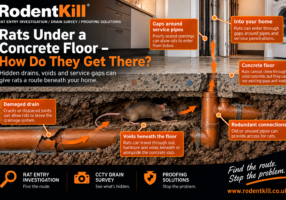
For example, a rat may travel through a drain until it reaches a displaced joint, damaged section of pipe or open connection.
It may then leave the pipe and enter the surrounding soil.
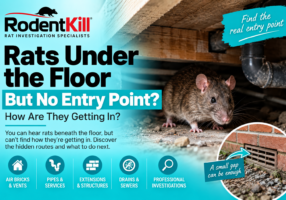
From there, it could potentially reach a void beneath the building, an old drain connection, a wall cavity or another hidden opening.
The place where you eventually hear or see the rat can therefore be some distance from the original drainage defect.
How Do I Know Whether Rats Are Coming From the Drains?
No single sign proves that rats are coming from the drains.
However, drainage should be considered when several clues point towards an underground route.
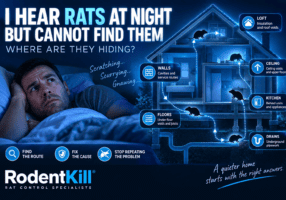
Possible warning signs include:
- Rats repeatedly returning after pest control.
- Scratching beneath ground-floor rooms.
- Rat activity around kitchens, bathrooms or utility rooms.
- No obvious external entry point.
- A history of drainage problems.
- An older property with clay drains.
- Extensions or alterations built over old drainage.
If you want to understand the warning signs in more detail, read our guide Are Rats Coming From My Drains?
What Is a Rat Drain Survey?
A specialist rat drain survey uses CCTV equipment to inspect accessible underground drainage.
The purpose is not simply to produce a list of drainage defects.
The investigation looks for evidence that could help explain how rats are escaping from the drainage system and gaining access towards the property.
This may involve examining:
- Inspection chambers.
- Drain runs.
- Pipe joints.
- Junctions.
- Redundant connections.
- Structural defects.
- Possible rat escape routes.
Where a suspicious defect is identified, its position in relation to the building can be extremely important.
For example, a displaced joint beneath an extension may be far more relevant to a rat problem than a minor defect located well away from the property.
Find out more about our Professional Rat Drain Survey.
What If I Don't Know Whether the Drains Are Responsible?
This is very common.
Not every recurring rat infestation originates from the drainage system.
Rats can also enter through structural gaps, service penetrations, damaged air bricks, wall cavities and other openings around a building.
If there is no strong evidence pointing specifically towards the drains, a broader investigation may be the better starting point.
Our Rat Entry Investigation is designed to answer the wider question:
How are rats getting into my property?
Where the evidence points towards the drains, a more detailed CCTV drainage investigation can then be carried out.
What Happens If a Drain Defect Is Found?
Finding a drain defect does not automatically mean that it is responsible for the rat infestation.
The location, size and nature of the defect need to be considered alongside the history and pattern of rat activity within the property.
If a credible entry route is identified, the recommended solution could include:
- Repairing damaged drainage.
- Sealing a redundant connection.
- Repairing an inspection chamber.
- Sealing structural openings.
- Proofing pipe penetrations.
- Installing a suitable rat barrier where appropriate.
- Carrying out further investigation.
The important principle is simple:
Investigate first, then fix the correct problem.
Why Rats Can Return After Pest Control
Removing the rats currently inside a property is important, but it does not necessarily stop another rat entering later.
If the same access route remains available, the infestation can return.
This is why difficult rat problems sometimes continue despite several successful pest control treatments.
The treatment may have worked perfectly well against the rats that were present at the time.
The unresolved problem is the route allowing new rats to enter.
Do Shared Drains Cause Rat Problems?
They can.
Many UK properties are connected through shared drainage systems before the pipework reaches the main sewer.
This means rats may be able to travel through drainage serving several neighbouring properties.
A defect affecting one section of the system can therefore potentially be relevant to more than one house.
This is another reason why understanding the drainage layout can be useful when dealing with recurring rat activity.
Don't Keep Paying to Treat the Same Rat Problem
If you have already paid for pest control and the rats keep returning, there is usually a reason.
Another baiting treatment may remove the rats currently inside your home, but it cannot repair a broken drain, close an abandoned connection or seal a hidden structural entry point.
Finding the route can break that cycle.
RodentKill specialises in investigating difficult and recurring rat problems.
If you suspect rats are coming from your drains, or you simply cannot work out how they are getting into your property, contact us to discuss the problem.
Make an enquiry with RodentKill →
Frequently Asked Questions
Who do I call if rats are coming from my drains?
If rats are entering your property and drainage is suspected, consider using a rat specialist who understands drainage investigation as well as rodent behaviour. Where appropriate, a CCTV rat drain survey can help identify possible underground entry routes.
Will pest control stop rats coming from drains?
Pest control can remove rats currently present, but it cannot repair a broken drain or close an underground entry route. If access remains open, further rats may potentially enter later.
Can a drainage company find where rats are getting in?
A drainage company can identify drainage defects. A rat-focused investigation also considers whether a defect is positioned in a way that could realistically form part of a rat's route into the building.
Do I need a CCTV drain survey for rats?
Not every rat problem requires one. A survey becomes particularly relevant when rats repeatedly return, activity is heard beneath floors, there is no obvious external entry point or other evidence suggests that the drainage system could be involved.
What if I don't know where the rats are coming from?
A broader rat entry investigation may be more appropriate. This considers possible structural, building and drainage routes before deciding whether a detailed CCTV drain survey is required.
Can rats travel through shared drains?
Yes. Rats can travel through connected drainage and sewer systems. The important issue is identifying whether there is a defect or opening that allows them to leave the system and gain access towards your property.
Rats Keep Coming Back? Find Out Why.
Stop treating the symptom and start looking for the route.
RodentKill investigates recurring rat problems, hidden entry points and suspected drainage-related infestations.
```