
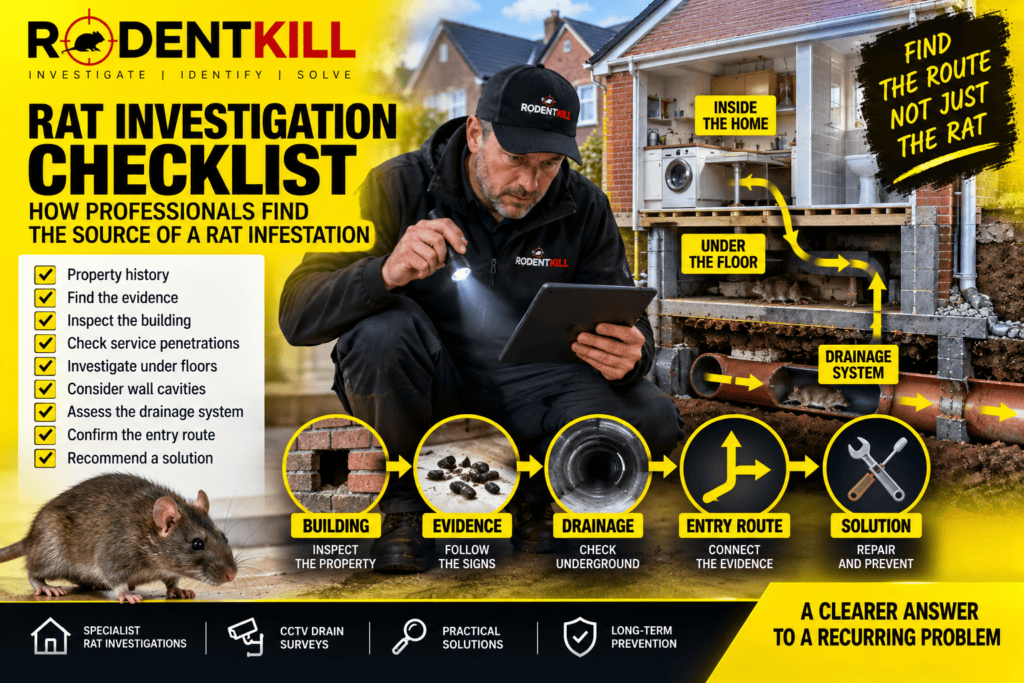
Rat Investigation Checklist for UK Homes: 15 Steps
Finding a rat is often easy. However, finding out how it entered your home can be much harder.
The entry point may be hidden under a floor. Alternatively, it could be behind a kitchen unit, inside a wall or below ground.
Therefore, a good rat investigation involves more than looking for holes.
The aim is simple. We want to find the route the rats are using.
This rat investigation checklist explains the process step by step.
What Is a Rat Investigation?
A rat investigation looks for the cause of a rat problem.
First, we look at where rats are active. Next, we consider how they could be moving through the property. Finally, we look for the most likely entry route.
This approach is especially useful when rats keep returning.
Bait and traps can control rats. However, they cannot repair a damaged drain or seal a hidden hole.
As a result, another rat may enter later if the route remains open.
Our Rat Entry Investigation focuses on finding these hidden routes.
1. Check the History of the Rat Problem
First, find out when the problem started.
For example, ask these questions:
- When were rats first seen?
- Where were they seen?
- Where can scratching be heard?
- Where are droppings found?
- Has pest control been tried before?
- Did the rats disappear and return?
- Has proofing already been done?
- Have there been drain problems?
- Has the house been extended?
- Do neighbours also have rats?
Together, these answers can provide useful clues. In addition, they can show whether the problem is new or recurring.
2. Look for Rat Evidence
Next, look at where the signs of rats appear.
Common signs include:
- Droppings.
- Gnaw marks.
- Grease marks.
- Footprints.
- Scratching sounds.
- Damaged food.
- Burrows.
- Nesting material.
- Rat sightings.
The location of this evidence matters. For example, several signs in one area may point towards a regular route.
However, the room where you see a rat may not be where it entered the building.
Finding a Hole Does Not Prove Rats Are Using It
Most houses contain small gaps and openings.
For example, gaps may be present around pipes, doors or air bricks.
Even so, a hole large enough for a rat is not automatically the entry point.
Instead, look at the evidence around it.
Ask:
- Can a rat reach the hole?
- Are there droppings nearby?
- Are there grease marks?
- Where does the hole lead?
- Does it connect with the rat activity?
Therefore, finding a possible hole is only the start.
The aim is to find the route, not just a gap.
3. Inspect Outside the House
Next, inspect the outside of the property.
In particular, check areas such as:
- Air bricks.
- Pipe openings.
- Waste pipes.
- Soil pipes.
- Doors.
- Brickwork.
- Extensions.
- Decking.
- Garages.
- Sheds.
- Inspection chambers.
Also, look for burrows and rat runs.
However, there may be no obvious hole. In some cases, the entry route is hidden below ground.
4. Check Around Pipes and Cables
Pipes and cables pass through many walls and floors.
Sometimes, gaps remain around them. As a result, rats may use these openings to move through a building.
For this reason, check around:
- Kitchen waste pipes.
- Water pipes.
- Gas pipes.
- Boiler pipes.
- Electrical cables.
- Broadband cables.
- Soil pipes.
Most importantly, try to find where each service enters the property.
5. Investigate Under the Floor
Scratching below the floor is an important clue.
Once below the floor, rats can move between rooms. Consequently, they may appear far away from the original entry point.
At this stage, ask two questions.
How did the rat get under the floor?
After that, ask:
How did it get from under the floor into the room?
Importantly, the answers may be completely different.
6. Check Hidden Areas
Rats can also travel through hidden spaces.
For example, they may use:
- Wall cavities.
- Boxed pipes.
- Service ducts.
- Ceiling spaces.
- Floor voids.
- Lofts.
Therefore, scratching inside a wall does not always reveal the original entry point.
Instead, consider how the hidden spaces connect.
7. Consider the History of the Property
Older houses often contain previous alterations.
For example, a property may have had:
- An extension.
- A kitchen moved.
- An outside toilet removed.
- A garage converted.
- A new bathroom.
- Old drains altered.
As a result, hidden openings may remain beneath floors or extensions.
Therefore, the history of the building can provide useful clues.
8. Decide Whether to Check the Drains
Not every rat problem starts in the drains.
Therefore, a CCTV drain survey is not always needed.
However, drains become more important when:
- Rats keep returning.
- Rats are heard under floors.
- No outside entry point is found.
- The property has old drains.
- There are known drain problems.
- The house has been extended.
- Neighbours also have rats.
In these cases, a Professional Rat Drain Survey may help identify the cause.
9. Inspect the Drains With CCTV
A CCTV camera allows us to inspect accessible drains from the inside.
During a rat investigation, however, we are looking for possible escape routes from the drainage system.
These may include:
- Displaced joints.
- Cracked pipes.
- Broken pipes.
- Collapsed sections.
- Open connections.
- Old branches.
- Damaged chambers.
A normal drain survey looks for drain defects.
In contrast, a rat-focused survey asks another question.
Could this defect provide a route for rats?
10. Find the Location of Drain Defects
The location of a defect can be very important.
For example, damage below a kitchen may be more relevant than damage far away from the house.
Where suitable, locating equipment can help find the camera position above ground.
We can then compare the drain defect with the rat activity inside the property.
11. Connect the Evidence
This stage is especially important.
A damaged drain does not automatically prove that rats are using it.
However, the case becomes stronger when several clues match.
For example:
- The defect is below the kitchen.
- Rats are heard below the kitchen.
- No outside hole is found.
- The rats keep returning.
- Droppings appear nearby.
Taken together, these clues begin to point towards the same route.
12. Is the Entry Point Possible, Probable or Confirmed?
Not every suspected entry point has the same value.
Therefore, we can place suspected routes into three groups:
- Possible: a rat could use the opening.
- Probable: several clues support the route.
- Confirmed: there is direct evidence of rats using it.
This simple approach helps avoid guesswork. In addition, it can prevent unnecessary repairs.
13. Monitor the Rat Activity
Sometimes, more evidence is needed.
In that case, monitoring can be useful.
For example, fresh droppings or new sightings may show where rats are travelling.
Therefore, gathering more evidence can be better than recommending expensive work based on a guess.
14. Fix the Entry Route
Once the likely route has been found, the correct solution can be chosen.
Depending on the cause, this may include:
- Sealing gaps around pipes.
- Repairing brickwork.
- Protecting air bricks.
- Repairing drains.
- Closing old drain connections.
- Repairing inspection chambers.
- Professional rat proofing.
- Installing a rat barrier where suitable.
Most importantly, the investigation should determine the repair.
In other words, do not choose the solution before you understand the problem.
15. Check the Results
Finally, check whether the rat activity stops.
Proofing a hole is not the end of the investigation.
If rats continue to appear, review the evidence again.
On the other hand, if activity stops, this provides further support for the suspected route.
What Equipment Is Used During a Rat Investigation?
Different properties require different equipment.
For example, an investigation may use:
- Torches.
- Inspection cameras.
- CCTV drain cameras.
- Drain locating equipment.
- Monitoring equipment.
- Drain access equipment.
However, equipment alone cannot solve the problem.
A camera can show a damaged pipe. Nevertheless, an experienced investigator still needs to decide whether that damage explains the rat activity.
Rat Investigation vs Pest Control
Pest control deals with active rats.
In contrast, a rat investigation looks for the cause.
For a simple problem, pest control and proofing may be enough.
However, investigation becomes more useful when rats keep returning.
Therefore, the ideal approach is simple:
Control the rats. Find the route. Prevent them from returning.
When Should You Consider a Rat Investigation?
A detailed investigation may be useful when:
- Rats keep returning.
- Previous treatment has failed.
- No entry point can be found.
- Rats are heard below floors.
- Rats are heard inside walls.
- The problem centres around a kitchen.
- The property has old drains.
- A previous drain survey found defects.
In these situations, finding the cause can be more useful than simply treating another rat.
Why Evidence Matters
It is easy to blame the first defect you find.
For example, you may find a cracked drain or a gap around a pipe.
However, that defect may not be the real entry route.
Therefore, compare it with the other evidence.
Does the route explain the noises? In addition, does it connect with the area where droppings appear? Finally, can rats actually reach it?
The more clues that match, the stronger the diagnosis becomes.
The RodentKill Approach
RodentKill specialises in difficult and recurring rat problems.
First, we consider the rat activity and the property itself. Where necessary, we can also investigate the drainage system.
However, we do not assume every rat problem comes from a drain.
Likewise, we do not assume every hole is an entry point.
We investigate the route — not just the rat.
Rats Keep Coming Back?
If rats return after treatment, an entry route may still be open.
Therefore, finding the cause can be the next step towards solving the problem.
Request a Rat Entry Investigation →
Frequently Asked Questions
What does a rat investigation include?
It can include checking rat evidence, inspecting the property and, where appropriate, looking at the drains.
How do you find where rats are getting in?
First, we compare clues such as droppings, noises, sightings, holes and drain defects. Then, we look for a route that connects the evidence.
Does finding a hole prove rats are using it?
No. Instead, other evidence should support the suspected route.
Does every rat problem need a drain survey?
No. However, CCTV can be useful when evidence suggests rats may be entering from underground.
Why do rats keep returning?
One possible reason is an open entry route. As a result, new rats may use the same route after the previous rats have been controlled.