
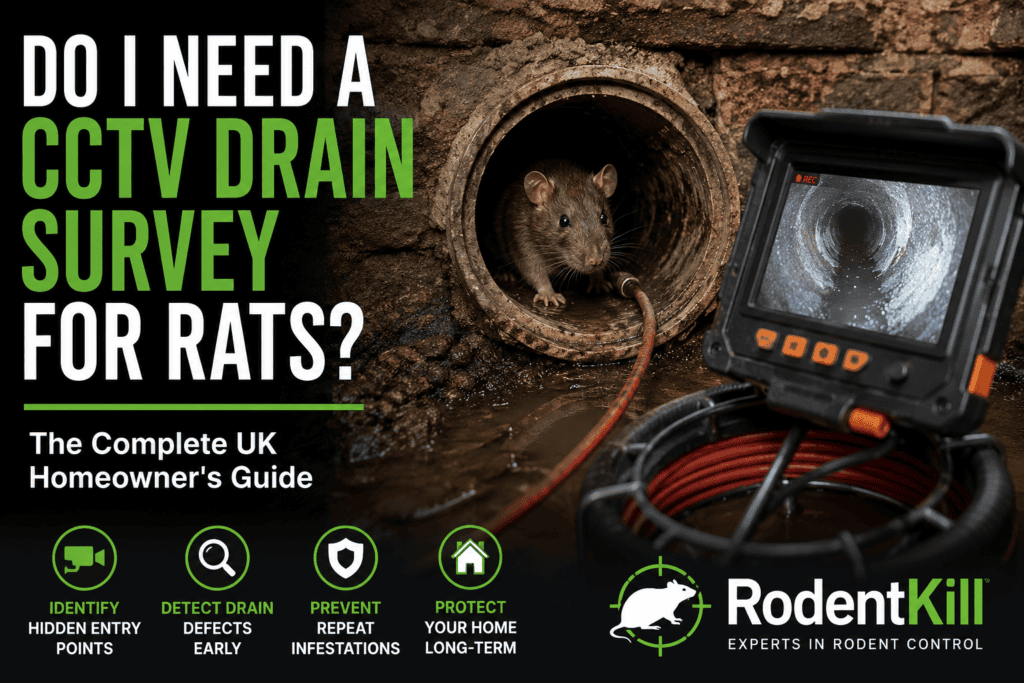
Do I Need a CCTV Drain Survey for Rats
If rats keep returning to your property, you may be wondering whether you need a CCTV drain survey for rats.
The answer is: not always.
A CCTV drain survey can be extremely useful when there is evidence that rats may be gaining access from underground. However, not every rat infestation originates from the drainage system.
The key is to look at the pattern of activity first and decide whether the drains provide a credible explanation.
This guide explains when a CCTV drain survey is worth considering, when it may not be necessary and what a rat-specific drain investigation should actually look for.
Do I Need a CCTV Drain Survey for Rats?
You should consider a CCTV drain survey when there are reasonable signs that rats could be entering from underground.
This is particularly relevant when:
- Rats keep returning after previous pest control
- You hear scratching beneath ground floors
- No convincing above-ground entry point can be found
- Rat activity is concentrated around kitchens, bathrooms or utility rooms
- The property has old drainage
- There have been previous drain problems
- The house has been extended or substantially altered
- There may be redundant drainage beneath the property
- A previous inspection has identified suspicious drainage defects
None of these signs proves that the drains are responsible. However, several clues occurring together can make CCTV investigation a sensible next step.
When Might I Not Need a CCTV Drain Survey?
A drain survey should not automatically be the first response to every rat infestation.
If there is a clear and well-supported above-ground entry route, investigating the drains may add little useful information.
For example, rats may be entering through:
- Damaged air bricks
- Openings around pipes or services
- Structural gaps
- Damaged external doors
- Wall or roof defects
- Other accessible openings around the building
Likewise, seeing rats outside near a drain cover does not prove that the drainage system is allowing them into the house.
If you genuinely do not know where the rats are coming from, a broader Rat Entry Investigation may be the better starting point.
Why Would Rats Be Inside the Drains?
Rats can live and travel within sewer and drainage systems.
Finding a rat inside a drain is therefore not necessarily unusual, and it does not automatically mean that the drain is responsible for rats inside your property.
The important question is whether there is a route that could allow a rat to leave the drainage system and reach the building.
That is what a rat-focused CCTV investigation should try to establish.
If you want a broader explanation of the investigation itself, read What Is a Rat Drain Survey?.
What Can a CCTV Drain Survey Find?
A CCTV drain survey allows accessible underground pipework to be inspected internally using specialist camera equipment.
Potentially relevant findings can include:
- Cracked or fractured pipes
- Displaced joints
- Collapsed pipework
- Open redundant connections
- Defective junctions
- Poor previous repairs
- Damaged inspection chambers
- Open-ended or incorrectly sealed pipework
These defects may be invisible from ground level.
However, finding a defect does not automatically prove that it is the rat entry route.
A Drain Defect Is Not Automatically a Rat Entry Point
This is one of the most important points when investigating recurring rat problems.
Many drainage systems contain defects, particularly older pipework.
If a CCTV camera finds a cracked pipe, the next question should not simply be:
“Is the drain damaged?”
It should be:
“Could this defect explain how rats are reaching the property?”
The position of the defect should be considered alongside:
- Where rat activity is occurring
- The construction of the building
- The location of sub-floor voids
- Previous alterations or extensions
- Other possible entry points
- The history of the infestation
This is what makes a rat-specific drain investigation different from a general drainage condition survey.
Rats Keep Coming Back After Pest Control
Repeated rat infestations are a strong reason to investigate whether an entry route remains unresolved.
Baiting or trapping may control rats already inside the property. However, neither method physically closes the route another rat could use later.
This can create a repeating cycle:
Rats appear → treatment is carried out → activity stops → another rat enters → the problem returns.
If this keeps happening, further investigation may provide more value than simply repeating the same treatment.
Rats Under the Floorboards
Scratching or movement beneath a ground floor can make underground access worth considering.
A rat leaving damaged drainage may potentially reach surrounding ground or a concealed void beneath a property.
Once beneath the building, it may travel considerable distances through sub-floor areas before emerging into an occupied room.
However, rats can also reach sub-floor voids through above-ground structural openings.
For that reason, noises beneath the floor are a clue rather than proof of a drainage problem.
No Obvious Rat Entry Point
Sometimes a property has recurring internal rat activity but an external inspection reveals no convincing opening.
This is another situation where the drainage system may deserve closer attention.
An underground route can remain completely hidden from normal visual inspection.
If the source is still uncertain, RodentKill's Rat Entry Investigation looks more broadly at the property before deciding which suspected routes require further investigation.
Older Properties and CCTV Drain Surveys
Older properties can contain drainage that has been repaired, extended or altered many times.
Clay pipework may have moved or deteriorated, while previous building work may have left old connections that are no longer required.
This does not mean every older property needs a CCTV survey.
However, older drainage combined with recurring unexplained rat activity can strengthen the case for investigating underground.
Extensions Can Make Drain Investigation More Important
Extensions can complicate both the drainage layout and the route rats may take through a building.
For example, an old outside gully, toilet connection or drainage branch may once have been outside the property but later ended up beneath an extension.
If redundant drainage was not correctly abandoned, it may provide a potential route away from the active drainage system.
Where rats are repeatedly heard beneath an extension, understanding what lies underground can therefore be valuable.
What Happens During a CCTV Rat Drain Survey?
During a CCTV survey, a specialist drain camera is inserted into accessible drainage and passed through the pipework.
The drainage is inspected for defects, unusual connections and other features that could be relevant to the rat problem.
The investigation should consider more than the condition of the pipe itself.
Where possible, the findings should be compared with the layout of the property and the location of rat activity.
For a detailed explanation of the procedure, see Rat Drain Survey Process: What Happens and What We Find.
You can read about the service itself on our Professional Rat Drain Survey page.
Can CCTV Show Rats Inside the Drain?
Sometimes a camera may record a rat inside the drainage system.
That can be interesting evidence, but it is not necessarily the most important finding.
Rats are capable of travelling through sewers and drains.
The more important objective is usually to identify a defect or connection that could allow them to leave the drainage system and gain access towards the property.
Can a CCTV Drain Survey Find the Exact Rat Entry Point?
Sometimes it can identify a highly suspicious defect or connection.
However, CCTV findings should be interpreted carefully.
A drain camera can show what is happening inside accessible pipework, but it cannot necessarily show the entire route a rat takes after leaving the drain.
For example, a rat might leave a damaged pipe, move through surrounding ground and then enter a sub-floor void through a separate structural opening.
The best diagnosis therefore comes from combining the drainage findings with evidence from the property.
CCTV Drain Survey or Rat Entry Investigation?
The right service depends on what you already know.
Consider a CCTV Rat Drain Survey when:
- There is good reason to suspect the drains
- Previous evidence points towards underground access
- Known drainage defects need investigating
- Rats are repeatedly active beneath ground floors
Consider a Rat Entry Investigation when:
- You do not know where the rats are coming from
- Several possible entry routes exist
- Previous pest control has failed to identify the source
- You want the building and possible drainage routes considered together
The aim is not to carry out the most complicated investigation possible. It is to choose the investigation that best fits the evidence.
What Happens If the Survey Finds a Drain Defect?
The appropriate next step depends on the type of defect and whether it provides a credible rat access route.
Possible recommendations may include:
- Drain repair
- Sealing a redundant connection
- Repairing an inspection chamber
- Further investigation
- Targeted proofing
- A suitable rat barrier where appropriate
Repairs should be based on the actual findings rather than assuming every defect needs major excavation.
What If the Drains Are Fine?
A clear drainage survey can still provide useful information because it allows one suspected route to be ruled out or considered less likely.
The investigation can then concentrate on other possibilities, such as service penetrations, wall cavities, air bricks, roof-level routes or structural openings.
This is another reason not to assume that every difficult rat problem originates from the drains.
So, Do You Need a CCTV Drain Survey for Rats?
If rats keep returning, you hear activity beneath the property and no convincing above-ground entry point can be found, a CCTV drain survey may be a sensible next step.
If you have no idea whether the drains are involved, start with the wider problem: how are the rats getting into the property?
RodentKill specialises in difficult and recurring rat problems. We investigate the evidence and recommend the most appropriate next step rather than assuming every property needs the same service.
If drainage is the likely route, our Professional Rat Drain Survey uses CCTV equipment to investigate accessible underground drainage for defects and potential rat access routes.
For more information about recurring rat problems, hidden entry routes and drainage-related rat activity, visit the Rat Knowledge Centre.
Not sure which investigation you need?
Tell us about your rat problem →
Frequently Asked Questions
Does every rat problem need a CCTV drain survey?
No. Many rat infestations involve above-ground entry points. CCTV is most useful when the evidence suggests an underground route or when rats repeatedly return without an obvious explanation.
How do I know if rats are coming from my drains?
Recurring activity, noises beneath ground floors, activity near kitchens or bathrooms and the absence of an obvious external entry point can make drainage worth investigating. None of these signs proves the drains are responsible on its own.
Will a CCTV drain survey find rats?
A camera may occasionally record rats inside the drainage system, but the more important objective is identifying defects or connections that could provide a route out of the drain towards the property.
Does a cracked drain mean rats are getting into my house?
No. A cracked drain is a defect, but it should be considered alongside the location of rat activity and the construction of the property before concluding that it is the entry route.
What is the difference between a rat drain survey and a normal drain survey?
A general drain survey primarily assesses the condition of the drainage system. A rat-focused survey considers whether particular defects or connections could help explain how rats are reaching the property.
Should I have a rat entry investigation before a drain survey?
If you do not know whether the drains are involved, a broader rat entry investigation can be a sensible first step. If there is already strong evidence pointing underground, a dedicated CCTV drain survey may be appropriate.
Can a CCTV survey inspect every drain?
Not necessarily. CCTV inspection depends on suitable access and the condition and layout of the drainage system. Some sections may be inaccessible or require additional investigation.