Are Rats Coming From My Drains
If you are asking “are rats coming from my drains?”, there are several signs that can help you decide whether the drainage system should be investigated.
Recurring rat activity, scratching beneath ground floors, rats appearing around kitchens or bathrooms and an infestation with no obvious external entry point can all make underground drainage worth considering.
However, not every rat problem originates from the drains. The important job is to look at the evidence and establish whether the drainage system could provide a credible route into the property.
At RodentKill, we investigate recurring rat problems to identify how rats may be getting into a building. Where the evidence points underground, a professional rat drain survey can be used to inspect accessible pipework for relevant defects and potential access routes.
Can Rats Come From Drains?
Yes. Rats can live and travel through sewer and drainage systems. A problem can develop when they find a route that allows them to leave the pipework and move towards or beneath a property.
Possible drainage defects and openings include:
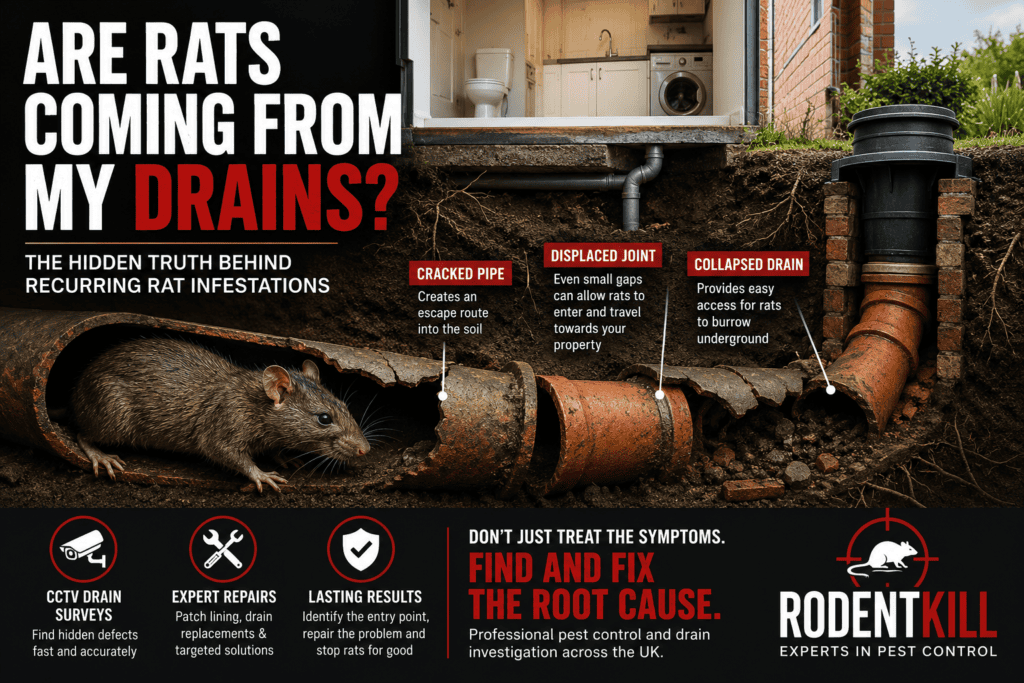
- Cracked or fractured pipes
- Displaced pipe joints
- Collapsed drain sections
- Open redundant connections
- Damaged inspection chambers
- Poorly sealed connections
- Defects associated with older drainage
A rat does not necessarily travel directly from a drain into the occupied part of your house.
It may leave damaged underground pipework, enter the surrounding ground or a concealed void and then find another opening into the building.
How Do I Know If Rats Are Coming From My Drains?
No single sign proves that rats are coming from the drains. Instead, we look for a pattern of evidence that makes a drainage route more plausible.
Some of the strongest clues include:
- Rats repeatedly returning after previous treatment
- Scratching or movement beneath the ground floor
- Activity around kitchens, bathrooms or utility rooms
- No convincing external entry point
- Known problems with old or damaged drainage
- Rat activity associated with an extension
- Evidence around inspection chambers or soil pipes
- Previous drainage alterations or redundant connections
The more of these signs that occur together, the stronger the case for investigating the drainage system.
Rats Keep Coming Back After Pest Control
Recurring rat activity is one of the main reasons to investigate how rats are entering a property.
Trapping or baiting may control the rats currently present. However, if another rat can use the same access route later, the problem can return.
The cycle can look like this:
Rats appear → treatment is carried out → activity stops → new rats enter → the problem starts again.
This does not automatically prove that the drains are responsible. Rats can also enter through structural openings, service penetrations and other building defects.
If the source remains unclear, a rat entry investigation can consider both the property and possible underground routes.
Scratching Beneath the Floor
Scratching, gnawing or movement beneath a ground floor can be an important clue.
Rats may travel through sub-floor voids without entering the visible living space. Activity can be particularly noticeable beneath:
- Kitchens
- Bathrooms
- Utility rooms
- Hallways
- Dining rooms
- Ground-floor extensions
Hearing rats beneath the floor does not prove that they entered through a drain, but it can make an underground route worth investigating.
Rats Around Kitchens and Bathrooms
Kitchens, bathrooms and utility areas contain numerous waste, water and soil pipe connections.
Rats may also emerge into these rooms after travelling through concealed voids beneath the building.
For that reason, repeated activity around pipework or behind kitchen units should be considered alongside the drainage layout and other evidence around the property.
No Obvious Rat Entry Point Outside
Sometimes a careful inspection of the outside of a property reveals no convincing opening.
Doors may fit correctly, air bricks may be protected and gaps around external services may already be sealed.
If rats are still appearing indoors, the possibility of an entry route beneath the building becomes more significant.
This is where simply walking around the outside of the house may not be enough.
What Drain Defects Can Allow Rats to Escape?
Rats usually exploit existing weaknesses rather than creating major structural drainage defects themselves.
Several types of defect can potentially provide a route out of underground pipework.
Cracked or Fractured Drain Pipes
Older drainage can crack because of age, ground movement, loading or other structural problems.
If an opening becomes large enough, a rat travelling through the drain may be able to leave the pipe and enter the surrounding ground.
Displaced Drain Joints
Older clay drainage was commonly installed in relatively short sections.
Movement can cause adjoining sections to become misaligned, potentially creating a gap at the joint while the drain continues to function.
Collapsed Drains
A partial or complete collapse can create a substantial opening into the surrounding ground.
It may also be associated with recurring blockages, poor flow, ground movement or other drainage symptoms.
Redundant Drain Connections
Old toilets, sinks, gullies and other drainage fixtures may be removed when a property is altered.
If a redundant connection remains open or inadequately sealed, it can potentially provide a route away from an active drainage system.
We cover this particular problem in more detail in our guide to disused drains and rat infestations.
Can Rats Come Up Through the Toilet?
Rats are capable swimmers and can travel through drainage systems, so reaching a toilet is possible.
However, a rat appearing inside a property should not automatically be assumed to have travelled directly through the toilet.
Underground defects, redundant connections and concealed routes beneath the building may provide less obvious ways for rats to leave the drainage system.
Can Rats Leave a Drain and Enter Under the House?
Yes, where a suitable drainage defect and building route exist.
A possible route could be:
- A rat travels through the drainage system.
- It reaches a defect or open connection.
- It leaves the pipework.
- It reaches surrounding soil or a concealed void.
- It moves towards or beneath the building.
- It finds an opening into a sub-floor area, cavity or service route.
This helps explain why the place where you eventually hear or see a rat may be some distance from the original drainage defect.
Could an Extension Hide a Drain-Related Rat Problem?
Extensions can complicate rat investigations because drainage and building layouts may have changed over time.
Old gullies, branches or redundant connections can sometimes remain beneath or close to later building work.
When recurring rat activity is concentrated around an extension, understanding the drainage layout can therefore be particularly useful.
Does a Drain Problem Always Mean Rats Are Getting In?
No.
This is an important distinction.
A CCTV survey may identify a cracked pipe, displaced joint or another defect, but the presence of a defect alone does not automatically prove that rats are using it to enter the property.
The location of the defect should be considered alongside the building layout, rat activity and other evidence.
Equally, finding rats within the drainage system does not by itself prove that the drains are the source of an internal infestation.
How Can You Confirm Whether the Drains Are Involved?
If the evidence suggests an underground route, CCTV inspection can provide information that cannot be obtained from an above-ground inspection alone.
A specialist camera can be passed through accessible drainage to examine the internal condition of the pipework.
The objective is not simply to find general drainage defects. For a rat problem, we are particularly interested in defects, connections and routes that could help explain the activity inside the property.
If you want to know exactly what this involves, see our Professional Rat Drain Survey service.
Do I Need a CCTV Drain Survey for Rats?
Not every rat infestation needs a CCTV drain survey.
If there is an obvious above-ground entry point that explains the activity, inspecting the drainage system may add little value.
A survey becomes more relevant when rats repeatedly return, activity appears to originate beneath the building or no convincing structural access point can be identified.
For a more detailed explanation, read Do I Need a CCTV Drain Survey for Rats?
What If the Rats Are Not Coming From the Drains?
Drainage is only one possible source of rat entry.
Other routes can include:
- Damaged air bricks
- Gaps around pipes and services
- Structural openings
- Wall cavities
- Sub-floor access points
- Roof-level defects
- Openings associated with alterations or extensions
This is why RodentKill does not assume that every recurring rat problem originates underground.
Where the source is uncertain, our Rat Entry Investigation is designed to look at the wider property and identify likely access routes.
For more specialist guidance on recurring rat problems, hidden entry points, drainage defects and rat proofing, visit our Rat Knowledge Centre.
Are Rats Coming From Your Drains? Find the Source
If rats keep returning and you cannot find an obvious way into the property, the drainage system may be worth investigating.
The key is to establish whether the evidence supports a drain-related route rather than simply assuming that rats must be coming from the sewer.
RodentKill specialises in difficult and recurring rat problems. We can investigate the property and, where appropriate, use CCTV equipment to inspect accessible drainage for defects and potential rat access routes.
Recurring rats? Investigate the route instead of repeatedly treating the symptoms.
Enquire about a rat investigation →
Frequently Asked Questions About Rats Coming From Drains
How do I know if rats are coming from my drains?
Possible signs include recurring rat activity, scratching beneath ground floors, activity around kitchens or bathrooms and rats appearing despite there being no obvious external entry point. No individual sign proves that drainage is responsible.
Can rats come into a house through damaged drains?
A suitable drainage defect can potentially allow rats to leave underground pipework. They may then reach soil, sub-floor areas or other concealed routes leading towards a building.
Can rats come up through a toilet?
It is possible for rats to travel through drainage pipework and reach a toilet, although this is not the explanation for every drain-related infestation.
Will a CCTV drain survey prove where rats are getting in?
A CCTV survey can identify relevant drainage defects and possible routes. The findings should then be considered alongside the property layout and evidence of rat activity.
Do recurring rats mean I have a broken drain?
No. A drainage defect is one possibility, but rats can also enter through gaps around services, structural openings, wall cavities and other building defects.
Should I have my drains surveyed if rats keep returning?
It may be worthwhile when the pattern of activity suggests an underground route, particularly if previous treatment has not stopped the problem and no convincing above-ground entry point has been identified.
What should I do if I do not know where the rats are coming from?
Consider a broader rat entry investigation first. This allows the evidence around the property to be assessed before deciding whether CCTV drainage inspection is necessary.