
Buying a House With a Rat Problem
Buying a House With a Rat Problem – Should You Get the Drains Checked?
Finding evidence of rats when you are buying a house can be worrying.
A few droppings in a garage or garden may have a relatively straightforward explanation. But repeated rat activity inside the property can indicate a problem that deserves closer investigation before you complete the purchase.
One area that is easily overlooked is the underground drainage system.
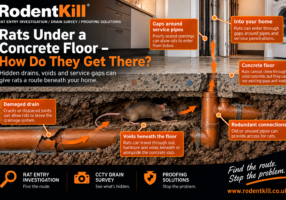
Rats commonly travel through sewers and drains. If damaged pipework, displaced joints or redundant connections allow them to leave the drainage system, they may potentially gain access beneath a property.
Before buying a house with a history of recurring rats, it can therefore be worth finding out how the rats are getting in rather than simply accepting that pest control will solve the problem.
Should I Be Worried About Rats When Buying a House?
Finding evidence of rats does not automatically mean you should walk away from the purchase.
Rat problems can often be resolved.
What matters is understanding the cause.
There is a considerable difference between a rat occasionally visiting an outside bin area and rats repeatedly entering the structure of a house through an unidentified route.
Before proceeding, useful questions include:
- Have rats actually been found inside the property?
- How long has the problem existed?
- Has professional pest control already been carried out?
- Have the rats returned after treatment?
- Has an entry point been identified?
- Has the drainage system ever been inspected?
- Are there known drain defects?
If nobody can explain how rats are entering the house, further investigation may be worthwhile.
Why Can Drains Be Important When a House Has Rats?
Most of the drainage system around a property is hidden underground.
From above ground, everything may appear perfectly normal.
Inside the pipework, however, there may be defects such as:
- Displaced clay pipe joints.
- Cracked or fractured drains.
- Collapsed sections.
- Open redundant connections.
- Damaged inspection chambers.
- Poor previous repairs.
- Defective junctions.
- Old drainage beneath extensions.
These defects do not automatically cause rat infestations.
However, if an opening allows rats to leave the drainage system, they may potentially reach the soil or voids beneath the building.
Why Doesn't a Normal House Survey Find Rat Drain Problems?
A standard property survey and a specialist CCTV drain investigation perform different jobs.
A building surveyor may identify visible evidence of rodents, structural defects or signs that further investigation is advisable.
However, underground pipework cannot normally be fully assessed simply by inspecting the house from above ground.
A CCTV drain survey uses a camera to examine accessible drainage internally.
When rats are the concern, the investigation can focus particularly on defects that might provide a route out of the drainage system.
What If the Seller Says the Rat Problem Has Been Treated?
That is useful information, but ask what was actually done.
There is an important difference between controlling the rats and removing the route that allowed them to enter.
Baiting or trapping may successfully eliminate rats currently inside a property.
But if a broken drain, open connection or structural gap remains accessible, another rat may potentially use the same route later.
If the property has experienced several infestations despite previous treatment, identifying the entry route becomes particularly important.
What Should I Ask the Seller About Previous Rat Problems?
If you know the property has experienced rats, try to establish as much history as possible.
Useful questions include:
- When were rats first noticed?
- Where in the property were they found?
- Was professional pest control used?
- How many treatments were required?
- Did the rats return?
- Was any proofing carried out?
- Were drains inspected?
- Were any drainage repairs completed?
Invoices, pest control reports, drainage reports and repair records can help build a clearer picture.
Are Older Houses More Likely to Have Drain Problems?
Older properties can contain drainage that has been altered and repaired many times.
Clay drainage systems, for example, are constructed from individual pipe sections with joints between them.
Over time, ground movement and settlement can cause joints to move or pipework to deteriorate.
Older houses may also have undergone substantial changes.
Kitchens may have moved. Outside toilets may have disappeared. Extensions may have been constructed and old gullies or drainage branches made redundant.
None of this means an older house necessarily has defective drains.
It simply means the drainage history can sometimes be more complicated than it first appears.
What About Houses With Extensions?
Extensions deserve particular attention when there is unexplained rat activity.
The area now occupied by a kitchen or rear extension may previously have contained external drainage.
During construction, those drains should have been appropriately diverted, removed or made redundant.
If an old connection remains accessible from the active drainage system, it may potentially create a concealed route beneath the building.
A CCTV investigation can sometimes help identify unexpected branches, old connections and defects associated with altered drainage.
What Does a Rat-Focused CCTV Drain Survey Look For?
A conventional drainage survey is primarily concerned with the condition and operation of the drainage system.
When investigating rats, we are asking an additional question:
Could anything inside this drainage system help explain how rats are reaching the property?
During a specialist investigation, accessible drainage may be checked for:
- Cracks and fractures.
- Displaced joints.
- Open-ended connections.
- Redundant branches.
- Collapsed pipework.
- Damaged chambers.
- Unusual alterations.
- Evidence of rat activity.
Where necessary, locating equipment can also help establish where a suspected defect sits in relation to the building.
Find out more about our Professional Rat Drain Survey.
What If I Don't Know Whether the Rats Are Coming From the Drains?
Do not assume that every rat infestation originates from drainage.
Rats can enter through many other routes, including damaged air bricks, gaps around services, structural defects and openings beneath buildings.
If the entry route is completely unknown, a wider investigation may be more appropriate.
Our Rat Entry Investigation is designed to answer the broader question:
How are rats getting into this property?
Where evidence suggests drainage is involved, CCTV investigation can then be used to examine the underground system.
Can a Rat Problem Affect a House Purchase?
A rat problem does not necessarily make a property unsuitable to buy.
However, an unexplained recurring infestation should not simply be ignored.
The potential solution could be relatively straightforward proofing.
Alternatively, investigation might reveal drainage defects requiring professional repair.
Understanding the likely cause before completion puts you in a much better position to make an informed decision.
Should I Get the Drains Checked Before Buying?
Not every property purchase requires a specialist rat drain survey.
It becomes more worth considering when:
- The property has a known history of rats.
- Rats have repeatedly returned after treatment.
- Activity has occurred beneath floors or inside walls.
- No convincing entry point has been identified.
- The property has older clay drainage.
- There are extensions or major alterations.
- Previous drainage problems are known.
- Evidence suggests rats may be using underground routes.
The objective is not to find reasons to avoid buying the house.
It is to understand the problem before it becomes your problem.
Already Bought the House and Then Discovered Rats?
Sometimes the problem only becomes apparent after moving in.
You may hear scratching beneath the floor at night, discover droppings behind kitchen units or find evidence that previous pest control has taken place.
At that point, repeatedly placing bait without understanding the entry route can become frustrating and expensive.
A structured investigation can help establish whether rats are entering through the building, underground drainage or another concealed route.
Buying a House With Rats? Find the Cause Before You Complete
If a property you are buying has a recurring or unexplained rat problem, getting more information before completion can provide valuable peace of mind.
RodentKill specialises in difficult rat problems, rat entry investigations and CCTV rat drain surveys.
We focus on finding the route rather than simply treating the rat.
Ask RodentKill About a Pre-Purchase Rat Investigation →
Frequently Asked Questions
Should I buy a house that has had rats?
A previous rat problem does not automatically mean you should avoid the property. What matters is whether the infestation has been properly controlled and whether the route allowing rats to enter has been identified and resolved.
Should I get a drain survey if a house has rats?
It can be worth considering where there is recurring internal rat activity, no obvious entry point or evidence suggesting underground drainage may be involved. Not every rat problem requires a CCTV drain survey.
Will a normal house survey check the drains for rats?
A normal property survey may identify visible evidence or recommend further investigation, but inspecting underground drainage internally normally requires specialist CCTV equipment.
What if the seller says pest control solved the rats?
Ask whether the entry route was also identified and proofed or repaired. Removing the rats and preventing further rats from entering are two separate parts of solving a recurring infestation.
Can old drains cause rats in a house?
Damaged or altered drainage can potentially provide rats with a route out of the pipework. Displaced joints, fractures and redundant connections can be particularly relevant where they are located close to or beneath a building.
Can RodentKill investigate rats before I buy a property?
Where access and permission are available, a specialist investigation can help assess possible rat entry routes and, where appropriate, accessible underground drainage.