
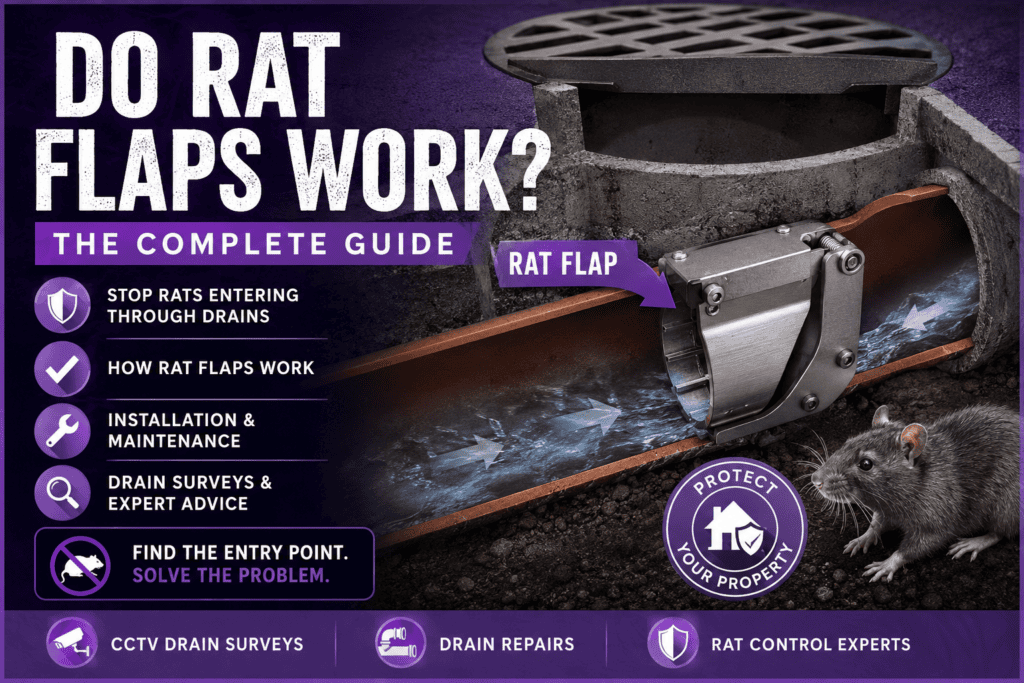
Do Rat Flaps Work
Do Rat Flaps Work? The Complete UK Guide to Drain Rat Flaps
If you've discovered rats around your home, someone may have suggested installing a rat flap.
Rat flaps, sometimes called rat blockers or drain blockers, are designed to prevent rats travelling from the sewer network into private drainage.
But one important question remains:
Do rat flaps actually work?
The answer is that they can be very effective when they are suitable for the drainage system, positioned correctly and installed properly.
However, a rat flap is not a universal solution to every recurring rat problem.
If drainage is damaged, another route remains available, or rats have already reached the ground or voids beneath a property, installing a flap alone may not resolve the infestation.
This guide explains how rat flaps work, when they can help, their limitations and why investigating the drainage layout can be important before deciding whether one is appropriate.
In This Guide
We'll explain:
- How rat flaps work
- Whether they can stop rats
- Where they may be fitted
- When they may not solve the problem
- Why damaged drains matter
- When a CCTV drain survey may help
- Whether your property actually needs a rat flap
If rats keep returning and you don't know how they are getting inside, our Rat Entry Investigation focuses on identifying credible access routes rather than simply treating the rats currently present.
What Is a Rat Flap?
A rat flap is a mechanical one-way device fitted inside an underground drain.
Its purpose is to allow wastewater to travel towards the sewer while restricting rats attempting to travel in the opposite direction.
The flap opens as wastewater passes through the pipe and then returns to its closed position.
If a rat approaches from the protected side of the drainage system, the closed barrier is intended to prevent it passing through.
In simple terms, it acts as a one-way barrier within the drain.
Why Do Rats Travel Through Drains?
Rats can live and travel within sewer networks.
Underground drainage can provide:
- Shelter
- Water
- Access to food waste
- Protected travel routes
- Connections across large areas
This allows rats to travel considerable distances without being visible above ground.
Problems can arise where private drainage provides a route towards a property and defects or open connections allow rats to leave the drainage system.
How Can Rats Get Into Houses Through Drains?
Where drainage is involved in a rat problem, rats may take advantage of existing defects or openings rather than needing to damage an intact pipe.
Potential problems can include:
- Cracked or fractured drain pipes
- Displaced pipe joints
- Collapsed sections
- Damaged inspection chambers
- Open or redundant connections
- Poor previous repairs
A relevant defect may potentially allow a rat to leave the drainage system and reach surrounding ground, sub-floor areas or other concealed spaces.
However, finding a drainage defect does not automatically prove that rats are using it. Its position and nature need to be considered alongside the activity inside the property.
Do Rat Flaps Really Work?
Yes, a correctly selected and installed rat flap can provide an effective physical barrier within a suitable drain.
Unlike bait or traps, its purpose is not to control rats already present. Instead, it is intended to restrict movement through the protected pipe.
However, there is an important limitation.
A rat flap only protects the drainage route in which it is installed.
If rats can use another drain, an open connection, a drainage defect downstream of the device or an entirely above-ground route, the flap may not prevent the problem.
This is why understanding the drainage layout and the wider evidence can be important before installation.
When a Rat Flap Won't Solve the Problem
A rat flap cannot repair damaged drainage.
It also cannot remove rats that have already left the drain and established themselves beneath or inside a property.
For example, suppose rats have been leaving a fractured pipe beneath an extension.
A correctly positioned blocker may help prevent additional rats travelling along the protected drain from the sewer.
However, rats already outside the drainage system still need to be dealt with, and the relevant drainage defect may require repair.
This is why recurring rat problems can require investigation as well as control.
When Can a CCTV Drain Survey Help?
Where the evidence suggests that underground drainage may form part of the rat's route, a CCTV drain survey can help inspect accessible pipework.
A survey may reveal:
- Cracked or fractured pipes
- Collapsed sections
- Displaced joints
- Root intrusion
- Open or redundant connections
- Unexpected drainage branches
- Poor previous repairs
- Other defects that could potentially provide an access route
Importantly, CCTV identifies the condition and layout of accessible drainage. A defect seen on camera should then be considered alongside the location of rat activity and the construction of the property.
Finding a defect does not automatically prove that rats are using it.
Where drainage investigation is appropriate, learn more about our Professional Rat Drain Survey.
Should Every House Have a Rat Flap?
No.
Many properties will have no reason to install one.
A rat flap is more relevant where investigation suggests that rats are travelling through a particular drainage route from the sewer.
Situations where one may be considered include:
- Recurring rat activity with evidence pointing towards drainage
- A known route between private drainage and the sewer
- Relevant previous drainage defects
- Rats repeatedly appearing beneath floors where an underground route is suspected
- CCTV or other evidence supporting sewer-related rat activity
Installing a rat flap without understanding the drainage layout may protect the wrong pipe or leave another route available.
The appropriate solution depends on what the investigation finds.
What Types of Rat Flaps Are Available?
Not all rat flaps are the same.
Different manufacturers use different designs, materials and fixing methods. Suitability depends on the drainage system, pipe size, condition and intended installation position.
Single-Flap Rat Blockers
Single-flap designs contain a hinged barrier intended to allow wastewater to pass in one direction while restricting rats travelling in the opposite direction.
Double-Flap Rat Blockers
Some devices use two flaps rather than one.
The exact design and suitability should be considered in relation to the drainage system in which the device will operate.
Stainless Steel Rat Flaps
Many professional drain rat blockers are manufactured from stainless steel because it is strong and resistant to corrosion.
Regardless of material, correct sizing, installation and maintenance are important.
Where Should a Rat Flap Be Installed?
The installation position is important because a blocker can only protect the drainage route behind it.
In some properties, an appropriate position may be within the final private inspection chamber before the relevant drain connects with the public sewer.
However, drainage layouts vary considerably.
Properties may have several branches, shared drainage, extensions, redundant connections or alterations that make the correct position less obvious.
For that reason, the drainage layout should be understood before deciding where a rat flap should be fitted.
Can You Install a Rat Flap Yourself?
Some rat blockers are available for DIY installation.
In a straightforward drainage system, installation may appear relatively simple.
However, common problems can include:
- Installing the device in the wrong direction
- Choosing the wrong drain
- Selecting an unsuitable size
- Failing to secure the device correctly
- Installing it into damaged or unsuitable pipework
- Failing to identify another available drainage route
An incorrectly positioned or poorly fitted blocker may provide little useful protection.
If the drainage layout or condition is uncertain, professional assessment can help determine whether a blocker is appropriate.
Should the Drain Be Surveyed First?
Not every rat-flap installation necessarily requires a full CCTV survey.
However, a survey can be particularly useful where rats repeatedly return, the drainage layout is uncertain or there is reason to suspect damaged underground pipework.
CCTV may reveal:
- Collapsed drains
- Cracked or fractured pipes
- Displaced joints
- Root intrusion
- Open or redundant connections
- Poor previous repairs
- Other relevant drainage defects
The findings can then help determine whether drainage repairs, a rat blocker or another form of investigation is appropriate.
How Much Does a Rat Flap Cost?
The cost depends on the device and the circumstances of the installation.
Factors can include:
- The type of rat flap
- The size of the pipe
- Ease of access
- The drainage layout
- The condition of the drain
- Whether cleaning or other drainage work is required
- Whether a CCTV investigation is appropriate
At RodentKill, rat blocker installation starts from £195 when combined with a survey, subject to the property, drainage layout, access and suitability.
If a relevant drainage defect is discovered, repairing that defect may be more important than simply fitting a blocker.
Can a Rat Flap Become Blocked?
Like any device installed within drainage, a rat flap can potentially be affected by debris or poor flow.
Items that commonly contribute to drain blockages include:
- Wet wipes
- Cooking fat and grease
- Sanitary products
- Nappies
- Kitchen roll
These materials can cause drainage problems whether or not a rat blocker is present.
Good drainage practice and appropriate maintenance therefore remain important after installation.
Does a Rat Flap Need Maintenance?
Yes. A rat flap is a mechanical device operating in a demanding environment.
Periodic checks can confirm that:
- The flap moves freely
- It closes correctly
- Debris has not become trapped
- The fixing remains secure
- The surrounding drain remains in suitable condition
- Wastewater is flowing correctly
Inspection and maintenance help reduce the risk of the device becoming ineffective.
Can Rats Already Be Outside the Drain?
Yes.
This is an important consideration before installing a blocker.
If rats have already left a damaged pipe and reached the ground, floor voids or other concealed parts of the building, fitting a rat flap will not remove those animals.
Existing rat activity still needs to be addressed, and any relevant drainage or structural defect should be considered separately.
Does Poison Solve the Problem?
Rodenticide can form part of an appropriate rat-control programme, but it does not repair an access route.
If new rats can continue entering through the same opening, recurring activity may occur after the original rats have been controlled.
For persistent problems, identifying credible access routes can therefore be as important as controlling the rats already present.
Read Why Poison Alone Won't Solve a Rat Problem for a more detailed explanation.
Common Reasons Rat Flaps May Not Solve the Problem
When rats continue appearing after a blocker has been installed, it does not necessarily mean the device itself has failed.
Possible explanations include:
- The device was installed in the wrong location
- Another drainage route remains available
- A relevant defect lies beyond the protected section
- Debris prevents the flap closing correctly
- The device has moved or become damaged
- Rats were already outside the drainage system
- Rats are entering through an above-ground structural route
The wider property and drainage evidence should therefore be considered before deciding why rat activity has continued.
Do Rat Flaps Work in Older Clay Drains?
They can, provided the particular drain is suitable for the device being installed.
Older clay drainage may contain:
- Cracks or fractures
- Displaced or open joints
- Root intrusion
- Previous repairs
- Changes in diameter
- Uneven or damaged pipework
Where the condition of an older drain is uncertain, CCTV inspection can help determine its condition and whether a particular installation is appropriate.
Frequently Asked Questions
Do rat flaps really work?
Yes. A correctly selected, positioned and installed rat flap can prevent rats travelling through the particular drainage route it protects. It will not, however, prevent rats using another drain or an unrelated structural entry point.
Can rats push a rat flap open?
A suitable rat blocker is designed to resist rats approaching from the protected direction. Its effectiveness depends on the design, installation, condition and maintenance of the device.
Will a rat flap remove rats already in my house?
No. A rat flap is a preventative barrier. Rats already outside the drainage system or inside the property still need to be dealt with appropriately.
Do I need a CCTV drain survey?
Not necessarily. A CCTV drain survey becomes particularly useful where the evidence suggests an underground route, rats repeatedly return, drainage defects are suspected or the drainage layout needs to be understood before deciding on remedial work.
Will a rat flap stop smells?
No. A rat flap is designed to restrict rat movement rather than act as a solution for sewer odours.
For more specialist guidance on recurring rat problems, drainage defects, hidden entry points and rat proofing, visit our Rat Knowledge Centre.
Our Advice
If rats have returned after previous treatment, the important question is not simply how to control them again.
It is also:
How are rats gaining access to the property?
Sometimes the answer involves drainage. In other cases, rats may be using structural openings, service penetrations, sub-floor routes or other defects.
Where drainage is suspected, CCTV can help identify relevant defects and connections. Any findings should then be considered alongside the evidence from the property.
If a suitable drainage route is confirmed, a correctly positioned rat flap may form part of the long-term solution.
Need Help with Rats Coming Through Your Drains?
RodentKill specialises in investigating persistent and recurring rat problems.
Our work can include property investigation, CCTV inspection of accessible drainage and advice on rat blockers where appropriate.
The aim is to identify credible access routes and recommend practical action based on the evidence.
Learn more about our Professional Rat Drain Survey or our Rat Entry Investigation.
If rats keep returning and you would like us to investigate the problem, send RodentKill an enquiry →
Authoritative UK Resources
Remember: a rat flap can be a useful preventative measure when rats are using the drainage route it protects. For recurring rat problems, the first priority is understanding how the rats are gaining access and choosing a solution that matches the evidence.